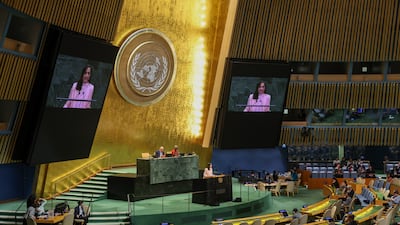

Today is the final day of the UN General Assembly’s high-level debate, and diplomats will soon begin leaving New York after another week of speeches, meetings and championing competing visions of the international order. However, this UNGA is significant for another reason – it marks the changing of the guard at an institution that faces some sharp questions about its continued relevance.
This was the last UNGA to be held under the stewardship of UN Secretary General Antonio Guterres, whose second and final term will end on December 31. His successor will take charge of the organisation in a world that is markedly different from the one in which Mr Guterres began his tenure back in 2017.
The assumptions that underpin the global order have been challenged by wars, strategic rivalry, lightning-fast technological change and growing disagreement among the major powers. The UN now operates in a world that has arguably changed faster than its structures have been able to keep up with. Therefore, the big question facing the next secretary general is how to renew an institution for the world of 2027 and beyond.
There are already signs that this process has begun. The UN80 Initiative launched by Mt Guterres in March last year is examining how the organisation works, including how to reduce duplication and improve efficiency. Earlier this year, the General Assembly adopted measures aimed at improving how UN mandates are created, implemented and reviewed.
Such reforms matter but so does a realistic understanding of what the UN can and cannot be. It cannot act as a world government nor can it resolve every conflict, compel governments to comply with its decisions without UN Security Council agreement or overcome the interests of powerful states. Expecting it to do so risks setting the organisation up for perpetual failure.
Nevertheless, the UN’s collective power and the good offices of its secretary general remain formidable forces for positive and influential statecraft. The Security Council can establish peacekeeping missions, issue legally binding resolutions and impose non-military solutions such as economic sanctions, arms embargoes, travel bans and financial restrictions. UN agencies champion critical issues that include nuclear safety, human rights, refugees, humanitarian aid and many more.
With this capacity as well as moral and legal authority comes a responsibility to live up to the lofty ambitions attached to the UN at its creation. Therefore, the next secretary general must guide it towards being more effective and reinvigorate the organisation. That means making it more responsive and better suited to the realities of a changing international system. It is a big ask, but with the right spirit of co-operation, UN renewal is achievable.

