
In this week’s midterm elections in the US, Arab Americans are expected to overwhelmingly vote for Democrats over Republicans running in the senate and congressional campaigns across the country. The actual margin is 59 per cent for Democrats versus just 26 per cent for Republicans.
This dramatic swing back to the Democratic Party is just one of the findings of the most recent poll of Arab-American voters commissioned by the Arab American Institute and conducted by John Zogby Strategies.
These two entities have been polling Arab-American voters for over three decades, and in all that time, the community has favoured Democrats if only by a small margin. The Iraq war and the widespread repressive policies of the George W Bush administration, against Arab and Muslim Americans as well as immigrants, so significantly changed attitudes towards the two parties and their candidates that for more than a decade and a half, Arab Americans ended up voting for Democrats by a two-to-one margin.
This changed in 2024 as a result of the Joe Biden administration’s acquiescence to and, at times, overt support for Israel’s war on Gaza. The community was so angered by Democrats’ complicity in that war that support for Democrats declined, while Republican numbers rose. Democrats still had the edge, but in that November’s presidential election, a significant number of Arab Americans voted for third-party candidates, while many didn’t vote at all.
What accounts for the flip back towards the Democratic Party’s candidates this year? The recent poll points to a number of factors.
Chief among them are the policies and behaviours of President Donald Trump. Eighty-two per cent of Arab Americans say they have personally experienced economic hardship due to the rising costs of health care, utilities, groceries or petrol prices. Ninety per cent say that the war in Gaza is still important in determining their vote (and will remain so as they choose a presidential candidate in 2028).

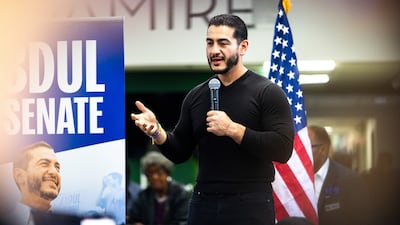
More than two thirds say they have experienced discrimination because of their heritage, and an even greater percentage fear this may increase in the future. In this context, the Trump administration’s anti-Muslim assault on Abdul El-Sayed, the Arab-American Democratic senate candidate in Michigan, has only added fuel to the dangerous fires of hate.
Finally, it’s important to note that as the polling has demonstrated going back to a study issued in 2001 titled “What Ethnic Voters Really Think”, Arab Americans, like other ethnic immigrant communities, while holding moderate views on some cultural issues, are quite liberal when addressing economic and governmental policies.
This is born out in our most recent poll where 56 per cent of Arab Americans say they are more aligned with the social and economic views of the Democratic Party versus only 28 per cent who say they feel more aligned with the Republican Party. And when asked to describe their political ideology – ranging from Maga Republican on the right to Democratic socialist on the left – only 18 per cent indicate a right-leaning ideology as opposed to 47 per cent who are left-leaning. Thirty-one per cent describe themselves as moderate.
What is especially fascinating about the results in this poll is the extent of convergence in the views of the diverse component groups within the community. While there are some understandable variations in the responses given to a few questions, the most important demographic subgroups (Christian, Muslim; country of origin; immigrant or native US born) all express concern about the economic situation, the war in Gaza and the fear of discrimination resulting from this election’s hateful anti-Muslim, anti-Arab hate speech.
Sectarian and national conflicts may afflict countries and regions across the Middle East, but Arab Americans have found their way to coalesce around shared heritage and issues of concern. It is this convergence that is the cornerstone of community building.

