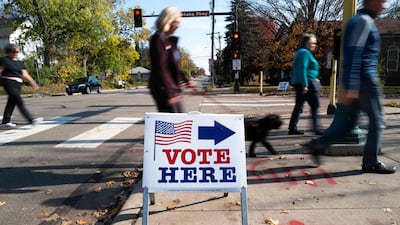
US voters will soon head to the polls to elect members of the House of Representatives and Senate, as well as governors and other official positions in states across the country.
More than 100 million people are expected to cast ballots in the midterm voting on November 3, and billions of dollars have been poured into political advertising across the country, especially in battleground states such as Texas, Ohio and Michigan.
What are the midterms?
Held in the middle of each four-year presidential term, the midterms by definition do not involve the president. They do, however, act as a report card on how the president is doing.
The outcome of the midterms will decide which political party, the Republicans or the Democrats, controls Congress. This will, in turn, indicate whether the president will be effective in the last two years in office at carrying out his or her agenda.
The president's party almost always loses seats in Congress during the midterms. President Donald Trump's approval rating sits in the mid-30s, with many Americans upset over the rising cost of living and the Iran war. Though Mr Trump is not on the ballot, the number of seats his Republicans win will show just how angry Americans are with his performance.
House of Representatives
Much is at stake in this election, as Democrats work to win majority control of Congress.
The House comprises 435 voting members, with the number of seats for each state apportioned based on population. Members serve two-year terms.
Currently in the House, where there are two vacancies and one independent who votes with conservatives, Republicans hold a 218-214 majority.
All 435 seats are up for grabs in the midterms. Democrats must have a net gain of four seats to win control of the House.

Senate
The Senate is made up of 100 seats, and each state receives two senators who are elected to six-year terms.
Republicans hold a 53-47 majority in the chamber, where 35 seats are up for re-election. The Democrats must win four additional seats to gain control of the Senate.

Vulnerable seats
Ten races, including those in Maine, Ohio, North Carolina, Iowa and Georgia, could decide control of the Senate.
In Michigan, Abdul El-Sayed is facing off against Republican Mike Rogers. Mr El-Sayed, a progressive Democrat, would be the first Muslim-American senator if elected, and both Mr Rogers and Mr Trump have engaged in a campaign to tie him to the Muslim Brotherhood and other extremist groups.

In Alaska, Mary Peltola is taking on Republican Senator Dan Sullivan, who is seeking a third term in a state hit hard by rising diesel prices. Alaska has become the subject of controversy after another man named Dan Sullivan appeared on the ballot. While the senator Mr Sullivan is marked clearly as the incumbent and a Republican, the Justice Department has filed a lawsuit seeking to block the certification of the results if the senator loses.
Among the most closely watched House races are Republican Representative Mike Lawler's bid for re-election in a New York district that Democratic candidate Kamala Harris won in her 2024 presidential campaign, and an open seat in a Nebraska swing district where farmers and lorry drivers face sharply higher fuel prices as a result of the US war against Iran.
Also high on Democrats' list of House seats they hope to take from Republicans are two in Pennsylvania and one in New Jersey.
What do the midterms mean for the Middle East?
Democrats are linking Republican support for the Iran war to higher fuel prices and what they say is Mr Trump's lack of a clear plan to end the conflict.
The approach has found a receptive audience as voters focus on affordability. An AP-Norc poll found that about eight in 10 registered voters want the next Congress to make lowering the cost of living a top priority, particularly the lowering of fuel prices. Many also want it to end the war in Iran.
The midterms will also be a test for progressive Democrats, most of whom support an end to military aid to Israel following the Gaza war.
Support for Israel has historically been strong in both parties, but non-establishment Democrats have pushed back on that long-time alliance. In states like Minnesota, Michigan and Florida, progressive candidates beat out pro-Israel Democrats for the nomination.

