
US President Donald Trump’s war against Iran has emerged as a liability for Republicans before next week’s midterm elections, including for several prominent hawks on foreign affairs committees.
Democrats are linking Republican support for the Iran war to higher fuel prices and what they say is Mr Trump's lack of a clear plan to end the conflict.
The approach has found a receptive audience as voters focus on affordability. An AP-Norc poll found that about eight in 10 registered voters want the next Congress to make lowering the cost of living a top priority. Many also want it to end the war in Iran.

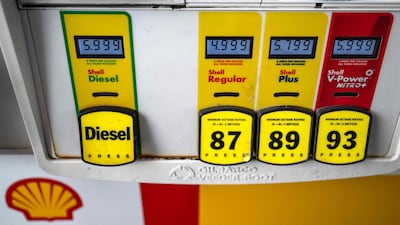
The conflict, which the US launched alongside Israel on February 28, disrupted the Strait of Hormuz for several weeks and helped push petrol prices past about $1.13 a litre in the US – still cheap compared to most rich countries but more than 40 per cent higher than at the start of Mr Trump's term.
The conflict has shone a spotlight on vulnerable Republicans as the Democrats try to take control of Congress.
Dan Sullivan
Mr Sullivan, a member of the Senate foreign relations committee, is seeking a fourth term in his home state of Alaska. He voted against a September resolution that would have required Mr Trump to end the war or seek congressional authorisation.
He finds himself in an unexpectedly competitive re-election race against Democrat Mary Peltola, with recent polls showing the challenger narrowly ahead.
Mr Sullivan has been an outspoken and consistent supporter of Mr Trump’s agenda, particularly on Iran, defence and energy. He backed last year's Operation Midnight Hammer strikes on Iranian nuclear sites and has strongly defended the current conflict, saying Tehran has effectively been at war with the US for decades.
The veterans' advocacy group VoteVets launched a $225,000 advertising campaign against Mr Sullivan in August, accusing him of backing the war at the expense of working families.
“Alaskans already pay more for everything and Dan Sullivan voted 12 separate times to make it worse," said VoteVets senior adviser Max Rose.

The Alaska race is complicated by another candidate who is on the ballot, Daniel J Sullivan, whose presence Republicans say could confuse voters and pull support from Mr Sullivan the incumbent. The Department of Justice last week sued Alaska election officials in a bid to block certification of the results if the incumbent Mr Sullivan loses, arguing that voters could confuse the two candidates.
A Reuters/Ipsos poll this month found that 78 per cent of Americans blamed Mr Trump’s policies for price increases outpacing their earnings, reinforcing concerns among Republicans that foreign policy is feeding into voters' economic anxieties.
Pete Ricketts
Meanwhile, Mr Ricketts, who also sits on the powerful Senate foreign relations committee, is facing a challenge from independent Dan Osborn in Nebraska.
Mr Ricketts has been a staunch supporter of the war in Iran and he has consistently opposed congressional efforts to restrict Mr Trump’s war powers, including by voting against the resolution in September along with Mr Sullivan.
Polls show a too-close-to-call race with Mr Osborn in Nebraska, which hasn't elected a Democratic senator for 20 years. Despite his broad support of the Iran war, Mr Ricketts has broken with Mr Trump on economic policies affecting his state's agricultural sector.
Mike Lawler
Republican Representative Mike Lawler, who sits on the House foreign affairs committee, is in a tight race in New York state against Democrat Cait Conley.
At a forum in April, voters challenged him over his opposition to a House resolution restricting Mr Trump’s war powers. He defended the strikes as within the President’s authority, arguing that the campaign was necessary to counter US adversaries.

A September Emerson College poll found that 52 per cent of district voters opposed US military action in Iran, against 37 per cent who supported it. Ms Conley’s campaign and Democratic groups have since attacked Mr Lawler over the war and its economic costs.
The Emerson poll found Ms Conley leading Mr Lawler 48 per cent to 46 per cent, within the survey’s 4.9-point margin of error
Support for Israel has also become a significant part of the race, with both candidates courting Jewish voters while arguing over who would best protect Israel and fight anti-Semitism.
Other vulnerable Republicans include Senator Roger Marshall, who has strongly supported the war against Iran and who in March voted against a resolution to restrict Mr Trump’s military authority.
Mr Marshall is now facing a competitive race against Democrat Adam Hamilton in Kansas, a Republican stronghold that that Mr Trump won by about 16 percentage points in 2024.

