Three years ago, families in southern Israel woke to a nightmare. Parents held safe-room doors shut while their children hid behind them. Young people fleeing a music festival were hunted across open fields. In the Hamas-led attack, about 1,200 people were massacred and 251 taken hostage into Gaza.
October 7 changed Israel profoundly. It shattered assumptions about security and left wounds that remain open to this day. No serious observer should expect Israelis to think about the future as though that day never happened.
The war that followed brought devastation to Gaza on a scale that will shape Palestinian society for years. Tens of thousands of Palestinians lost their lives. Children grew up knowing displacement, and hunger and fear became part of everyday life. Across Gaza, grief settled into homes, schools and neighbourhoods.

Having spent much of my professional life working on this conflict, I have become wary of anniversaries. They encourage remembrance but rarely reflection. Every year we repeat familiar arguments, revisit familiar grievances and reaffirm familiar loyalties. Then we move on, leaving unresolved the very questions that produced the tragedy in the first place.
Yet one truth remains difficult to escape: grief has no nationality. A mother in Nir Oz and a mother in Khan Younis may never meet, and they may hold radically different views about this conflict and its causes, but neither needs a lesson in loss.
The question before Israelis, Palestinians and the wider region is not whose suffering matters more. It is whether enough has been learnt to prevent a continuation of the cycle of pain and suffering.
A year ago, the parties accepted a framework intended to move Gaza away from full-scale war. It established a path towards demilitarisation, deradicalistaion, transitional Palestinian governance, Israeli withdrawal and reconstruction. But the hardest part is not agreeing on the destination. It is turning those commitments into realities.
Today there are essentially three possible futures for Gaza.
The first is a return to the familiar and painful cycle. Hamas rebuilds its military capabilities. Israel prepares for the next confrontation. Another ceasefire eventually follows another round of violence, leaving the underlying reality unchanged.
We have seen this many times before. Every round of fighting was meant to restore deterrence. Every truce was presented as a new beginning. Yet the conflict returned because the conditions that produced it never fundamentally changed.
The second future may appear more stable but is ultimately no more promising. Gaza remains suspended in a state of permanent uncertainty. Humanitarian assistance attempts to replace governance. Reconstruction advances slowly, if at all. The world gradually loses interest. There are no dramatic headlines, but there is no meaningful progress either.
-
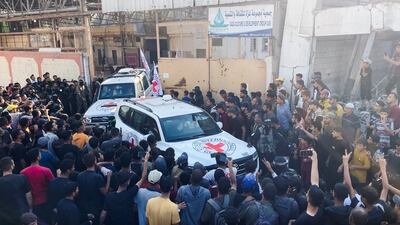
Red Cross vehicles carry hostages from Gaza city under the ceasefire agreement between Israel and Hamas. Reuters -

US President Donald Trump arrives at Ben Gurion Airport near Tel Aviv, before delivering a speech to Israel's Knesset. AFP -
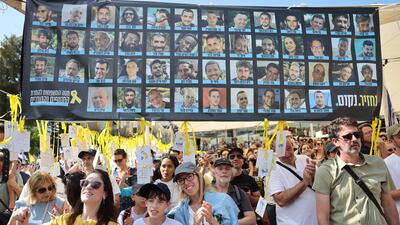
Israelis gather in Tel Aviv to celebrate the release of hostages from Gaza. EPA -

Palestinians board a bus after being released from the Ofer military prison between Ramallah and Beitunia, in the occupied West Bank. AFP -

US President Donald Trump signs the guest book at the Knesset, with Israeli Prime Minister Bejamin Netanyahu, second left, and Knesset Speaker Amir Ohana, second right -
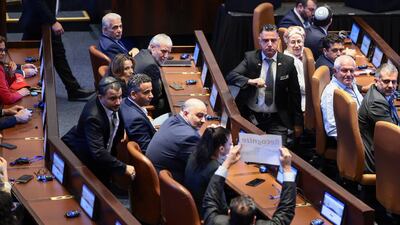
Knesset member Aymen Odeh holds up a sign bearing the message 'Recognise Palestine' during Mr Trump's speech to Israeli politicians. Reuters -

Released Israeli hostage Ziv Berman waves from a military helicopter as he arrives at Sheba Hospital, near Tel Aviv. EPA -

Released Israeli hostage Matan Zangauker, left, is greeted by his mother. AFP -

Palestinians released from Israeli jails. More than 150 have crossed the border into Egypt to live in exile. AFP -
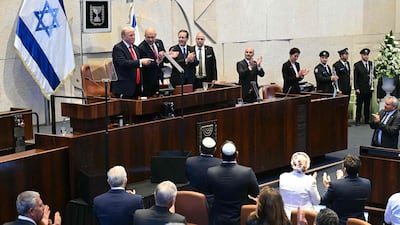
Mr Trump receives a standing ovation from Israeli politicians in the Knesset. AFP -
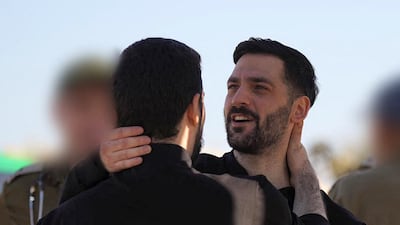
Gaza hostage Gali Berman is released as part of an exchange deal between Israel and Hamas. AFP -
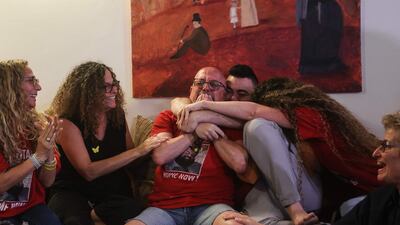
Family and friends of an Israeli hostage celebrate news that Hamas has released captives from Gaza. AFP -
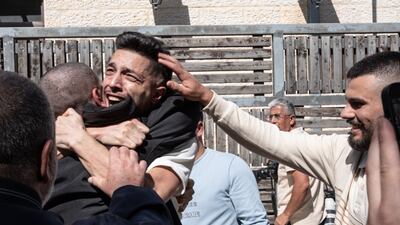
Palestinians welcome relatives released from Israeli jails. Thomas Helm / The National -
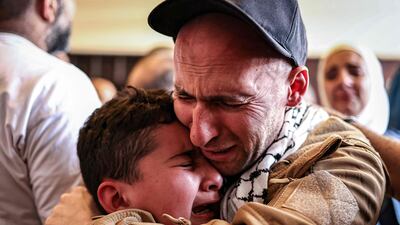
A freed Palestinian detainee arrives at Ramallah Culture Centre, in the occupied West Bank, after leaving Ofer military prison. AFP -
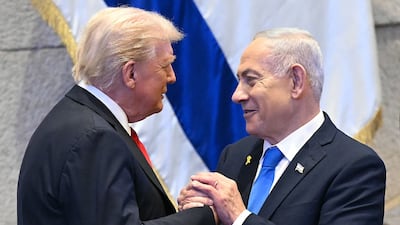
Mr Trump and Mr Netanyahu at the Knesset, where the US President was praised for his support of Israel. AFP -
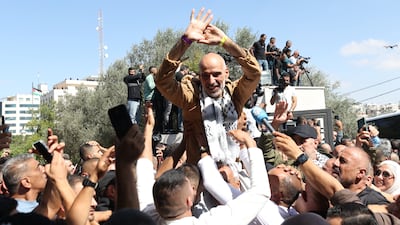
A freed Palestinian is greeted by a cheering crowd in Ramallah, in the occupied West Bank, as Israel releases hundreds of detainees from jail. EPA -
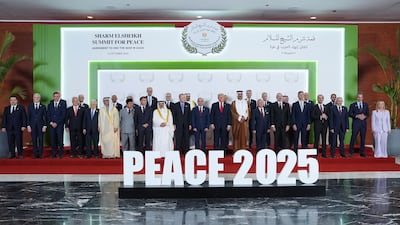
Mr Trump and other world leaders pose for a photo during a summit in Sharm El Sheikh, Egypt. Getty Images -
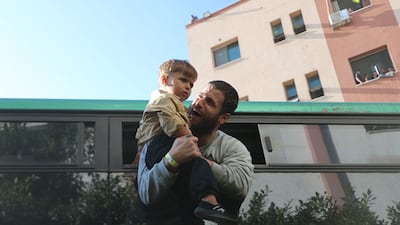
A Palestinian released from Israeli prison is reunited with family after arriving on a bus outside Nasser Hospital in Khan Younis, Gaza. AFP -
Freed hostage Avinatan Or gestures to the crowd outside Beilinson Hospital in Petah Tikva, Israel. Getty Images -
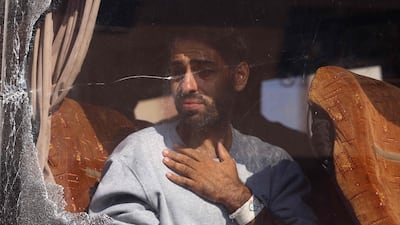
A released Palestinian arrives on a bus in Khan Younis. AFP -
Released Israeli hostage, Eitan Abraham Mor, embraces his loved ones in Petah Tikva. Reuters


History offers little reason to believe that such arrangements endure. Political vacuums rarely remain empty. Despair is a poor foundation for peace and an excellent recruiting tool for extremism.
The third future is more difficult. It is also the only one that offers a genuine path forward.
Its premise offers the best foundation for peace: verified decommissioning of weapons, deradicalisation, accountable Palestinian civilian governance, phased Israeli withdrawal and reconstruction.
The future of Gaza must ultimately be determined by accountable Palestinian civilian institutions, not competing armed factions. Under US President Donald Trump’s Comprehensive Plan to End the Gaza Conflict, security must be exercised through lawful structures that answer to a civilian transitional authority. Reconstruction must proceed in an environment where weapons have been permanently decommissioned and military infrastructure dismantled, and where investors, donors and ordinary families can have confidence that war is not simply being postponed. That is not simply a technical requirement, it is a political one.
To Israelis, I would offer one observation.
I understand why many hear proposals for withdrawal or transitional administration and think of the failings of the past. The lesson I draw is that withdrawal without durable security and governance arrangement inside Gaza was insufficient. The fundamental question of who legitimately controls force inside Gaza was never properly resolved.
The answer cannot be blind trust. Security arrangements must be verified and enforced. Yet Israelis should also confront an uncomfortable reality. Walls, buffer zones and recurring military operations cannot deliver lasting security if Gaza remains permanently unstable and under the control of armed factions.
A strategy built entirely around managing the next war is not, in the long run, a strategy for peace.
To Palestinians, and to Arabs across the region, I would offer a similarly candid observation.
The destruction of Gaza has generated understandable anger. Many Palestinians also view international initiatives with suspicion. But there is another question that deserves an honest answer.
Has the dominance of armed factions brought Palestinians closer to statehood, prosperity or freedom?

Societies become stronger when institutions function, when schools educate children, when hospitals care for patients and when accountable governance provides services to people. They do not become stronger when decisions about war and peace are concentrated in the hands of armed groups.
Nor can Gaza build a different future without confronting the ideologies and narratives that have normalised violence and extremism. Change cannot be imposed from outside; it must come through education, functioning institutions, economic opportunity and a political horizon that gives young people an alternative to militancy. The Palestinians of Gaza have paid an intolerable price. They deserve a future that demands more from politics than just aid or calls to sacrifice.
The region and the international community also have responsibilities. Gaza cannot make this transition through declarations alone. Security guarantees must be credible, reconstruction must be supported and Palestinian transitional institutions must be given the means to succeed. Commitments made in conference rooms must ultimately translate into change on the ground.
Implementing President Trump’s comprehensive plan, endorsed by UN Security Council resolution 2803, will not be easy. Agreements alone change very little. What matters is implementation, political courage and sustained commitment long after international attention moves elsewhere. The framework exists. Regional partners are engaged. Technical expertise is available. Financial resources can be mobilised.
The question is whether the political will exists.
There will always be those who resist change because new arrangements challenge familiar interests and established sources of influence. Building something new is invariably harder than defending what already exists. Yet leadership is measured precisely by the willingness to choose the harder path.
For generations, this conflict has imposed costs on the entire region. Palestinians and Israelis have borne by far the greatest burden.
While the dead deserve remembrance, the living deserve a future. We can preserve the conditions that repeatedly produce war, or we can begin building the conditions for peace. There is no neutral ground between those alternatives.