

On September 30, the official White House rapid response account on X reproduced research from the libertarian Cato Institute showing that legal immigration from majority-Muslim nations was cut by 96 per cent after US President Donald Trump took office. Nineteen of the countries included Arab countries, countries in the broader Middle East and North Africa, and Arab League member states in East Africa, such as Somalia, Sudan and Djibouti.
By highlighting this information, the Trump administration clearly regarded such a figure as a sign of success – an effort to implement Mr Trump’s failed “Muslim ban” of 2017, but this time directed against legal immigrants, not all Muslim travellers to the US.
That the administration could take pride in keeping Muslims out of the country, most of them citizens of states with which the US has close political relations, was revealing. It showed that Mr Trump still regards Muslims as legitimate and popular targets for what increasingly appears to be his brand of ethno-nationalism, at a time when the American public remains highly polarised on the issue of Muslims and Muslim immigration.

According to a Pew Research Centre poll conducted in spring this year, 43 per cent of US adults said Muslims were less patriotic than other Americans, against only four per cent who said they were more patriotic; 42 per cent said Muslim Americans were having a negative impact on the country, against only 17 per cent who said they were having a positive impact.
Recently, the journalist Rozina Ali published a highly regarded book on Islamophobia in the US, in which she examined it through the lens of four families. While she was caustic about the extent of discrimination that Muslims have faced, especially since the 9/11 attacks, she closed her book on a fair-minded conclusion. While Islamophobia endured in America, she wrote, “it is also true that it is met with a refusal to accept it”.
Indeed, the White House’s tweet received rapid pushback. David Biers of Cato, whose research led to the figures mentioned by the White House, responded by saying: “Thanks for citing my work. You are violating the law and harming Americans while making the country less safe, less free and less prosperous.” Mr Biers went on to point out that “Immigrants from majority-Muslim countries are more highly educated, work in higher-skilled occupations, and have reduced federal, state and local deficits by $1.1 trillion over the last 30 years”.
-
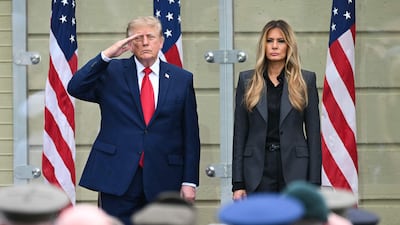
Donald and Melania Trump listen to the national anthem during the commemoration at the Pentagon in Washington DC. AFP -
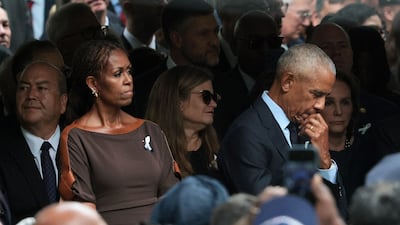
Michelle and Barack Obama during the ceremony at the National 9/11 Memorial & Museum. Getty Images via AFP -
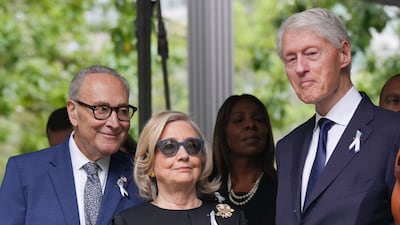
US Senate Minority Leader Chuck Schumer with Hillary and Bill Clinton. AFP -
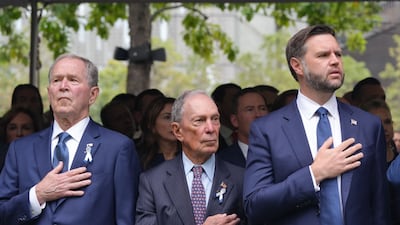
Former president George W Bush, former New York City mayor Michael Bloomberg and Vice President JD Vance. AFP -
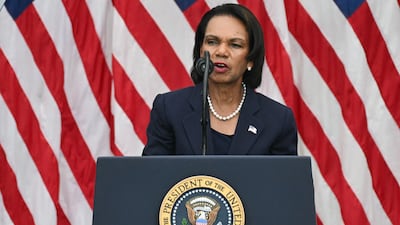
Former US secretary of state Condoleezza Rice speaks during the commemoration at the Pentagon. AFP -
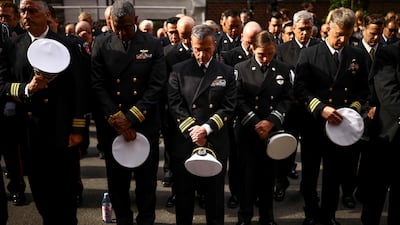
Firefighters pay tribute outside the Engine 54/Ladder 4/Battalion 9 firehouse in New York. AFP -
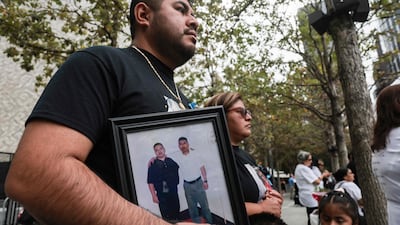
Juan Lopez, who lost his father Leobardo in the attacks. Getty Images via AFP -

Matt Dunleavy holds his daughter Ellie during the ceremony at the 9/11 Memorial. EPA -

People at the commemoration event at the 9/11 Memorial. AFP -
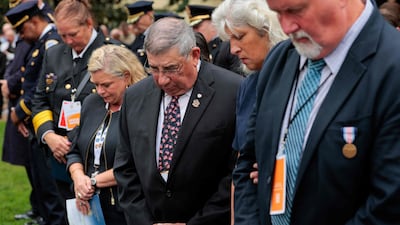
The ceremony at the Pentagon. Getty Images via AFP -

Firefighters outside Engine 54/Ladder 4/Battalion 9 firehouse. AFP


Such attitudes raise questions about a matter that may seem distinct from Islamophobia in the US, namely the durability and strength of the US-dominated geopolitical order in the Middle East. The notion that American attitudes towards Muslims at home should affect whether Pax Americana in the region can endure is not evident. US security connections are about interests; immigration is about perceived social compatibility. The two need not be linked.
They need not be linked, but usually are. The great strength of the Nato alliance was that the US anchored it in shared values with the countries of Western Europe. These endured even after the alliance lost much of its impetus and was declared “brain dead” by French President Emmanuel Macron. Similarly, the EU has been built around common principles, as has the Aukus security partnership of the US, UK and Australia.
In the Middle East, this has never been the case. Other than Israel, which many Americans regard as an “exceptional” nation, in the words of the late writer Amy Kaplan – “a moral community of both concentration camp survivors and heroic warriors … a state both vulnerable and indomitable, an invincible victim” – there has been little US identification with the values (or states) of the region; or little regional identification with the US.
The security relationship that the US has maintained with Middle Eastern states has never been underpinned by more than transactional reasoning. The problem, however, is that when ties are merely transactional, their foundations immediately buckle when one side fails to fulfil its end of the bargain. That is where we are today. With the US security umbrella having taken a major blow in the conflict with Iran, some countries in the region are looking for alternative paths to security, for example the Makkah Joint Defence Agreement.
Yet even when pragmatic ties come up short, inter-state relations can be prolonged when the public remains attached to an alliance. The Egyptians suffered a debacle in the June 1967 war with Israel, but many Arab societies remained emotionally committed to Egypt and its leader Gamal Abdel Nasser afterwards. This allowed the Egyptians to retain regional sympathy for years, adding an element of soft power more effective than their hard power.
Pax Americana in the Middle East has no such appeal, and probably never did. For many people in the region, the insulting way a surprising number of US public figures speak of Muslims only adds to a broader perception that Americans are unconcerned about the well-being of the majority of the region’s inhabitants – which US actions in Gaza had already anchored in the minds of people.
If a political relationship offers few practical benefits for Arab societies, and is accompanied by public disdain directed at them and what they consider important, there is little impetus to defend such an arrangement. As the Trump administration takes pride in barring immigrants from majority-Muslim countries, the message is clear: We may be friends, but we really don’t much care for you. Pax Americana cannot sustain itself on such fragile foundations when the more practical expectations of political ties have also come up short.