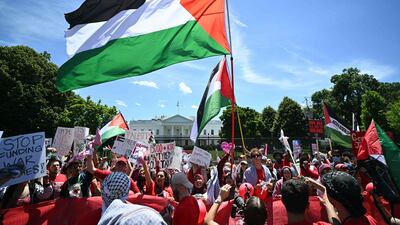

One reason US policy in the Middle East has been so problematic is that policymakers refuse to consider its impact on the needs of most of the citizens of the Arab world.
With Israel, it’s a different story. Over-attentiveness to Israeli concerns coupled with the lack of sensitivity to what Arabs think about Washington’s actions has led to deep fractures between the Arab people and the US and within the Arab world.
Since 2000, we have conducted more than 50 multi-nation opinion polls on a variety of topics. We explored Arab attitudes towards other Arabs, the US, China, Russia, Iran and Israel. We also examined attitudes towards conflicts in the region.
It’s been more than two years since we have polled across the Arab world, but based on what we saw developing during our two and a half decades of work, it’s clear that US policies are headed towards disaster – not only for the US and its stated goals, but also, and more importantly, for the Arab people.
There are some important observations to be made based on the trend lines we have culled from our surveys.
After 9/11, then-US president George W Bush famously claimed: “They hate us because they hate our values.” Our 2002 polling found the opposite: large numbers of Arabs liked American people, products, education and values, but strongly disliked US policies towards the Arab world – especially regarding Palestinians. As I said during a congressional hearing on my polling: “Arabs like us and our values – what they resent is that we don’t apply those values to them.”
Mr Bush’s Iraq war and neglect of Palestinians further lowered US ratings. They rose when his successor, Barack Obama, promised change but fell when he didn’t deliver on them. Attitudes further plummeted with Donald Trump’s pro-Israel, anti-Muslim policies.
By late 2023, our last multi-nation poll showed then-president Joe Biden’s support for Israel’s war on Gaza generating even stronger negatives. To make matters worse, the complications created by Mr Trump’s US-Israel attacks on Iran, coupled with his assault on the very aspects of America that were respected worldwide – its universities, press freedom and immigration policy – make it likely that Arabs are now finding it difficult to even like American values.
Over the years, we have often polled on favourable/unfavourable attitudes towards China and the US. During this time, while opinions towards the US ebbed and flowed, attitudes towards China remained steady. By the end of 2023, for the first time, China’s ratings were competitive with those of the US in areas that had previously been the US’s strong suits – education and doing business. And in several Arab countries, China was seen as a more reliable partner than the US.
Arab attitudes towards Iran have followed a consistent pattern. When Iran was perceived to be under attack for resisting the US and the West, it found a strong base of support among many Arabs. But when Iran directly meddled in Arab countries, opinion turned against it. And when its ally Hezbollah turned its weapons against its domestic Lebanese opponents and joined Iran in direct involvement in Syria’s civil war, majorities in most Arab countries turned against Iran.
Following this trajectory, one can reasonably assume that the US-Israel attacks on Iran coupled with Israel’s attacks on Lebanon and Syria, and Israel’s boasts of becoming the regional power that was “defending western civilisation against barbarism”, won Iran some sympathy in Arab public opinion. The same might be true for the recent US-Israel attacks on Iran, except that instead of seeking Arab support, Iran deliberately attacked its Gulf neighbours – the very countries that had been trying to restore relationships with the meddlesome Islamic Republic.
This, no doubt, turned opinion among many in the Gulf against Iran. It is uncertain, however, how much intra-Arab friction this is causing in the rest of Arab world.
-

Protestors face-off against police during a rally for a Cease Fire in Gaza outside a UAW union hall during a visit by U. S. President Joe Biden in Warren, Michigan. Reuters -
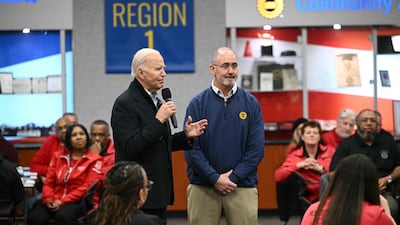
US President Joe Biden speaks alongside UAW president Shawn Fain during a visit to United Auto Workers in Detroit, Michigan. AFP -
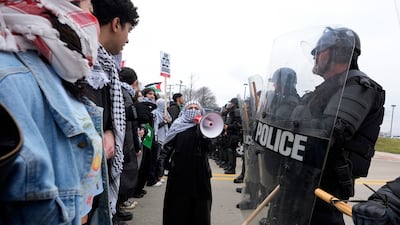
Pro-Palestinian demonstrators march against police during a visit by President Joe Biden in Warren, Michigan. AP -

Protestors rally for a cease fire in Gaza outside a UAW union hall during a visit by U. S. President Joe Biden in Warren, Michigan. Reuters -

Protestors rally for a cease fire in Gaza outside a UAW union hall during a visit by U. S. President Joe Biden in Warren, Michigan. Reuters -

People gather in support of Palestinians outside of the venue where US President Joe Biden is speaking to members of the United Auto Workers (UAW) at the UAW National Training Center, in Warren, Michigan. AFP -

Pro-Palestinian demonstrators march during a visit by President Joe Biden in Warren, Michigan. AP -

People gather in support of Palestinians outside of the venue where US President Joe Biden is speaking to members of the United Auto Workers (UAW) at the UAW National Training Center, in Warren, Michigan. AFP -
Protestors rally for a Cease Fire in Gaza outside a UAW union hall during a visit by U. S. President Joe Biden in Warren Michigan. Reuters -

Dearborn, Michigan, is often referred to as the heart of Arab America. Joshua Longmore / The National -

A protester waves a Palestinian flag at a rally in Dearborn, Michigan. Joshua Longmore / The National -

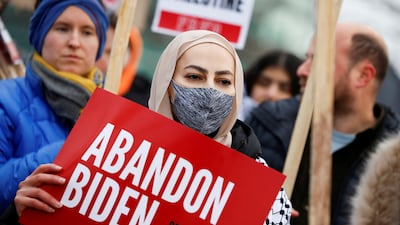
A protester holds up a placard reading 'Abandon Biden' in Dearborn, Michigan. Joshua Longmore / The National


Support for Palestinians has long been a central Arab concern. They showed little interest in making peace with Israel – even in those countries that had signed peace agreements with Israel. As Israeli repression of Palestinians intensified and the fractured and visionless Palestinian leadership failed to inspire, Arab opinion began to change.
In late 2019, we asked Arabs if they felt it would be desirable to make peace with Israel, even if Israel didn’t accept the terms of the Arab Peace Initiative. When significant numbers said that it might be desirable, we asked why. The responses varied but many told us that it might help end the violence and give Arabs more leverage to convince Israel to grant Palestinian rights.
We repeated this question at the end of September 2023 and had completed about half of the questionnaires by October 7, the date of the Hamas-led attacks on Israel. We interrupted the survey and went back only a few weeks later to complete it. The changes in the results were significant. Before October 7, responses were similar to the 2019 poll, but by the end of October, in reaction to the intensity of Israel’s assault on Gaza, attitudes shifted dramatically against any attempt to deal with Israel. Three years later, one can reasonably assume this hasn’t changed.
In 2024 and last year, on three occasions, we polled in the Occupied Territories. Results were disturbing.
Israeli policy had worked to discredit the Palestinian Authority, weakening its ability to govern. Opinion in the West Bank had turned against the PA, with respondents saying they preferred Hamas. In Gaza, we found that Hamas had fallen into deep disfavour, with a strong plurality of Gazans preferring the PA. In both the West Bank and Gaza, there was little support for US, Israeli or international governance. They preferred Palestinian unity.
Meanwhile, Israel continues to lay waste to Gaza and is running roughshod over the West Bank and East Jerusalem, further angering Palestinians and discrediting the PA. All the while, Israel rejects any role for the PA in Gaza. As the situation further unravels, the US ignores Palestinians’ wishes and turns a blind eye to Israeli misdeeds.
In Lebanon, when Hezbollah was seen as resisting Israel, it found favour among many Lebanese, especially since Israel frequently bombed Lebanon and occupied a swatch of its land from the late 1970s to 2000. However, when in 2008, Hezbollah turned its weapons against the state and in 2019 against the popular revolt, Lebanese opinion divided along sectarian lines.
Our polling before 2023 showed that most Lebanese wanted Hezbollah disarmed or under the control of the Lebanese army. But Israel’s recent devastating assault on Lebanon, its bombing throughout the country, its forced expulsion of one million Lebanese from the south, its destruction of homes, farmlands and entire villages, and explicit intention to annex a large portion of the country have, no doubt, restored some support for Hezbollah and exacerbated internal sectarian tensions, while turning more Lebanese against Israel and the US.
Seen in this light, US efforts to pressure the Lebanese government to forcibly disarm Hezbollah and make a peace agreement with Israel is dangerous for Lebanon’s stability.
In each instance, it is America’s lack of attentiveness to Arab sensitivities and needs that contributes to making a bad situation even worse – further embittering many Arabs towards the US, deepening fissures within the Arab world, while fostering ever-expanding Israeli impunity.

