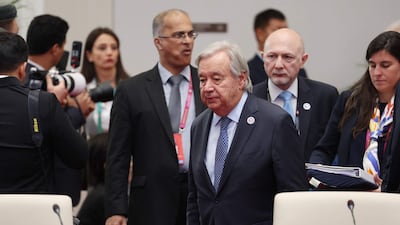

What’s known in New York as “UN week” is well under way.
Assembled are the many parts of the organisation, encompassing humanitarian relief, bureaucracy, administration as well as agencies charged with upholding treaties. Alongside are thousands of stakeholders from heads of state and government to activists.
What cannot be ignored are the scores of conflicts, many worsening, in the world. The question to be asked: is there a better alternative to the UN as the place to find a way through the mess?
It might be tempting to think bleak thoughts, but we should come to praise the UN for what it can be – not bury it for what it can represent. For that reason, there should be a focus on the political operations of the body that persevere to see through tensions between member states and work quietly in the backroom for a resolution.
Ahead of the annual gathering of the UN General Assembly, a memorial was held on Friday at the New York Headquarters for the recently deceased former official and envoy Nicholas Haysom, also known as “Fink”.
For an organisation where everyone agrees it has reached a fork in the road over its credibility, Fink was universally hailed as one of the good ones. He served as the chief legal and constitutional adviser to then-South African president Nelson Mandela and went on to play a leading role in post-Saddam Hussein Iraq as well as post-Omar Al Bashir Sudan.
Whatever the trajectory of both countries in the years that followed the demise of their respective regimes, Fink was an effective operator for the UN as the situation in these countries unfolded. UN spokesman Stephane Dujarric noted that the late official’s defining characteristic was to strive for “the right side of history” as he addressed the challenges of each mission he undertook.
A former political director to the UN Secretary General and latterly a serial special envoy, Fink was – as Mr Dujarric said – also a formidable player in the “combat zone of the 38th floor”, the leadership suite clustered around the Secretary General’s office.
Watching on from the other side of the Atlantic, it was hard not to think that the UN needed to prioritise its dedicated and knowledgeable cadre of political operators as the only third-party force available to tackle the worst of problems.

Former UK foreign secretary David Miliband mused last week that a new approach was needed if the world was going to push back against the forces pursuing the conflicts of global significance.
To Mr Miliband, the key characteristic that has changed is a “diffusion of power globally and concentration of power nationally”. This makes the former politician’s previous emphasis on grassroots approaches – which played to the strengths of the administrative and bureaucratic parts of the UN – less effectual and relevant.
One writer who has laid emphasis on the type of political skills that people such as Fink possess is Robert Pape, who has charted a fundamental shift in worldwide dynamics that will inevitably change the UN.
The rise of conflicts that are driven by deep-seated political divisions about national direction from within the borders of a country has spilled over into international relations. As a result, supra-national directions or micro-management through UN-style programmes do not represent an elixir anymore. Many would argue, despite the UN’s best efforts, that these initiatives can – at best – only be a glass half full.
The UN’s operational footprint covers a global need to address disease, climate change and hunger, among other fundamental scourges. To sustain these efforts, the new Secretary General – due to take office next year – would be well advised to turn to, and beef up, his or her political team.
The strategic choices that drive international developments require this shift in focus for the UN. With the major powers finding that military and technical dominance cannot avoid the trap of escalation in the current Middle Eastern conflicts, the UN must be ready to assume a more nimble but harder political edge.
This will involve something of an internal reshuffle, but it should not be seen as anything other than a consolidation around the most effective tools in the UN’s cupboard.
There is no word on the identity of the UN’s next leader. The long-run emergencies to be addressed – such as climate change, the breakdown of global supply systems and the rise of AI – are only intensifying as pressing issues. But it is worth remembering for UN week that there is no other body that has the infrastructure to address all these issues, plus the fundamental challenges posed by conflict.
That is why the engagements around Manhattan this week are vital and consequential, no matter what happens.

