
What has happened to the world and how should we respond?
This question is by no means abstract. Whether a shipment can arrive at port on schedule or a flight can take off and land on time depends closely on peace and stability in the world. It also depends on effective global governance.
The complex situation in the Middle East, in particular, is a test of the effectiveness of global governance. Without stability in the Middle East, there can hardly be tranquillity in the world. How to end hostilities, promote peace and restore stability is the most pressing aspiration of the people in the region and a question the international community must answer.
China has always been committed to peace, stability and lasting security in the Middle East. Recently, during his talks with Egyptian President Abdel Fattah El Sisi, President Xi Jinping put forward a four-point proposal for advancing common security in the Middle East. The proposal supports countries in the region in exploring a new security architecture along four dimensions: strengthening the region’s own capacity to improve security, taking a comprehensive approach to security challenges, reinforcing the foundations for security through development and enhancing international co-ordination.
Earlier, during his meeting with Sheikh Khaled bin Mohamed, Crown Prince of Abu Dhabi, and his talks with King Abdullah II of Jordan, Mr Xi also set out China’s positions on protecting and promoting peace and stability in the Middle East and advancing the settlement of the Palestinian question.
These positions are underpinned by a consistent approach: lasting peace and security in the Middle East require respect for the sovereignty and legitimate security concerns of all countries, the resolution of differences and disputes through dialogue and consultation, political solutions to hotspot issues, peace through development and security through co-operation. Ultimately, the future and destiny of the Middle East should be in the hands of the people of the region themselves.
Amid a world of intertwined changes and turbulence, China and the UAE share much common ground.
The UAE advocates inclusive multilateralism and supports multilateral co-operation and co-ordinated global action to address common challenges. China has put forward the Global Governance Initiative, which is built on five core principles: sovereign equality, international rule of law, multilateralism, a people-centred approach and real actions. At the recent Shanghai Co-operation Organisation Summit, the Chinese President further elaborated on the principles underpinning an equal and orderly multipolar world.
These ideas point to several straightforward questions. Should international affairs be decided by a handful of countries, or discussed by all? Can all countries, regardless of their size or strength, be treated with equal respect? When differences arise, should we keep building walls, or work to build bridges?
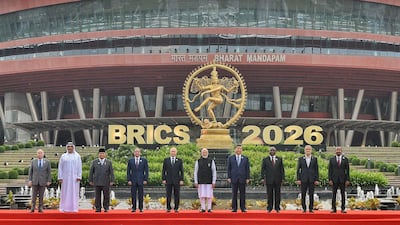
This convergence of ideas provides an important foundation for China and the UAE to strengthen co-ordination on regional and international affairs. The 18th Brics summit was held in New Delhi last week. As members of the grouping, China and the UAE joined other Brics partners for in-depth exchanges and efforts to build consensus on how to address global challenges together.
At the summit, Mr Xi Jinping pointed out: “The Global South is gaining strength, and the trend towards a multipolar world is unstoppable.” He further stressed: “Brics must stand firmly on the right side of history, strive to be a pioneer of our times, steer the international order in a direction that is more just and equitable, and work together to build a community with a shared future for humanity.”
Sheikh Khaled’s participation also reflects the UAE’s consistent commitment to strengthening engagement among emerging and rising economies and broadening the horizons for development and shared prosperity. As Brics co-operation continues to deepen and deliver concrete results, China and the UAE can further strengthen co-ordination, jointly uphold multilateralism and an open world economy, and work for greater representation and voice for the Global South.
What has happened to the world? Conflicts persist yet calls for peace have never ceased. Divisions and barriers are growing, making dialogue and co-operation all the more precious.
How should we respond? World affairs should be discussed by all, and when it comes to the Middle East, greater attention should be paid to the voices of countries in the region. Let there be more dialogue, greater co-operation and stronger forces for peace.
In answering the questions of our times, China and the UAE are offering their own response through shared ideas and common action.

