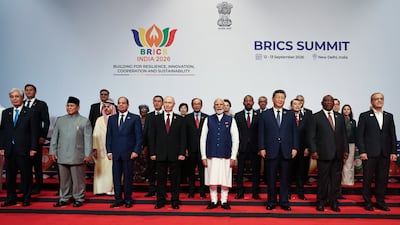

For an organisation founded less than two decades ago, the Brics group of nations is displaying a maturity beyond its years. The 11-nation group now accounts for about a quarter of the world’s nominal gross domestic product and roughly half of its population. Counting several major energy producers and consumers among its ranks, Brics is too significant to overlook, but also too diverse to operate like a conventional geopolitical alliance. That, however, could be one of its strengths.
The grouping, whose leaders' summit in New Delhi ended yesterday, contains countries with different political systems, varied strategic interests and mixed relationships with the West. China and India remain strategic competitors. Russia is locked in a broad confrontation with Europe, Nato and the US. Iran is embroiled in a regional war.
Trying to force such a grouping into the mould of another geopolitical bloc would miss the point that the world does not necessarily need another political, economic or military faction. What’s needed is more connections and consensus between the camps that already exist. At this summit, the UAE – a Brics member with an array of partnerships – demonstrated how it can encourage the organisation to act as a bridge between countries.

That push for consensus could be seen on the summit’s final day when a joint statement urged all parties in the Iran war to exercise restraint and avoid exacerbating the situation. No one is arguing that such a communique is a solution to the Middle East’s problems, but getting almost a dozen countries with competing interests to agree on the need for restraint has real value.
The UAE’s instinct for consensus-building was also visible in a meeting between Crown Prince Sheikh Khaled bin Mohamed and Iranian President Masoud Pezeshkian on the summit's sidelines. The encounter should not be overinterpreted, particularly after the erosion of trust caused by Iran's attacks, but keeping channels of communication open remains important.
Dr Anwar Gargash, diplomatic adviser to President Sheikh Mohamed, said yesterday that the Emirates’ approach rests on “the twin pillars of deterrence and diplomacy”. Neither of which, he added, “can function effectively without the other”. That philosophy has relevance well beyond Iran’s complex position in the region and Brics gives the UAE another platform from which to practice its “strategic autonomy” principle for foreign policy.
Brics presents a key value in its ability to maintain relationships across geopolitical divides, while bringing the concerns of the Middle East into a forum whose weight is growing. Brics members will not agree on everything, and nor should they be expected to. However, if the organisation keeps doors open with countries outside the bloc, then it can make the grouping more useful in an increasingly divided world.

