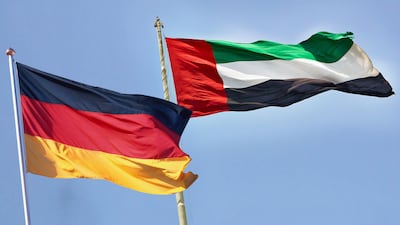
This week marks a moment of genuine historic significance in the relationship between the UAE and Germany. For the first time since diplomatic relations were established, a UAE President will travel to Germany. President Sheikh Mohamed bin Zayed's visit and his meeting with German President Frank-Walter Steinmeier, therefore, represents more than a historic first. It is a signal of how far our relationship has come – and of where we believe it can go next.
The foundations of this partnership were built over decades. The bilateral Strategic Partnership Agreement of 2004, followed by further steps to deepen co-operation in 2019 and 2022, established a relationship grounded in mutual respect, shared interests, economic openness and international co-operation. What began with diplomacy and trade has evolved into a partnership between two countries looking towards the industries, technologies and infrastructure that will shape the global economy of tomorrow.
Germany and the UAE are navigating a world where economic resilience, energy security, supply-chain reliability and technological competitiveness have become fundamental to national prosperity and security. Geopolitical instability in both Europe and the Middle East has illustrated that strong economies need trusted partners, and resilience is built through co-operation.
This is where the UAE and Germany are exceptionally well matched.
Germany brings strengths in engineering, advanced manufacturing, research and industrial technology. The UAE brings strategic investment capital, world-class infrastructure, an open and competitive business environment, and a unique position connecting Europe with the Gulf, Asia and Africa.
-

President Sheikh Mohamed meets Friedrich Merz, Chancellor of Germany, at Al Shati Palace in Abu Dhabi. Abdulla Al Bedwawi / UAE Presidential Court -

Sheikh Mohamed and Mr Merz held discussions focused exploring opportunities for 'enhanced collaboration' between the UAE and Germany. Abdulla Al Bedwawi / UAE Presidential Court -

President Sheikh Mohamed said the UAE remains keen to strengthen relations with Germany. Mohamed Al Hammadi / UAE Presidential Court -

Sheikh Mohamed greets a dignitary accompanying Mr Merz. Mohamed Al Hammadi / UAE Presidential Court -

Dr Sultan Al Jaber, Minister of Industry and Advanced Technology and UAE special envoy to Germany, and Markus Steilemann, chief executive of German chemicals manufacturer Covestro, exchange a Memorandum of Understanding, at Al Shati Palace. Abdulla Al Bedwawi / UAE Presidential Court -

Dr Al Jaber with Dr Anwar Gargash, Diplomatic adviser to the President, Dr Thani Al Zeyoudi, Minister of Foreign Trade, Lana Nusseibeh, Minister of State, and Ahmed Al Attar, UAE Ambassador to Germany, during the meeting with the German delegation. Abdulla Al Bedwawi / UAE Presidential Court -

Members of the German delegation. Abdulla Al Bedwawi / UAE Presidential Court


Total bilateral trade surged to €13.5 billion ($15.6 billion) last year, and it continues to grow at a remarkable rate. This development is driven by a profound structural integration, clean energy partnerships, advanced manufacturing and technology exchange, rather than volatile oil markets.
About 2,000 German companies now operate in the UAE, alongside a significant German community. At the same time, Emirati investment is flowing into German firms.
The most important measure of this partnership is what we are building together, and what those investments will make possible years from now. The scale of that commitment is already visible. Through XRG’s €14.7 billion investment in Covestro, the leading German polymer and specialty chemicals manufacturer, the UAE has made one of the largest commitments by an international investor to German industry. The significance of that investment lies not in its size alone, but in what it represents: confidence in Germany’s industrial future, its technological leadership and its ability to remain home to global champions. It reflects a shared belief in German innovation, manufacturing excellence and industrial leadership, and a long-term commitment to helping world-class companies grow, compete and lead in the industries that will shape the future.
Both countries are making deliberate choices today about the economies we want to have tomorrow. That means investing in clean energy and hydrogen, advanced manufacturing, AI, digital infrastructure, logistics and other high-value technologies. It means creating the jobs and skills that will allow our people to benefit from the next economic transformation.
Germany is strengthening and modernising its industrial base. The UAE is accelerating its transition towards a more diversified, knowledge and technology-driven economy. Both countries increasingly recognise that long-term prosperity will depend on innovation, diversification and technological competitiveness.
Energy offers a clear example.
Germany is focused on both securing reliable energy supplies alongside the longer-term challenge of decarbonisation. Rather than treating these as competing priorities, the Energy Security and Industry Accelerator signed by our countries in 2022 brought them together as part of one agenda.
The agreements that followed demonstrated what this can look like in practice: an LNG cargo to commission the floating terminal at Brunsbuttel, alongside demonstration cargoes of low-carbon ammonia for German industry. The ammonia reached Hamburg in 2022, where Aurubis used it in place of natural gas in a test series at its copper wire rod plant. The LNG followed at Brunsbuttel in 2023 – the first cargo shipped to Germany from the Middle East. RWE, which received it, is developing an ammonia import terminal at the same location, with the aim of converting the site to the import of green molecules.
That co-operation has since moved into its next phase. In 2023, Masdar invested in the €1.6 billion Baltic Eagle offshore wind project off the north-eastern coast of Germany. The 476MW project provides enough renewable energy to power 475,000 households.
The opportunities extend well beyond energy. German companies can use the UAE as a platform to expand and connect with some of the world’s fastest-growing economies. For the UAE, deeper engagement with German industry brings expertise, innovation and industrial partnerships that support our own economic transformation.
The experience of Wilo offers a compelling example of how this relationship is evolving into mutually beneficial industrial partnerships.
Wilo, a water technology and pump manufacturer from Dortmund, has produced in the Jebel Ali Free Zone for almost 20 years and expanded its Dubai capacity last year. In June, Wilo and DP World signed an agreement to extend that partnership into sustainable water technology, smart logistics and AI-based solutions for the water sector.
But this partnership is about more than economics. The UAE and Germany share a commitment to dialogue, international co-operation and stability. In a period of geopolitical uncertainty, trusted relationships matter. Economic resilience and political stability reinforce one another. Partnerships that create jobs, strengthen livelihoods and deepen economic connections can also help build foundations for a more stable and prosperous future.
That is why this first presidential visit is so significant.
It reflects the depth and maturity of a relationship that has been built over decades. It reflects the UAE’s importance to Germany as a trusted strategic partner – across energy, investment, technology and trade. And it creates an opportunity to take the relationship into a new phase.
For our two countries, the ambition is clear: to be strong partners for the future economy, for shared prosperity, and for a more secure and resilient world.
The significance of a first visit is ultimately measured not by the fact that it happened, but by what it sets in motion.
We hope this visit sets in motion more investment, more innovation, more jobs, more connectivity and more solutions to shared challenges.
That is the opportunity before us – and the future of the UAE-Germany partnership is only beginning.
Ahmed Alattar is the UAE ambassador to Germany
Tobias Tunkel is the German ambassador to the UAE