

Across the GCC, transport infrastructure is transforming how people move. Metro networks are expanding, national rail programmes are advancing and cities are investing heavily in integrated mobility systems. The GCC Railway programme alone represents an estimated investment of $240 billion.
Ultimately, success is less about what has been built and more about how people experience it. If the journey is not seamless, even the most advanced infrastructure can fall short of its potential. Having worked on mobility programmes across the Middle East, it has become increasingly apparent to me that the real measure of a transport system is not the infrastructure itself, but the ease and quality of the passengers' journey.
Around the world, leading cities are shifting their focus from infrastructure delivery to accessibility. Transport networks create the greatest value when they make opportunities, services and destinations easy to reach. The UN has embedded this principle within its Sustainable Development Goals, measuring how many people live in convenient reach of public transport. Yet only about half of the world's urban population currently does. This is where the last mile becomes critical.
This approach is particularly relevant in the GCC. Rapid population growth, ambitious urban development plans and long-established reliance on private vehicles are reshaping mobility needs across the region. During the summer months, extreme temperatures can make even short journeys to and from a station less appealing, increasing the importance of shaded walkways, convenient feeder services and well-connected mobility networks.
Delivering that experience depends on more than strong individual transport assets. It requires a connected mobility ecosystem where metro, rail, buses, walking routes and micromobility options operate as a single network. As cities become denser and travel patterns more complex, the success of future mobility systems will depend less on individual modes and more on how effectively they function together as a connected network. Integrated ticketing, intuitive interchanges and reliable first and last-mile connections should make moving between different modes feel effortless rather than fragmented.
An unshaded walk in summer, a feeder service that does not align with rail schedules, a fragmented payment system or a poor interchange may seem like minor issues. Collectively, these seemingly small inconveniences create enough friction to influence behaviour and often determine whether people choose public transport or their private car.
Making public transport easier to reach and use has a direct impact on ridership. Across the region, evidence suggests that when networks become easier to access and integrate with daily life, ridership grows rapidly. Doha Metro has now carried more than 200 million passengers since opening in 2019, with the second 100 million riders achieved in less than two years, demonstrating how adoption accelerates as public transport becomes embedded in everyday travel. Improving use does not necessarily require building more infrastructure. Often, it requires designing the entire journey more effectively.
-
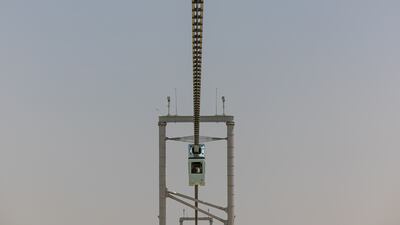
A sky pod runs along a 2.4km track at uSky Test & Certification Centre in Sharjah on May 7, 2024. All photos: Christopher Pike for The National -
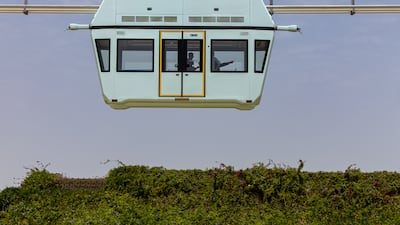
The pods that can carry 25 passengers at a time -
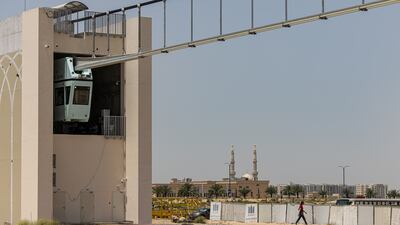
They move on cables made of extremely durable material -
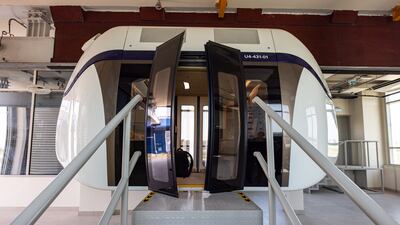
A four-person Skypod line at the uSky Test & Certification Centre in Sharjah -
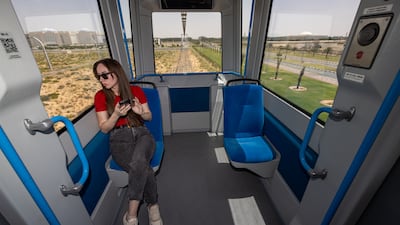
An employee of uSky rides on a pod at the test centre in Sharjah -

A model of the steel cables on which the pods move on -
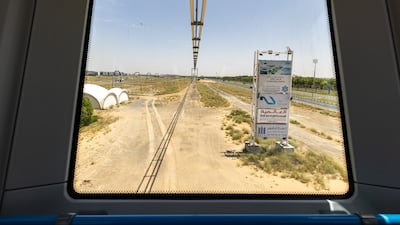
The futuristic sky pods can transport passengers at speeds of up to 100 kph -
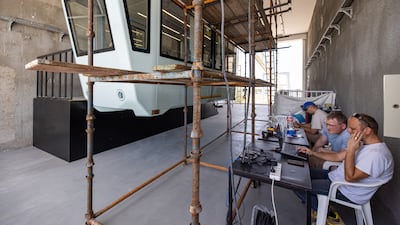
The aerial track is expected to contribute to ambitious plans to take thousands of cars off the roads and curb congestion -
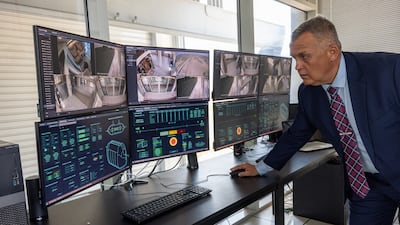
Oleg Zaretskiy, chief executive of uScovery and uSky Transport systems, at the test centre in Sharjah


The world's most successful mobility systems understand this. Singapore, for example, is working towards having eight in 10 households within a 10-minute walk of a train station by 2030. Across the GCC, similar thinking is emerging through integrated mobility initiatives in Doha and Dubai's ambition to bring more residents within convenient reach of public transport.
The GCC has demonstrated its ability to deliver transport infrastructure at a globally competitive scale. Dubai's continued investment in integrating its Metro, tram and bus networks illustrates how the focus is evolving from building infrastructure to creating smoother journeys. According to the Roads and Transport Authority, the emirate's public transport, shared mobility and taxi services carried more than 747 million riders in 2024, while Dubai Metro alone served 275 million passengers, reflecting continued growth in demand for integrated mobility options.
Abu Dhabi is advancing a more integrated approach to mobility. Alongside continued investment in public transport services, the emirate is expanding on-demand transport options, active mobility infrastructure and wider connectivity initiatives designed to improve accessibility and strengthen links across the transport network. This reflects a broader shift towards making journeys easier, more connected and more convenient for users rather than focusing solely on individual transport assets.
In Riyadh, the development of one of the world's largest urban transit systems is similarly placing greater emphasis on how people connect to the network through feeder services, multimodal integration and improved accessibility. The Riyadh Metro reached 100 million passengers in less than nine months after opening, highlighting the scale of demand that can be unlocked when major transport investments are combined with integrated access and connectivity.
The GCC has shown it can deliver transport infrastructure on a world-class scale. The next phase is ensuring people can access, use and benefit from it with ease. The last mile is often described as the final stage of a journey. In reality, it is frequently the first factor that determines whether that journey happens at all. As the region continues to invest in the future of mobility, the cities that succeed will not simply be those that build the most infrastructure, but those that make sustainable mobility the easiest choice for millions of people every day.

