

For decades, Nato summits were about one big issue – countering threats from Russia. Now Nato summits, whatever the external shows of unity, are about countering discontent, disruption and threats from within. This is centred on the most powerful Nato member: the US and the unpredictability of its President, Donald Trump.
What is predictable at this week’s Nato summit in the Turkish capital, Ankara, is the public display of bonhomie, handshakes and smiles. However, an existential question remains for what has historically been an extraordinarily successful transatlantic, trans-continental alliance of more than 30 countries. It is this: how committed is the Trump administration to the defence of Europe? Might the US in the 2020s echo America in 1914 and 1939, and pursue an “America First” policy of indifference to European conflicts, until forced at great cost to take part?
It is worth remembering that Nato has been an astonishing peacekeeping success. The organisation was founded in April 1949 with the remit of keeping Soviet troops out of Western Europe and American troops in. The Trump administration wants to reduce that US presence, which includes warships in the Mediterranean, ground troops in Germany and military aircraft stationed across Europe.
As a seven-year-old growing up just outside Edinburgh in Scotland, my friends included the sons and daughters of US Air Force personnel stationed nearby. I developed a real fondness for American accents, American movies and American food, especially the huge sandwiches prepared by a friend’s mother. As a child, I did not realise that my way of life was also being kept safe by American hard power in my neighbourhood.
The overarching question for Nato is how secure that wonderful, historic friendship looks now.
Mr Trump has – reasonably – suggested that Europeans have to pay more for defence. Less reasonably, he has suggested the US should seize the territory of a Nato founding member – Denmark – by annexing Greenland. He has also made unhelpful comments about Nato neighbour Canada, and disparaged European leaders who have not done his bidding by enthusiastically supporting the war with Iran.
In January, Mr Trump scorned Nato’s commitment to supporting the US saying that Nato sent “some troops” to Afghanistan after the terrorist attacks on New York and Washington on September 11, 2001, and that Nato’s troops “stayed a little back, a little off the front lines”. This was nonsense and deeply offensive. More than 450 British military personnel died in that war to help defend US security.
Yet the big question underlying the Nato summit remains. Do the grumblings from Mr Trump and the more serious scepticism of Vice President JD Vance undermine Nato’s future, whatever public signs of unity emerge in Ankara?
The full-scale Russian invasion of Ukraine in 2022 provoked a new European enthusiasm for Nato. Finland and Sweden became the newest members of the organisation in 2023 and 2024 respectively. Nato Secretary General Mark Rutte has tried to be a “Trump whisperer”. This is to keep the US onside.
-
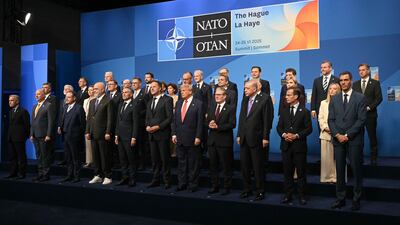
Leaders pose for a family photo during the Nato summit in The Hague. AP -

US President Donald Trump speaks to British Prime Minister Keir Starmer. Getty Images -
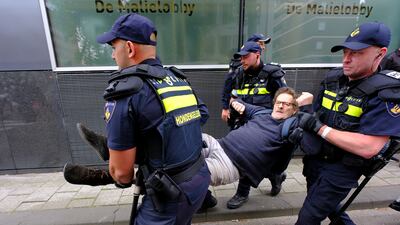
Police detain a protester during a rally against the summit. AP -

Macarons with the Nato logo were served. AP -
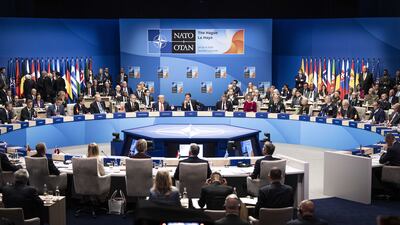
Secretary General Mark Rutte speaks at the beginning of the summit. EPA -
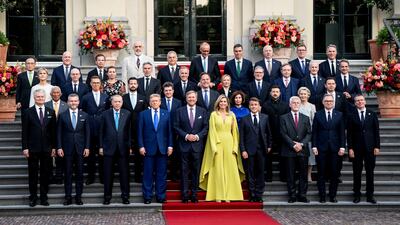
King Willem-Alexander and Queen Maxima of the Netherlands join a photo of leaders. Reuters -
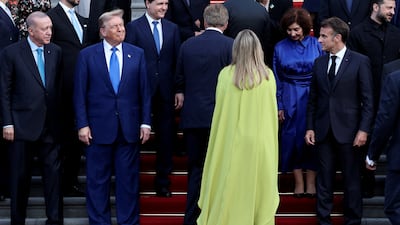
Turkey's President Recep Tayyip Erdogan, US President Donald Trump, Dutch King Willem-Alexander, Queen Maxima and France's President Emmanuel Macron in The Hague. Reuters -
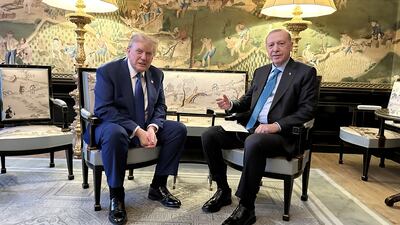
Turkey's President Recep Tayyip Erdogan, right, and US President Donald Trump talk on the sidelines of the Nato summit in The Hague. Reuters -
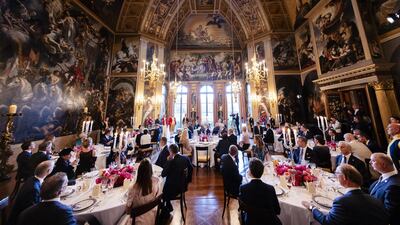
Mark Rutte, secretary general of Nato, addresses heads of state and government at Paleis Huis Ten Bosch at the invitation of Dutch King Willem-Alexander in The Hague. EPA -
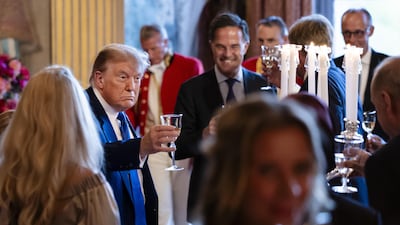
US President Donald Trump, left, at a dinner with heads of state and government at Paleis Huis Ten Bosch at the invitation of Dutch King Willem-Alexander in The Hague. EPA -
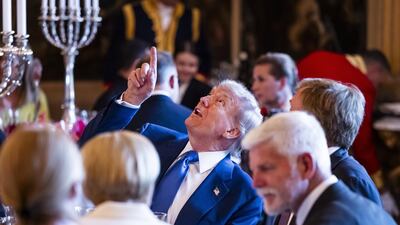
US President Donald Trump, centre, and Dutch King Willem-Alexander, second right, chat during a dinner for Nato heads of state and government at Paleis Huis Ten Bosch in The Hague. EPA -
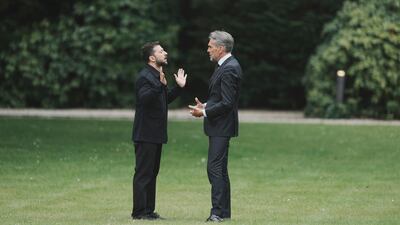
Dutch Prime Minister Dick Schoof, right, and Ukraine's President Volodymyr Zelenskyy in discussions at the Catshuis on the sidelines of the Nato summit at The Hague. AP -
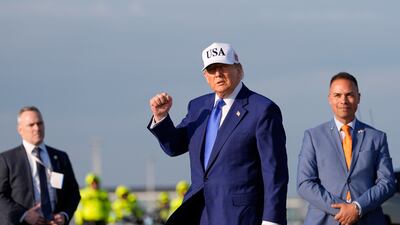
US President Donald Trump arrives at Amsterdam Schiphol Airport for the Nato summit. AP -

From left: French President Emmanuel Macron, Germany's Chancellor Friedrich Merz and Britain's Prime Minister Keir Starmer at the Nato summit in The Hague, Netherlands. Reuters -

A demonstrator joins a protest against the arrival of a ship carrying F-35 fighter jet parts for Israel in Rotterdam, Netherlands. EPA -
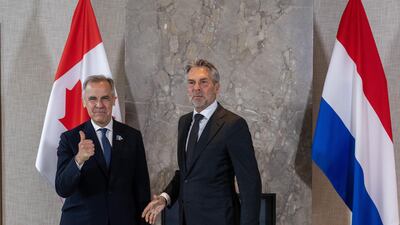
Dutch Prime Minister Dick Schoof, right, receives Canadian Prime Minister Mark Carney at the Catshuis, the Prime Minister's official residence. EPA -
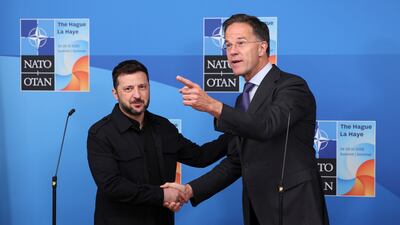
Nato secretary general Mark Rutte with Ukraine's President Volodymyr Zelenskyy at the Nato summit in The Hague. AP -
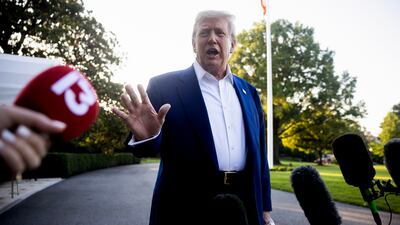
US President Donald Trump before boarding the Marine One helicopter at the White House and travelling to The Hague from the US. Bloomberg


Mr Rutte has also talked up how Europeans are honouring commitments to raise defence spending. It is expected that arms deals worth tens of billions of dollars will be signed and Mr Rutte said recently in Berlin that “the summit … will focus on turning extra spending into combat-ready capabilities and significantly scaling up our defence industries”. He added that “Nato is, and will always be, a transatlantic alliance but we need to rebalance it for the better”. Rebalancing is already happening because “working closely with the United States, European allies and Canada are taking greater responsibility for conventional defence in Europe”.
Mr Trump has either not noticed all of this or remains unimpressed. In a Truth Social post last Thursday, he made a familiar complaint, that the US was spending money to protect Nato members “without getting any benefit from so doing”.
That statement, however transactional and clumsy, gets to the heart of Nato’s problems. If an American president really cannot see the “benefit” for the US in having peace and stability in Europe, Washington’s biggest trading partners, then Nato continues to face an existential problem. European diplomats must wonder whether history is going to repeat itself and not in a good way, with America reverting to a kind of isolation as it did before.
Perhaps no one truly knows the answer to that question, maybe not even Mr Trump himself. The US President uses rhetoric and social media posts as negotiating tactics. If things go wrong, he tends to declare victory anyway and move on to other business.
What we do know is that in a previous meeting in The Hague last year, Nato leaders agreed to spend 3.5 per cent of gross domestic product on core defence items by 2035 – up from a previous goal of 2 per cent. They also agreed to invest a further 1.5 per cent of GDP on broader defence-related investments such as boosting cyber security.
Perhaps Mr Trump and Russian President Vladimir Putin should together be congratulated. The two of them in different ways have combined to shake European nations in Nato out of years of complacency.

