

Last Saturday, Mohammad Baqer Saad Dawood Al Saadi appeared in a New York federal court on six counts of providing material support to designated foreign terrorist organisations and conspiring to bomb a place of public use.
Al Saadi, 32, is an Iraqi national. The US Department of Justice identifies him as a senior commander in Kataib Hezbollah, a US-designated foreign terrorist organisation and one of Iran’s most lethal Iraqi proxy militias. He operates publicly under the alias Mohammad Baqer Suleimani – a transliteration of the name of Qassem Suleimani, the Iranian Quds Force commander killed by a US drone strike in January 2020.
According to the federal complaint, Al Saadi was a disciple of both Suleimani and of Abu Mahdi Al Muhandis, the Kataib Hezbollah founder killed in the same 2020 strike. He has been involved in 20-odd attacks on US and Israeli targets across Europe and Canada since the war between Iran and the US-Israeli coalition began in February.
The case itself is straightforward. The complaint alleges that Al Saadi attempted to arrange the bombing of a prominent Manhattan synagogue and additional Jewish institutions in Los Angeles and Scottsdale through a Federal Bureau of Investigation undercover agent he believed to be a member of a Mexican cartel. He sent the undercover photographs and maps of the targets, transferred $3,000 in cryptocurrency as a down payment and demanded the attack be carried out by April 7. The undercover broke contact. Al Saadi went silent – not heard from again until his Manhattan court appearance six weeks later.
What is not straightforward, and what makes this case substantively important, is how he ended up in that courtroom.
The Justice Department’s press release on Saturday states only that Al Saadi was “transferred into US custody overseas, and transported to the United States”. No country is named. In the same statement, FBI Director Kash Patel credited US ambassador to Turkey Tom Barrack with leading what he described as a “joint sequenced operation” involving the FBI’s Critical Incident Response Group, the unit that conducts hostage rescue and high-risk arrests abroad.
Anonymous federal officials told ABC News and the Associated Press that Al Saadi had been apprehended in Turkey and passed to American authorities. CNN, citing flight records, reported that a Justice Department aircraft “often used for global extraditions” flew Turkey-Morocco-New York last Thursday, landing the night before his court appearance. His federal defender told the court that Al Saadi had been arrested in Turkey by Turkish authorities at the behest of the US and handed over without an opportunity to contest his detention or transport – a description more consistent with extraordinary rendition than with extradition.
The Turkey framing is incomplete because the parallel timeline inside Iraq directly intersects the case. On March 31, with Al Saadi pressing the FBI undercover for an imminent Manhattan attack, Kataib Hezbollah abducted American journalist Shelly Kittleson in central Baghdad. During the week of her captivity, Iraqi security sources reported that the militia’s senior commanders were “nowhere to be found” and that Kataib Hezbollah was demanding the release of “several of its detained members” as the condition for her release.
The militia has a documented record of holding foreign nationals as bargaining instruments – Russian-Israeli academic Elizabeth Tsurkov was held by Kataib Hezbollah from March 2023 until last September before her release through extended international negotiations. The substantive difference last month is that the militia appeared to be demanding the recovery of a specific, recently detained senior figure.
Kittleson was released on April 7 – the same morning Al Saadi ceased communication with the FBI undercover. The next day, three drones were launched at Baghdad International Airport; one reportedly landed about 50 metres from the US diplomatic team escorting Kittleson out. The US Department of State condemned the “April 8 ambush of US diplomats in Baghdad”.
The most operationally consistent reading is that Kataib Hezbollah seized Kittleson to compel the release of Al Saadi, who had already been detained by US forces operating with at least tacit Iraqi co-operation. When the swap failed and Kittleson was returned without Al Saadi, the militia retaliated against the convoy at the airport.
The Turkey framing satisfies a separate set of requirements. It shields the Iraqi government from the domestic political cost of a US operation on sovereign Iraqi territory. It denies Kataib Hezbollah’s parliamentary allies a sovereignty-violation argument requiring US withdrawal. And it provides Turkey, a Nato ally, the cover of a routine handover.
Mr Barrack’s diplomatic portfolio makes the operation legible. He serves concurrently as ambassador to Turkey, special envoy for Syria and – since January, four weeks before the war with Iran began – special envoy for Iraq.
Iraqi government sources at the time of his Iraq appointment told regional outlets that Washington had selected Mr Barrack because he was “more hardline with regards to the case of Iran and armed groups” than his predecessor. His Iraq portfolio was specifically framed as confronting Iran-linked militias within the Popular Mobilisation Forces, including Kataib Hezbollah.
-

Members of Iraq's Popular Mobilisation Forces take part in a parade to mark the seventh anniversary of the organisation's founding at Camp Ashraf in Diyala province. AFP -
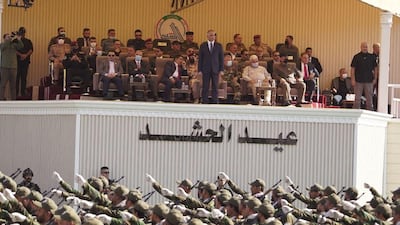
Iraq's Prime Minister Mustafa Al Kadhimi attends a parade marking the seventh anniversary of the Popular Mobilisation Forces. AFP -
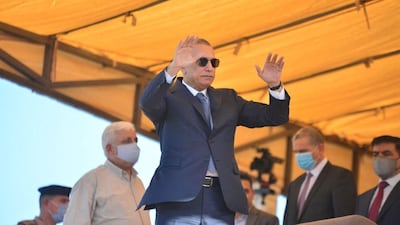
Mustafa Al Kadhimi told members of the Popular Mobilisation Forces: 'I esteem your sacrifices, and the sacrifices of the Iraqi armed forces' in fighting ISIS. He warned against sedition within PMF but did not elaborate. AFP -
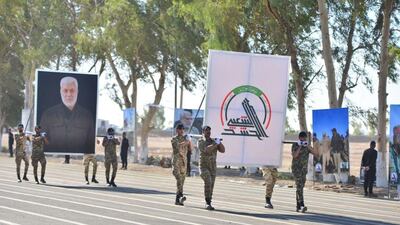
Members of Iraq's Popular Mobilisation Forces take part in a parade to mark the seventh anniversary of the organisation's founding at Camp Ashraf in Diyala province. AFP -
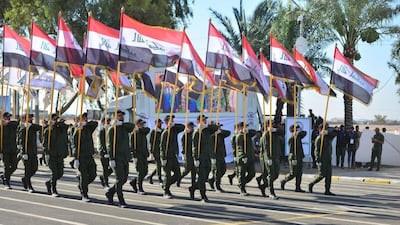
Members of Iraq's Popular Mobilisation Forces take part in a parade to mark the seventh anniversary of the organisation's founding at Camp Ashraf in Diyala province. AFP -
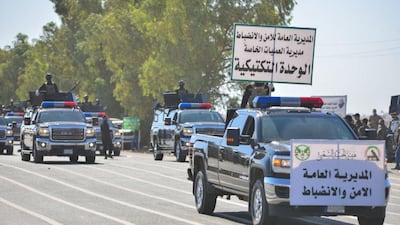
Members of Iraq's Popular Mobilisation Forces take part in a parade to mark the seventh anniversary of the organisation's founding at Camp Ashraf in Diyala province. AFP -
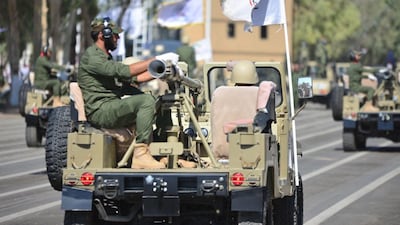
Members of Iraq's Popular Mobilisation Forces take part in a parade to mark the seventh anniversary of the organisation's founding at Camp Ashraf in Diyala province. AFP -
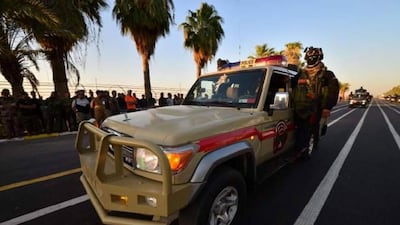
Members of Iraqi Popular Mobilisation Forces take part in a military parade in Diyala province to mark the seventh anniversary of the organisation. Reuters -
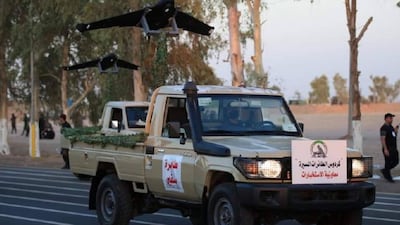
Members of Iraqi Popular Mobilisation Forces take part in a military parade in Diyala province to mark the seventh anniversary of the organisation. Reuters -
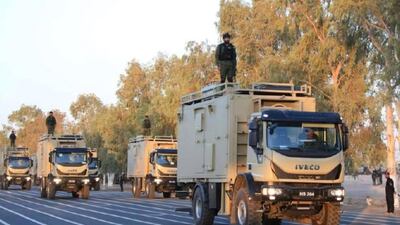
Members of Iraqi Popular Mobilisation Forces take part in a military parade in Diyala province to mark the seventh anniversary of the organisation. Reuters -
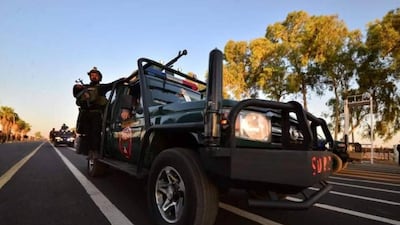
Members of Iraqi Popular Mobilisation Forces take part in a military parade in Diyala province to mark the seventh anniversary of the organisation. Reuters -

Members of Iraqi Popular Mobilisation Forces take part in a military parade in Diyala province to mark the seventh anniversary of the organisation. Reuters


For the four months between his Iraq appointment and Al Saadi’s capture, the entire theatre – Turkey, Syria and Iraq – sat under a single envoy with explicit instructions to confront Iranian proxy networks. Mr Patel’s public attribution to Mr Barrack acknowledges that the operational and diplomatic tracks were designed in tandem.
The significance of Al Saadi’s case is best understood against the trajectory of US action against Iran-backed Iraqi actors since 2020.
The January 2020 strike that killed Suleimani and Al Muhandis was the high-water mark of direct US kinetic action on Iraqi soil. For five years afterwards, Washington largely held that line. Strikes against Kataib Hezbollah and other militia facilities occurred periodically – including the February 2024 response to the Tower 22 drone attack in Jordan, which killed three American service members – but no senior militia commander was arrested or rendered out of Iraq.
Kataib Hezbollah’s incorporation into the PMF gave it an effective sovereign shield. Direct US action against the leadership risked an Iraqi government crisis that the US was not prepared to manage.
Two events broke this framework. Last June, the US and Israel conducted an air campaign against Iran’s nuclear infrastructure and senior military leadership. The Iran war that followed killed its then-supreme leader, Ayatollah Ali Khamenei, and decapitated the senior Islamic Revolutionary Guard Corps leadership. With the Iranian regime under emergency conditions, its conventional deterrent degraded and its leadership replaced under crisis pressure, the political shield that Iraqi militias depended on for five years collapsed.
The Iraqi government’s reduced capacity to absorb US pressure, combined with the Donald Trump administration’s appetite for direct kinetic and intelligence-led action against Iran-aligned targets, produced an operating environment that had not existed since the height of the surge.
The Al Saadi operation is the first publicly visible exercise of this new environment. It is not a one-off capture. It demonstrates a model: patient intelligence collection through a confidential informant, a sting operation designed to elicit overt acts within US extraterritorial criminal jurisdiction, operational seizure in one country and formal handover through another, integrated diplomatic cover through a single envoy with regional portfolio, and controlled public disclosure that protects the host government’s deniability.
The architecture is portable. Senior figures across the Iran-backed Iraqi militia network – Akram Al Kabi of Harakat Al Nujaba, Qais Al Khazali of Asaib Ahl Al Haq, the Kataib Hezbollah leadership remaining after Al Saadi and the broader network of US-designated terrorists within the PMF – are all, in principle, within reach.
Several risks shape whether this becomes a sustained campaign. Iran-backed Iraqi actors will probably accelerate attacks on US interests abroad, both as retaliation and as deterrence. The Kittleson abduction and the April 8 airport drone strike were the first iterations. The Iraqi government faces pressure from Iran-aligned parties who will argue that US operations on Iraqi territory, even when laundered through Turkey, violate sovereignty and necessitate American withdrawal.
The rendition framing also creates legal exposure in US courts; Al Saadi’s defender has already set the foundation for a habeas challenge. And the model depends on Turkish co-operation that cannot be assumed indefinitely if Ankara’s relationship with Tehran shifts.
Al Saadi’s capture is the first publicly visible counterterrorism rendition out of Iraq since the 2020 strike that killed his mentors. It marks a substantive change in what the US is willing and able to do inside Iraq against Iran-aligned actors. It was enabled by the war, the regime’s decapitation in Tehran and the diplomatic architecture installed in January.
Additional operations against senior Iran-backed Iraqi figures should be expected in the months ahead, contingent on the continued weakness of Iran’s regional posture and Baghdad’s continued willingness to allow operations on Iraqi soil to be routed publicly through third countries.

