
It all ended, and started, at Baghdad International Airport. The life of Qassem Suleimani, the man who had pulled the strings of Iran's proxy shadow war in the Middle East since the start of the Syrian conflict, was taken in a flash, his body initially too burnt to recognise.
But the US attack, confirmed by the Pentagon, now threatens to blow wide open the American-Iranian standoff in the Middle East.
Even though Washington designates the Islamic Revolutionary Guard Corps as a terrorist organisation, killing the leader of Iran's elite Quds Force is akin to Tehran murdering the head of the CIA or the Mossad on foreign soil. He is the head of a state arm.
The US justification is that he was responsible for the death of hundreds of American nationals, and was plotting further attacks. He was the long arm of Iran's clerical regime, vital to its strategy to boost its influence across the Middle East, specifically in four centres: Beirut, Sanaa, Damascus and Baghdad.
In times of crisis in any of these cities, it would quickly be reported that Suleimani had shuttled in, not only to advise those in power, but to ensure that Tehran's influence was preserved. This was seen no more clearly than in the recent Iraqi protests, in which he arrived in Baghdad to stop then Prime Minister Adel Abdul Mahdi from resigning. He is also believed to have orchestrated the crackdown on protesters that left hundreds dead. He has also played a key role in propping up the regime of Syrian President Bashar Al Assad, and aiding the Houthi rebels in Yemen, who have attacked Saudi Arabia and the global oil supply.
But his death is an escalation that has surely thrown out the diplomatic and economic tit-for-tat that Tehran has been engaged in since the US president withdrew from the nuclear deal in 2018.
-

A burning vehicle near Baghdad International Airport, Iraq. Security Media Cell / EPA -
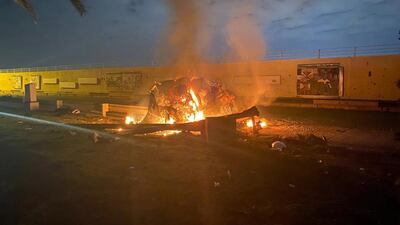
A burning vehicle near Baghdad International Airport, Iraq. Security Media Cell / EPA -
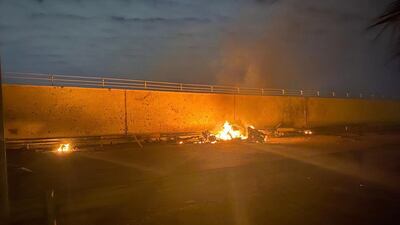
A burning vehicle near Baghdad International Airport, Iraq. Security Media Cell / EPA -

Qassem Suleimani, head of the Revolutionary Guard's foreign operations branch, the Quds Force, was killed in a US rocket strike at Baghdad International Airport. AFP -
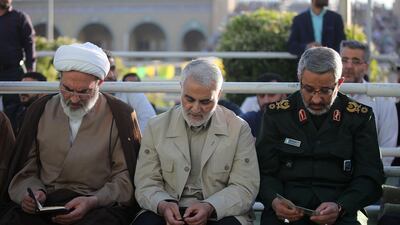
Suleimani, centre, began to rise in stature during the 1980-88 Iran-Iraq War. Getty Images -

Suleimani and Hadi Al Amiri, head of Iraqi Badr organisation, in Iraq during the fight against ISIS. -
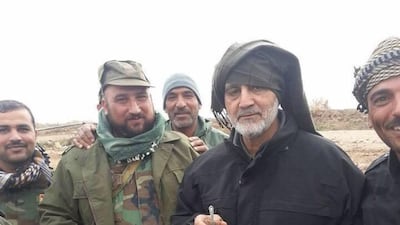
Suleimani, the commander of Iran's Quds Force, drinking tea in Tikrit in 2015. -

Suleimani and Iraqi Shiite cleric, politician, and militia leader Moqtada Al Sadr in Tehran. AFP -
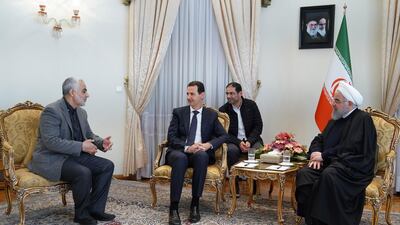
Suleimani during a meeting with Syria's President Bashar al-Assad, centre, and his Iranian counterpart Hassan Rouhani in Tehran in 2019. AFP -
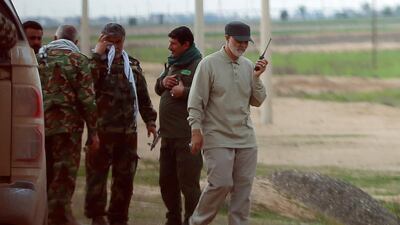
Suleimani uses a walkie-talkie at the frontline during offensive operations against Islamic State militants in the town of Tal Ksaiba in Salahuddin province in 2015. Reuters -
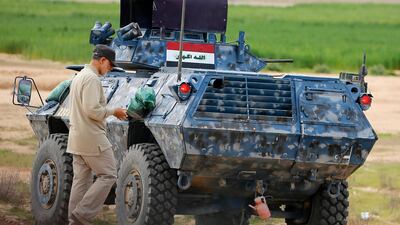
Suleimani walks near an armoured vehicle in Tal Ksaiba in Salahuddin province. Reuters -

Suleimani stands at the frontline in Tal Ksaiba. Reuters -

Suleimani attends an annual rally commemorating the anniversary of the 1979 Islamic revolution, in Tehran in 2016. AP Photo -

Suleimani was one of the Revolutionary Guard officers sent to Lebanon to organise the formation of Shiite militia groups during the Lebanese Civil War. Out of his efforts rose the now regionally dominant Hezbollah. AP -
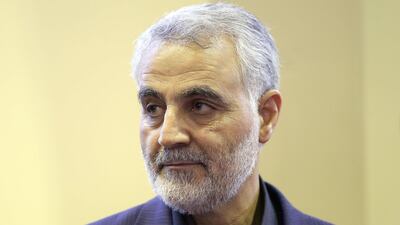
Suleimani became close to Hezbollah leader Hassan Nasrallah while assisting the rise of the group. AFP -

Together, the pair planned countless Hezbollah actions inside and outside of Lebanon. -

Suleimani was close to Iran's supreme leader Ayatollah Ali Khamenei, seated. -

Under Suleimani, the Quds Force helped Iraqi militias carry out a deadly attacks on American and coalition troops following the US-led invasion in 2003. AFP -
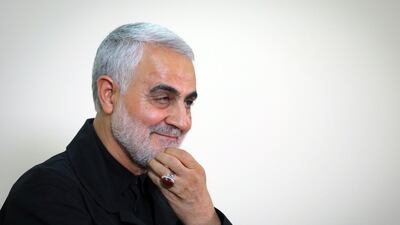
In Syria, Suleimani served as commander-in-chief of Iran’s operations in support of Bashar Al Assad’s regime. AFP -
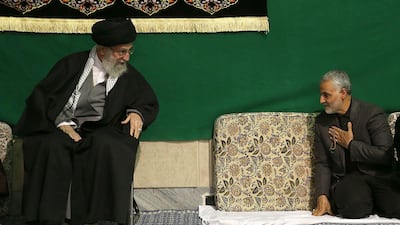
Iran's supreme leader Ayatollah Ali Khamenei with Suleimani in 2015. AFP


Leaders in Tehran will be discussing their response, but have already made clear that any form of negotiation with the US is impossible. They will be looking for revenge and what that may look like depends on how far they are willing to respond to the death of such a high-profile figure. The US has 5,000 troops stationed in Iraq that are now at serious risk of being attacked, particularly at the embassy compound in Baghdad and Al Asad airbase in the western province of Anbar.
If not resulting in an outbreak of war, the escalation could lead to a new phase of assassination and terrorism. The US killed Suleimani on foreign soil. Iran now has the justification to do the same. The strike not only endangers American expats in Iraq, but around the Middle East.
It could also bring harm to locals in the different corners of Iran's Shia crescent that have already been so blighted by conflict. That is Yemen, Syria, Lebanon and Iraq.
It also puts America's allies in the firing line. Israel will almost inevitably be drawn into the conflict. It is already waging a covert war with Iran on its borders with Lebanon and Syria that has now been brought into the open. Its role in Suleimani's assassination remains unknown but it has carried out targeted killings of nuclear scientists inside Iran and the Mossad spy agency has worked with the CIA before to take out prominent Iran-backed proxy figures, such as Hezbollah commander Imad Mugniyeh in a Damascus car bomb in 2008.
Saudi Arabia, subject to the drone attacks on the Aramco facilities last year, can expect an increased threat from Yemen, where Houthi rebels backed by Iran have launched rockets and drones at the kingdom's infrastructure and civilian populations. It remains unknown if the kingdom was consulted before the attack took place.
Some Baghdad residents celebrated the death of Suleimani and Abu Mahdi Al Muhandis, deputy commander of the Iran-backed militias known as the Popular Mobilisation Forces. They are angry about Iran's grip on the country, but they could be the very people who suffer the most from any US-Iranian conflict.
Questions will be asked in Tehran if there was any cooperation from the Iraqi security services in his assassination, something that, if did take place, could lead to a bloodbath in the country. Iran oversees tens of thousands of militia fighters that helped to defeat ISIS that could now be turned on the Iraqi security forces that stood down when those very militiamen laid siege to the US embassy just days ago. Such divisions would only serve to give space to a resurgence of the extremist group that occupied major cities for three years, or militants under a different name.
Suleimani was a young and daring revolutionary who fought to ensure the regime's stability in the Iraq-Iran War and worked his way up by winning the admiration of his peers. He was ultimately driven by nationalism and this patriotism is what saw him become the ruthless and feared spy chief that would lead to both the US and Israel seeking his demise.
To state the obvious, he should not be lionised. He was a constant danger to Western and Gulf interests. Yet his death may ultimately cause more harm than good. The strategic advantages, at least for now, appear to be severely outweighed by the disadvantages.
It is such acts that can lead states into war, conflicts that become bloody, trillion dollar quagmires with no end in sight. That is why this is such a huge gamble by the president. Trump may have other reasons for making such a decision, but US officials need only to look at Iraq and Afghanistan for the justification to pull back from a conflict with Iran, no matter how bad of a man that Suleimani was. Whether the president listens or not is another question.

