US President Donald Trump again demonstrated his skilful, albeit cynical, shrewdness by manoeuvring Vice President JD Vance into an impossible political trap. Suddenly heading the all-important but exceptionally difficult negotiations with Iran, the Vice President is effectively being told “heads I win, tails you lose” as Mr Trump flips a coin in the air.
If Mr Vance can somehow shepherd the inexperienced and underprepared negotiators – otherwise led by Mr Trump’s son-in-law Jared Kushner and his special envoy to the Middle East, Steve Witkoff – to a satisfactory agreement, Mr Trump will definitely take the credit. But if the talks fail, Mr Vance will shoulder the blame, at least in Mr Trump’s probable narrative.
It’s a deft manoeuvre by Mr Trump, who has shown that he has no qualms about assigning the blame to others while ducking himself when things don’t work out according to plan (his recent remarks suggest Defence Secretary Pete Hegseth is the other probable fall guy).
Mr Vance is in a unique position within the administration. Being independently elected to his position alongside Mr Trump, unlike all other administration officials including Mr Hegseth, he cannot be dismissed. The President is stuck with him no matter what, barring the highly unlikely event that Mr Vance is impeached by the House of Representatives and convicted and removed from office by the Senate.
Until recently, that relative independence was irrelevant. But after the war against Iran was launched on February 28, Mr Vance quietly but carefully and effectively made sure that everyone in Washington, and throughout the country among those who pay any attention to such matters, was well aware that he was the strongest voice within the administration opposing the decision to go to war alongside Israeli Prime Minister Benjamin Netanyahu.
That stance fits well with the political profile he has developed in recent years. Mr Vance – who was formerly extremely critical of Mr Trump – describing him as “America’s Hitler”, “cultural heroin” and “reprehensible” – was drawn into the President’s orbit through their common attachment to the US version of right-wing “blood and soil” nationalism.
The Vice President is among the leading proponents of casting the US as the creation and virtual possession of white, Christian families that settled and built the country before the great migration of the late 19th century. He is extremely critical of both liberal and conservative narratives that emphasise American values and ideals, instead focusing on shared history, culture and even religion as the heritage of “legacy Americans”, meaning those who can trace their family presence to before the last quarter of the 19th century.
That typically informs a “Jacksonian” foreign policy orientation, supposedly deriving its inspiration from Andrew Jackson, the president from 1829-1837. It usually means a neo-isolationist outlook that is highly suspicious of fixed alliances, policies based on ideals rather than material interests, and, above all, foreign adventures, the antithesis of neo-conservatism.
He was selected as Mr Trump’s running mate at the urging of his far-right allies, including journalist Tucker Carlson, billionaire Elon Musk, activists Steve Bannon and the late Charlie Kirk, and Mr Trump’s two sons Don Jr and Eric, all of whom opposed then-North Dakota governor – and now Secretary of the Interior – Doug Burgum who was reportedly the leading candidate until the last minute. But the late intervention of his ideological comrades, and their (probably correct) insistence that Mr Vance best represents the perspectives of younger Republicans, convinced Mr Trump to instead select the relatively young and inexperienced Ohio senator.
Now he’s stuck with him. There’s not much Mr Trump can do other than sideline and ignore Mr Vance, which had been going quite well.
-

The Middletown water tower sits next to the major I-75 highway. All photos by Joshua Longmore / The National -

AK Steel, recently bought out by Cleveland-based Cliffs, has a renowned history in Middletown dating back to the turn of the 19th century. -
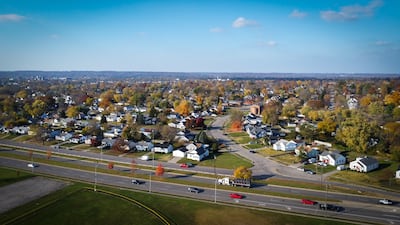
An aerial view of Middletown's suburban homes, just next door to the former AK Steel plant. -
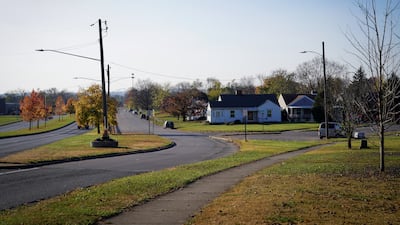
A street view of one of Middletown's suburban strips. -

Historic downtown Middletown, Ohio. -

As the steel industry in Middletown Ohio depleted, so too did many household incomes, livelihoods, and businesses. -
!['[Ohio] is moving in the direction of not being a swing state anymore,' Nancy Martorano Miller, an Ohio politics expert and Associate Professor of Political Science at The University of Dayton, told 'The National'.](https://www.thenationalnews.com/resizer/v2/QXSNMNDP7BEUVHDBAZPFNZKT3I.jpg?auth=7c71ff7f7a8b6e3dde6d7100be6f2514ae021ad38c1c02b572709e24f7116468&smart=true&width=400&height=225)
'[Ohio] is moving in the direction of not being a swing state anymore,' Nancy Martorano Miller, an Ohio politics expert and Associate Professor of Political Science at The University of Dayton, told 'The National'. -

Middletown is 'rich in history', says Marc Morgan, pointing to landmarks the historic Madison Inn where former president John F Kennedy's stayed, community members who marched with civil rights leader Dr Martin Luther King Jr, and enduring family businesses. -
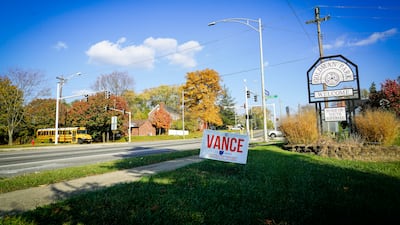
JD Vance rose to national fame for his book 'Hillbilly Elegy', which describes his upbringing in Middletown, Ohio and portrays a disillusioned white, working class. -
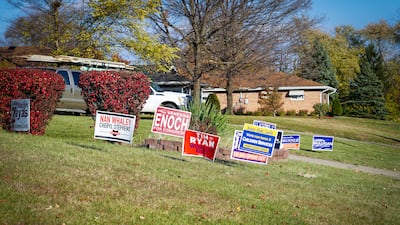
Middletown is a largely Republican area, with widespread support for one of its own, JD Vance, running for Senate. But yard signs indicate blips of enthusiasm for Democrat Tim Ryan. -

Despite pockets of run-down strips, Middletown is sprinkled with local family businesses, a beautiful library and historic homes and buildings.


!['[Ohio] is moving in the direction of not being a swing state anymore,' Nancy Martorano Miller, an Ohio politics expert and Associate Professor of Political Science at The University of Dayton, told 'The National'.](https://www.thenationalnews.com/resizer/v2/QXSNMNDP7BEUVHDBAZPFNZKT3I.jpg?auth=7c71ff7f7a8b6e3dde6d7100be6f2514ae021ad38c1c02b572709e24f7116468&smart=true&width=800&height=450)


But the Iran war proved to be far more complex and difficult – especially to satisfactorily resolve – than Mr Netanyahu promised and he expected. Mr Vance’s highly effective messaging, that he was the most vocal opponent of a conflict that was always unpopular and increasingly regarded as a huge mistake, became not merely irritating but also politically dangerous for the President.
There’s no chance of Mr Vance upstaging Mr Trump. But it became increasingly clear that the Vice President was poised to emerge as the big political winner among Republicans of a failed Iran war.
By seeming to agree to Iran’s demand that Mr Vance lead the American negotiators, Mr Trump hit upon an elegant solution. Now, if an agreement with Iran is perceived as a success, the President can allow the Vice President some credit in order to claim the lion’s share for himself. If they collapse, he can protect not only himself but also Mr Kushner and Mr Witkoff, by assigning full responsibility to Mr Vance for the failure.
This is all the more urgent because Mr Trump finds himself in an unenviable conundrum over the war. Tehran clearly believes time is on its side. Iran’s war policies suggest an arrogant confidence, and its domestic policies virtual certainty that the regime is under no imminent threat of being destabilised, let alone overthrown, by popular protests or armed rebellions by ethnic minority groups.
While Mr Trump is plainly looking for a way out, Israel is all-but-pushing to resume and intensify the bombardment to either extract more concessions from the Iranian regime or inflict enough damage to its military capabilities that, it could be argued, justify the conflict even without a meaningful agreement. As for Tehran, it is gambling that it can withstand any plausible additional onslaught.
Iran has reportedly offered five years of no enrichment followed by another five years of low-level enrichment for civilian use. Although recent reports suggest they want the nuclear file postponed entirely for this round of talks, Mr Trump obviously needs an agreement he can plausibly claim is significantly better than the 12-15-year hiatus secured by his nemesis, former president Barack Obama, in 2014-2015, which he condemned as “one of the worst deals ever made”. If he can’t, at least, get more time out of the Iranians in a similar agreement, he’s probably going to be deeply humiliated.
Mr Trump’s other great exposure is the crisis over the Strait of Hormuz. It invites domestic and international criticism that he mainly just succeeded in demonstrating to Iran how easy it is for them to effectively shut down international shipping with bloodcurdling threats but little effort.
It’s obvious that Mr Trump feels desperately vulnerable over the outcome of the conflict. But by blockading Iran’s ports and saddling Mr Vance with the negotiations, the President has shown he can still draw on flashes of real cunning.