

Major wars rarely erupt because of a single incident or a sudden decision. More often, they are the result of accumulated strategic developments that reach a point where confrontation becomes more likely than maintaining the status quo.
The most important question, therefore, is not only why this war has erupted, but why it has erupted at this particular moment, and what the major powers seek to achieve through it.
The most common explanation links the war directly to Iran: its nuclear programme, its missile capabilities and its regional influence. Yet this explanation, while partially valid, remains insufficient to capture the full picture.

The war unfolding today appears closer to an attempt to reshape the balance of power in the Middle East. Iran may be the immediate target, but it is not the only objective.
The first dimension relates to Israel.
Since the establishment of the Islamic Republic, Israel has viewed Iran as the most significant strategic threat to its national security. Iran is not merely a hostile state; it is a country with a large industrial, military and demographic base, capable of developing advanced military programmes and building a network of regional influence that stretches across several countries.
From this perspective, it is not enough for Israel to temporarily degrade Iran’s military capabilities. The deeper objective is to eliminate Iran’s ability to re-emerge in the future as a threatening regional power. This explains why some strands of Israeli strategic thinking go beyond simply targeting Iran’s nuclear or missile programmes, extending instead to weakening the Iranian state itself or altering the nature of the system that governs it.
The second dimension concerns the reshaping of the regional balance of power.
Since the fall of Saddam Hussein’s regime in Iraq in 2003, a new regional order has emerged, characterised by a fragile balance among several key powers: Iran, Turkey, Israel and the Gulf states. This balance enabled Iran to expand its influence across several regional arenas, making it a central actor in the region’s strategic equations.
The current war may represent an attempt to redraw this balance so that Iran emerges weakened or exhausted, thereby opening the way for a new regional order in which Israel assumes a greater economic and military role, alongside an expanded role for other regional powers.
The third dimension relates to energy and strategic geography.
The Gulf region and the Strait of Hormuz represent among the world’s most critical arteries of global energy supply. Iran’s ability to threaten maritime navigation or target energy infrastructure has long been a strategic concern for countries around the world, primarily the US.
Weakening Iran militarily could effectively secure the flow of global energy under a security umbrella led by Washington, thereby strengthening its capacity to influence one of the most vital levers of the global economy.
The fourth dimension concerns great power competition.
In recent years, Iran has strengthened its relations with both Russia and China, in military as well as economic spheres. In some western strategic circles, this growing alignment has been viewed as part of a broader axis seeking to reduce western influence in the Middle East. From this perspective, weakening Iran would not only alter the regional balance of power but could also reduce the scope of Russian and Chinese influence in the region.
Finally, there is the dimension of military dominance.
Despite repeated discussions about reducing its military footprint in the Middle East, the region remains a strategic crossroads within the international system for the US. It sits at the intersection of global trade routes, energy flows and vital maritime corridors. Reasserting American military dominance in the region may, therefore, be one of the war’s unstated objectives – not only to manage Middle Eastern balances, but also to send a broader deterrent message within the international system.
In light of these factors, the current war can be understood as more than simply a confrontation with Iran and its proxies. It may represent a moment of profound transformation in the regional order of the Middle East.
If Iran emerges from this war weakened or exhausted, the map of influence across the region could change significantly, potentially giving rise to a new regional order markedly different from the one that has prevailed over the past two decades.
Yet such large-scale transformations rarely occur without cost. Weakening a regional power of Iran’s size could also create political and security vacuums whose effects may extend across a number of countries in the region.
-
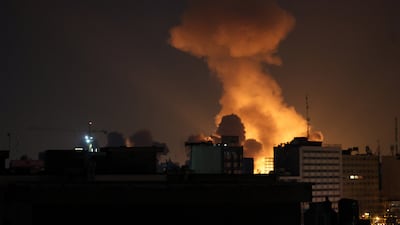
Smoke rises after an air strike in central Tehran. A joint Israeli and US military operation continues to target multiple locations across Iran. EPA -
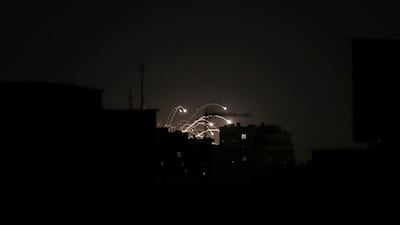
Projectiles fly through the sky. Reuters -
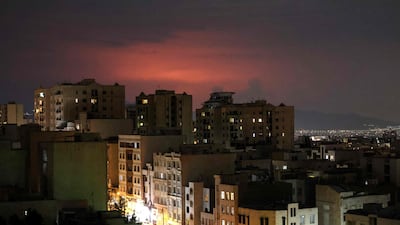
Smoke rises during air strikes in Tehran. AFP -
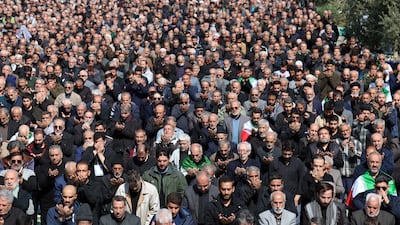
Iranians attend Friday prayers at Mosallah mosque in Tehran. EPA -
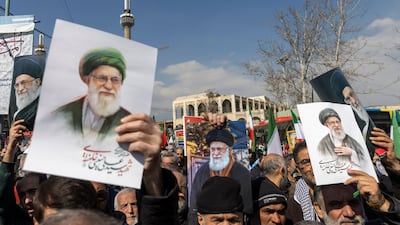
Iranians hold images of Ayatollah Ali Khamenei as they take part in a demonstration against the US and Israel in Tehran. Getty Images -
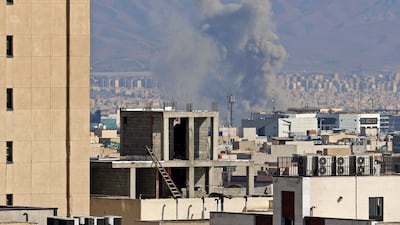
Smoke rises from the site of air strikes in Tehran. AFP -
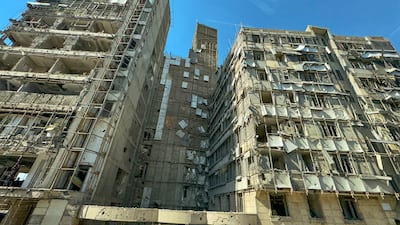
A view of the damaged Gandi Hospital in Tehran. AFP -
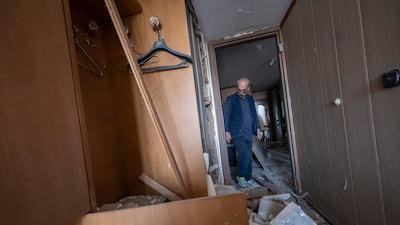
An Iranian man attends his damaged office in Tehran. AFP -
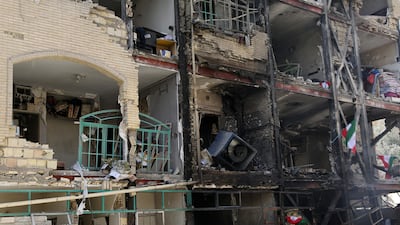
A residential complex in Tehran damaged by intense bombardment. AFP -
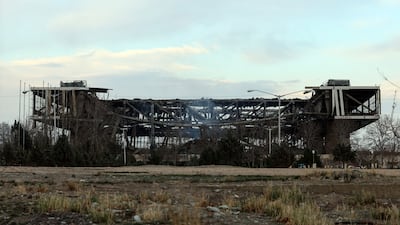
A damaged building at Tehran's Azadi Sport Complex. AFP


The ultimate outcome of the war will therefore depend not only on what happens on the battlefield, but also on how the post-war phase is managed.
For Iraq, these transformations represent both a challenge and an opportunity. Iraq lies at the heart of the regional system that may now be undergoing reshaping, and by virtue of its geography and its political and economic relations with Iran, the Gulf states and the US, it is likely to be among the countries most affected by the outcome of this war.
In such historical moments, it becomes essential for Iraqi foreign policy to adopt a pragmatic approach built on three fundamental principles.
The first is to insulate Iraq from regional conflicts and prevent its territory from becoming a battleground among competing powers as much as is feasibly possible. The second is to maintain balanced relations with major international and regional actors, enabling Baghdad to act as a bridge for dialogue rather than as an arena of confrontation. The third principle is to use regional transformations as leverage to strengthen Iraq’s role as a balancing state in the region – capable of playing a greater political and economic role within the emerging regional order.
Ultimately, this war may not simply be a conventional military confrontation, but rather a step in a longer process of reshaping the Middle East’s strategic landscape. The decisive question for the region will not only be who prevails in the war, but what the Middle East will look like after it ends and how particular countries of the region – foremost among them Iraq – will be able to adapt to the regional order that may emerge from the crucible of this war.

