

Recent weeks have given us an idea of the direction of travel that Syria, Lebanon and Iran are taking, as all three countries find themselves at a crossroads in their respective strategic journeys.
Syrian President Ahmad Al Shara’s upcoming visit to Washington will be a textbook example of the art of seizing momentum, involving unprecedented regional and international attention and assistance. In contrast, developments involving Iran are unfolding behind closed doors, with reports of Tehran engaging in covert talks with the administration of US President Donald Trump.
But let’s begin with Lebanon, which teeters on the edge of self-destruction as its leaders continue to bury their heads in the sand. Israel is poised to launch large-scale military operations against Hezbollah’s infrastructure across the country, should Beirut continue to drag its feet on the task of disarming the Iran-backed Lebanese proxy. Just days ago, the group reaffirmed its commitment to armed resistance and its right to bear arms, regardless of Lebanon’s official stance.
Iran supports Hezbollah’s obstructionist position, doing so publicly while quietly seeking sanctions relief from the US and European countries. In truth, however, it is Beirut that has allowed Hezbollah to dominate it, despite the fact that the group today is considerably weakened following its conflict with Israel last year.
Indeed, the Lebanese state granted Hezbollah veto power over sovereign decisions, tying its own ability to act and deliver on its promises to the group’s approval or rejection. Beirut stripped itself of its sovereignty the moment it yielded to the farce of “dialogue” over decisions it had already made. So it was no surprise when Hezbollah declared its continued commitment to resistance. Surprising is the state’s continued failure to grasp the consequences and its silence over Iran’s interference.
There is little doubt Israel is an aggressor against Lebanon. It probably prefers that Beirut remain paralysed, as this enables it to sidestep international pressure to withdraw from occupied Lebanese territories. Perplexing, however, is that Hezbollah and Iran are the very parties inviting Israeli strikes. Either Iran is indifferent to what happens to the Shiite communities in southern Lebanon – viewing Hezbollah merely as a bargaining chip in its negotiations with the US and Israel – or Tehran and Hezbollah are jointly pursuing a secret deal with Israel behind Beirut’s back.
Either way, the Lebanese government’s prevarications stand in stark contrast to the Trump administration’s clarity that there will be no deterrent to Israeli military action if the former continues to put off disarming Hezbollah.
Many Lebanese have taken issue with US envoy Tom Barrack’s recent remarks at the Manama Dialogue in Bahrain that amounted to insult after insult. He described Lebanon as a “failed state” with no institutions and deep structural problems, even implying that the real state is Hezbollah. While many Lebanese objected to Mr Barrack’s tone, some agreed with the substance of his assessment.
The envoy’s bluntness may have revealed the Trump administration’s frustration over inaction in Beirut. But his message to the Lebanese state was clear: act, or else. Enter direct talks with Israel, or else. Israel is ready to reach a border agreement with Lebanon, so seize the moment, or else. Ride the momentum, or else. His view as shared by many others is that Hezbollah is floundering, and that this is the opportune moment to put the group in its place.
Mr Barrack also spoke of two other key developments.
First, he said Turkey and Israel are moving towards mutual understanding and co-operation, and that war will not erupt between them.
Second, he suggested Syria was well on its way to securing understandings with Israel, perhaps even normalisation as envisioned in the Abraham Accords. He added that Damascus will formally join the US-led international coalition against ISIS during Mr Al Shara’s visit to Washington.
-
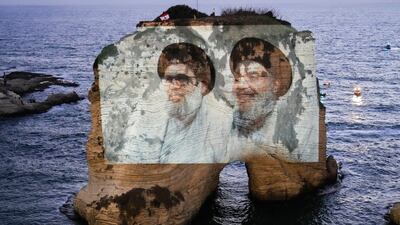
Portraits of former Hezbollah leaders Hassan Nasrallah, right, and Hashem Safieddine, are projected onto the landmark Raouche sea rock during an event commemorating their assassinations, in Beirut. AP -
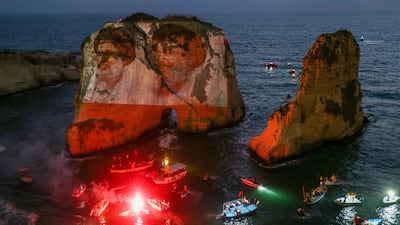
The move came despite an apparent attempt by Lebanon’s Prime Minister Nawaf Salam to halt the planned light show. EPA -
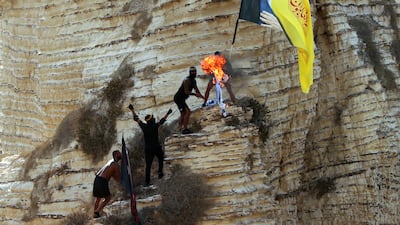
Hezbollah supporters burn an Israeli flag at the Raouche rock. EPA -
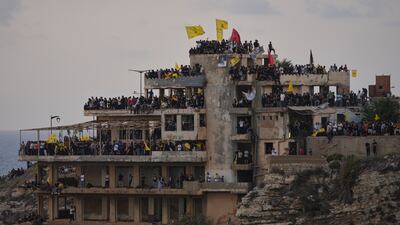
Thousands of Hezbollah supporters gathered at the site on Beirut’s coast to commemorate the killing of the group’s former longtime leader and his successor. AP -
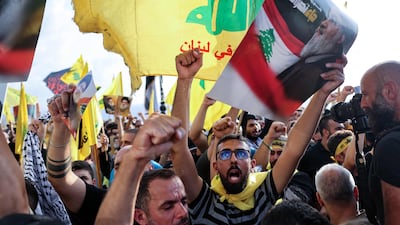
Hezbollah supporters raise the party's yellow flags and pictures of its slain leader Hassan Nasrallah, as they mark the first anniversary of his killing. AFP -
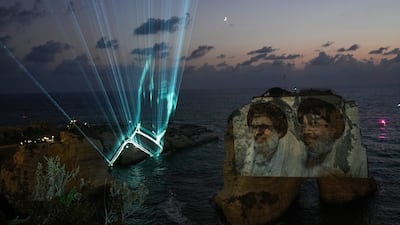
Portraits of the two former Hezbollah leaders are projected onto the landmark. AP -
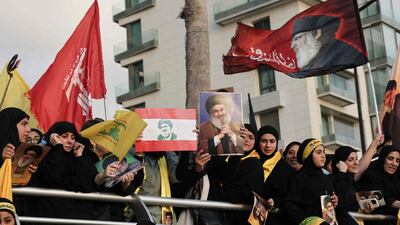
The event was a show of force by the militant group and political party, which suffered serious blows in last year’s war with Israel. AFP -
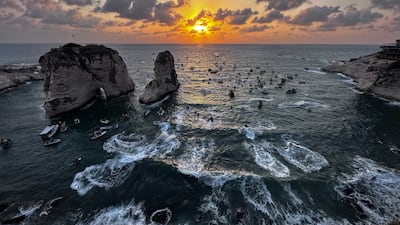
Supporters of Hezbollah sail near Raouche Rock. EPA


Momentum, regardless of outcomes, is thus a core principle of Mr Trump’s foreign policy. It is paramount along with the inducement of economic prosperity as a counterweight to conflict and destruction. The celebration of Mr Al Shara’s visit doesn’t come out of a vacuum but stems from international and regional consensus on assisting Syria in moving away from the legacy of former president Bashar Al Assad and his patrons in Iran, as well as from extremist ideology.
This position requires the new Syrian leadership to present its credentials to the US Congress, proving that Damascus is a partner in the fight against ISIS, serious about border normalisation with Israel, open to wider normalisation, and willing to respect minority rights. These are the foundations on which to persuade Congress to lift sanctions on Syria, particularly those under the Caesar Act, which the Trump administration cannot revoke on its own.
In Manama, Syrian Foreign Minister Asaad Al Shibani told me that Mr Al Shara’s US visit opens a new chapter in Damascus-Washington relations, stressing that ISIS is both a regional and global threat and that “we in Syria need help” to counter this danger. “We do not want Syria to be a battle front between East and West,” Mr Al Shibani said, adding that his government seeks to build “balanced relations ... not based on polarisation ... keeping equal relations with all”.
Meanwhile, Iran, too, is seeking a change in equation with the US. But, in contrast with Syria’s strategy, Tehran is engaging in backdoor diplomacy. That backdoor remains in Oman. I am given to understand that negotiations remain at the level of partial understandings, not a comprehensive deal. In other words, the focus of the talks is solely on Iran’s nuclear weapons programme and not on its regional behaviour, including its use of armed proxies across the Arab world.
Mr Trump continues to express his willingness to turn the page with Iran, even suggesting that it could eventually join the Abraham Accords. But what kind of Iran is he talking about? And when would this happen? These are the critical questions that will determine not only the future of the Islamic Republic but also the course of war and peace in the region.

