


The world held its breath to see if it would really happen, and it finally did. A ceasefire and hostage deal to stop the horrendous, two-year-long war in Gaza went into effect between Israel and Hamas. Even more intriguing was the framing of the agreement, which was presented as a US-sponsored “peace deal” brokered by President Donald Trump that goes beyond the immediate Gaza conflict and speaks of Palestinians’ long-term future – albeit in unspecific terms. (Notably, neither in his plan, nor at the “peace summit” in Egypt for the formal signing, does Mr Trump make any references to the occupied West Bank, which still faces the risk of Israeli annexation.)
The two-phased plan has plenty of merit, but there are already signs that it is being implemented poorly, in a way that will leave those of us who have longed to see Gaza free from the tyranny of Hamas wondering if that will ever happen.
Beyond the first phase, in which living and deceased Israeli hostages would be exchanged for Palestinian prisoners and detainees from the war, the plan ostensibly offers what many have called for over the past two years: a true reshaping of the Gaza Strip. The second phase includes the disarmament of Hamas, the introduction of an international force to stabilise the territory, a transitional period with a transitional administration, a “de-radicalisation process” and a gradual reconstruction plan – all of this under the auspices of a “board of peace” chaired by Mr Trump.
Most critically, Mr Trump’s 20-point plan seems to have put an end to any notion of the forced displacement of the Palestinian people from Gaza – a major reversal from what the President had declared his intent was back in February. Indeed, Mr Trump’s plan seems to crush the hopes of far-right Israeli government ministers and ideologues, who have been salivating at the prospect of resettling Gaza after the military’s conquest, looking to Trump’s “Gaza Riviera” non-idea idea as a green light to pursue the settlement agenda.
Despite the plan’s many promising components, there is still cause for scepticism. It became abundantly clear immediately after all living Israeli hostages and Palestinian prisoners were released that nothing concrete was in place to quickly link phase one with phase two of the deal, and to ensure that Hamas would be held accountable for its end of this bargain. The militant group quickly began asserting its power throughout the areas of Gaza vacated by the Israeli military, deploying men with guns in markets, public areas, roads and various locations that maximised its visibility.
It is a strange departure from a key premise of the US peace plan: that this is meant to be the end of Hamas. Reports this week suggest Hamas mobilised up to 7,000 fighters, who have not only comprised a show of force but also waged a campaign of retribution against opponents, including rival groups and those Palestinians it believes betrayed its cause. This was perhaps most visible in the deadly clashes Hamas had with the Doghmush clan, a Gazan armed group which has been accused of collaborating with Israel, and a few others almost immediately after the ceasefire went into effect. Videos, thought to have been taken this week inside Gaza City, have circulated showing Hamas militants carrying out gruesome executions.
Worse, Mr Trump appeared to be unbothered by Hamas’s actions, describing the gangs involved in the clashes as “very bad” and suggesting on at least two occasions that Hamas was given permission to re-establish order.
Given that Hamas surrendered its chief bargaining chip and only remaining leverage, one cannot help but wonder what it was offered in return. After all, Hamas’s public statements since the ceasefire suggest it has no intention of disarming, nor will it accept an international stabilisation force. It does not agree to the formation of a board of peace and continues to see itself as part of Gaza’s future, even if it doesn’t govern directly.
Was Hamas promised a role in a future policing and security apparatus if it ceased being a threat to Israel? One must ask this question because it would have been extraordinarily difficult to align the desires of President Trump with the interests of an intransigent Hamas. And it is very difficult to see how temporarily empowering Hamas to reassert itself in Gaza and exact brutal violence upon its enemies is a viable bridge to the group disarming and surrendering.
-

Red Cross vehicles carry hostages from Gaza city under the ceasefire agreement between Israel and Hamas. Reuters -

US President Donald Trump arrives at Ben Gurion Airport near Tel Aviv, before delivering a speech to Israel's Knesset. AFP -
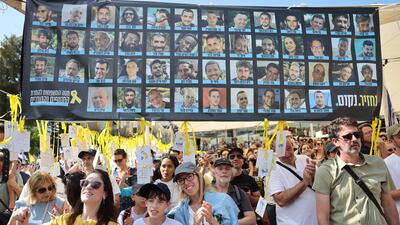
Israelis gather in Tel Aviv to celebrate the release of hostages from Gaza. EPA -

Palestinians board a bus after being released from the Ofer military prison between Ramallah and Beitunia, in the occupied West Bank. AFP -

US President Donald Trump signs the guest book at the Knesset, with Israeli Prime Minister Bejamin Netanyahu, second left, and Knesset Speaker Amir Ohana, second right -
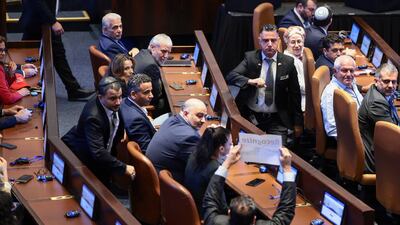
Knesset member Aymen Odeh holds up a sign bearing the message 'Recognise Palestine' during Mr Trump's speech to Israeli politicians. Reuters -
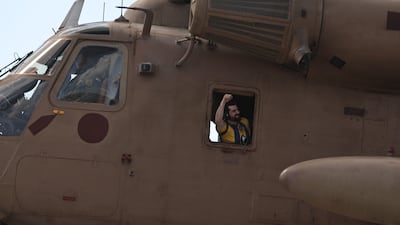
Released Israeli hostage Ziv Berman waves from a military helicopter as he arrives at Sheba Hospital, near Tel Aviv. EPA -

Released Israeli hostage Matan Zangauker, left, is greeted by his mother. AFP -

Palestinians released from Israeli jails. More than 150 have crossed the border into Egypt to live in exile. AFP -
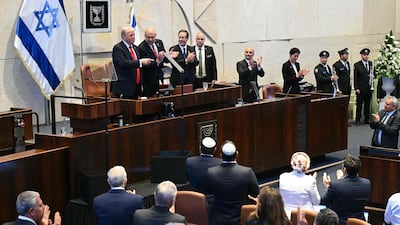
Mr Trump receives a standing ovation from Israeli politicians in the Knesset. AFP -
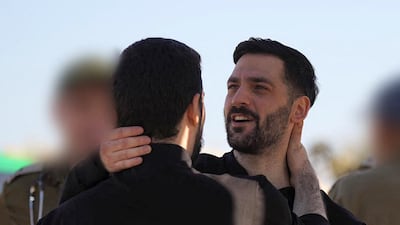
Gaza hostage Gali Berman is released as part of an exchange deal between Israel and Hamas. AFP -
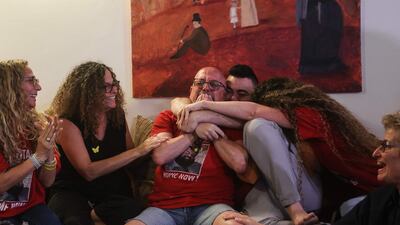
Family and friends of an Israeli hostage celebrate news that Hamas has released captives from Gaza. AFP -

Palestinians welcome relatives released from Israeli jails. Thomas Helm / The National -
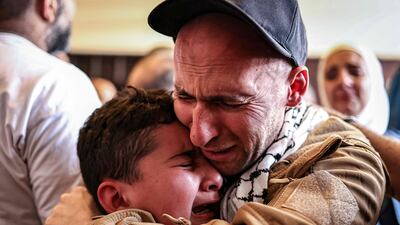
A freed Palestinian detainee arrives at Ramallah Culture Centre, in the occupied West Bank, after leaving Ofer military prison. AFP -
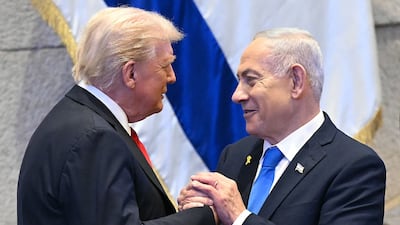
Mr Trump and Mr Netanyahu at the Knesset, where the US President was praised for his support of Israel. AFP -
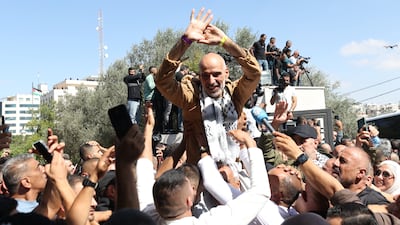
A freed Palestinian is greeted by a cheering crowd in Ramallah, in the occupied West Bank, as Israel releases hundreds of detainees from jail. EPA -
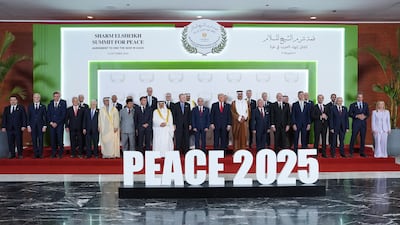
Mr Trump and other world leaders pose for a photo during a summit in Sharm El Sheikh, Egypt. Getty Images -
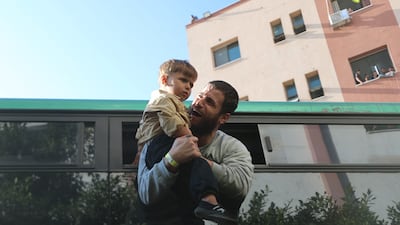
A Palestinian released from Israeli prison is reunited with family after arriving on a bus outside Nasser Hospital in Khan Younis, Gaza. AFP -
Freed hostage Avinatan Or gestures to the crowd outside Beilinson Hospital in Petah Tikva, Israel. Getty Images -
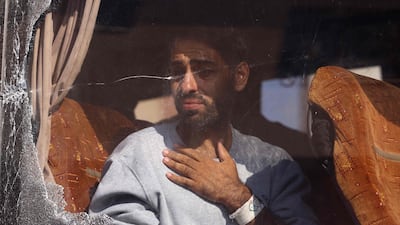
A released Palestinian arrives on a bus in Khan Younis. AFP -
Released Israeli hostage, Eitan Abraham Mor, embraces his loved ones in Petah Tikva. Reuters


What most Gazans are thinking about right now is the need for safety, sustained access to basic sustenance and a means to earn a living. Establishing the conditions to enable Gazans to meet these three needs requires rapid and urgent steps to minimise the gap between the first and second phases of the agreement. It is critical to prevent the risk of stagnation and to ensure that the war is not merely frozen, but rather permanently resolved. Stopping criminal enterprises and gangsters who terrorised Gazans, looted aid during the war and more is indeed important. But that cannot be achieved with Hamas’s terror campaign and field executions, which are anyway more about settling scores than law and order.
Hamas can never be trusted to be an enduring partner for anything in Gaza. They have lost their right to govern or even to exist as an organisation. It would be naive to think they could be tamed and repurposed as Gaza’s police force. They should only be engaged through the prism of a temporary transitional period. And one way or another, the international community must ensure that Hamas’s militant infrastructure is defanged, and its tunnel network is destroyed. The future of Gaza depends on this.
The longer the time passes, and Hamas continues to assert its control throughout Gaza, the greater the risk of a complete collapse of the ceasefire and a return to war because of an ill-conceived strategy that appears to be paralysed by the fast-moving nature of events. The people of Gaza continue to pay the price for a war they did not start and were powerless to stop. They cannot continue to be held hostage by the same extremist group that has imposed endless wars on them.

