


The Middle East has been in turmoil since October 2023. Missiles have flown in just about every direction, and there is significant concern about what the future might hold. One of the surprises, however, is that Iraq has managed to stay out of the conflict.
For years, many analysts have argued that Iraq has fallen completely under Iran’s shadow partially through control that proxy groups exercise in the country. And yet, these groups have been almost entirely inactive since October 2023, leading to questions as to where exactly the balance of powers lies in Iraq.
The Popular Mobilisation Forces were established following ISIS’s 2014 invasion and occupation of Iraq’s north-west. After the terror group’s defeat, the PMF and affiliated groups sought and obtained direct representation in Parliament and in government. Like all other parties, they used those positions to extract rents and to exercise influence over policy and financial matters. The difference, however, is that the PMF used its status as a paramilitary organisation to impose outcomes in ways that many other groups could not.
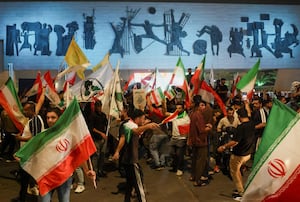
Many factions within the PMF were also plainly anti-western in their rhetoric. On occasion, their leaders could be seen directing marches of (relatively small numbers of) followers and openly declaring that their ultimate source of authority was the supreme leader of Iran, Ayatollah Ali Khamenei.
However, since 2003, Iraq has lost its monolithic status and has become a more complicated society. The PMF may have been pushing a specific political line, but much of the state and society have had little to no interest in being involved in regional struggles of any kind.
Formally, the Iraqi government’s position has been to seek to de-escalate tensions in the region and internally. Politically, however, the government is made up of myriad forces, including groups affiliated to the PMF, each of which has its own set of interests and the means to act upon it.
The quietist groups have long been at a disadvantage, however, given that they favour a moderate and dialogue-based approach that shies away from confrontation no matter the circumstances, which more aggressive groups have consistently used to push the limits on a range of issues.
The contrast can most obviously be seen after arriving at Baghdad International Airport, the road to which has been co-opted by the PMF’s efforts to construct a narrative of struggle and resistance. But visitors to Baghdad who drive along that road can look immediately to the left and see the enormous campus of the newly established American University of Baghdad and the thousands of students who now visit every day. English business schools and language academies can be found almost everywhere in the capital, including on streets that sometimes bear the names and faces of Iranian officers and their Iraqi allies who were killed in action by the American military.
Recent developments will probably have an impact on that delicate balance.
Iraqis and outside observers will all have noticed that the PMF did not get involved at all during the recent fighting between Iran and Israel. Analysts have offered different explanations for what was happening in the background. Some have said that Iran was opposed to any involvement by the PMF for fear that this could lead to greater escalation. Others have argued that Iran’s main priority in Iraq is not to seek military support from the PMF but rather to keep the flow of dollars from Baghdad open.
According to that narrative, any direct military involvement by the PMF could threaten that financial lifeline. Others still have noted that the Iraqi government – mainly Prime Minister Mohammed Shia Al Sudani and the security forces – worked tirelessly behind the scenes to keep the country out of the conflict, which has been bearing fruit.
Now that the conflict is over, however, a number of consequences will probably flow.
Regardless of which narrative is the most accurate, the fact that the PMF did not take any action whatsoever will be interpreted by many as a sign of weakness and vulnerability. Political forces that have always been antagonistic to the PMF will seek at least partial realignment on a number of fronts, much of which the PMF will find hard to resist given that it will all be coming at the same time.
Within the Iraqi government itself, and within governing coalitions – including but not limited to the Co-ordination Framework (of which the PMF is a part) – the quietist camp will necessarily feel emboldened. It could be that Iraqi politics will be entering a non-confrontation stage, in which armed skirmishes of any kind will be eschewed in favour of business as usual (including the continued and uninterrupted extraction of rents).
Clearly, however, Iraq’s relationship with Iran will not break entirely. All that is likely to happen is that Iraqi groups will feel less compelled to consult or to defer to Tehran in as many matters as before. Iraqi political groups’ relentless rent-seeking for the past 20 years has always meant that they are economically independent, and many now will feel less politically tethered to Iran as well.
If that does happen, it is altogether unclear whether this will translate into any concrete improvements for ordinary Iraqis. It will probably only mean that political power will gradually slip away from the confrontation camp – not with a bang, but with a whimper – with nothing much to replace it other than Iraq’s decrepit political system.
Iraqi politics is too fractious to coalesce around a concrete strategy, particularly in relation to foreign policy, given the country’s limited regional influence. Thus, it is not that a new strategy is being developed. It is that the previous status quo will probably fray without collapsing altogether.

