Israeli Prime Minister Benjamin Netanyahu, Iranian supreme leader Ayatollah Ali Khamenei and US President Donald Trump will be taking stock of their countries' recent actions. AFP


Israel, Iran and the US are all stuck in traps of their own making


  • English
  • Arabic

June 25, 2025

It was one of the most public, personalised and extraordinary schisms between the US and Israel, and certainly the first conducted on television and in real time.

US President Donald Trump found himself decisively in over his head, swearing at Israeli Prime Minister Benjamin Netanyahu, and – largely for politically necessary balance – at Iran’s leadership, to maintain his ceasefire. On TV, then social media, and finally an angry telephone call. In a flurry of 20 minutes, Israel was compelled to call off a major air strike.

As Israel sent aircraft streaking towards Iran in response to a lone missile that, as he noted, may well have been erroneously launched, Mr Trump instantly recognised that he was about to be played.

He wasn’t going to put up with it. The old dictum about “no daylight” between American and Israeli positions just can’t function with a US President as patrimonial as Mr Trump and an Israeli Prime Minister as prevaricating as Mr Netanyahu. Mr Netanyahu was compelled to hit a minor radar installation site instead.

That’s how a 48-hour whirlwind of real and phony attacks, theatrical and genuine threats, and an atmosphere of overall mayhem, saw Mr Trump flailing and frustrated.

The US President found himself trapped between his characteristically self-serving rhetoric and realities, and between his goals and Mr Netanyahu’s ongoing effort to lure the Americans into a protracted conflict with Iran that Mr Trump is still seeking to avoid.

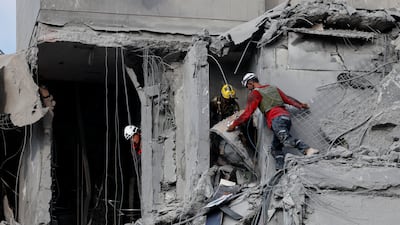
  • Rescue and recovery crews at work at a residential site in Be'er Sheva following a missile attack from Iran on June 24. Reuters
    Rescue and recovery crews at work at a residential site in Be'er Sheva following a missile attack from Iran on June 24. Reuters
  • Contrails from Israeli air defence system are visible as interceptor rockets are launched towards Iranian missiles during an Iranian attack on June 24. AP
    Contrails from Israeli air defence system are visible as interceptor rockets are launched towards Iranian missiles during an Iranian attack on June 24. AP
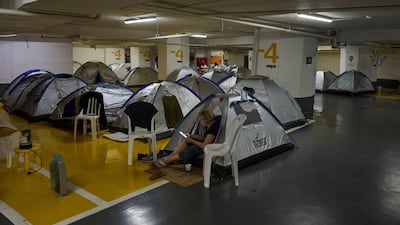
  • Residents spend the night in an underground garage as a precaution against Iranian missile attacks in Tel Aviv on June 23. AP
    Residents spend the night in an underground garage as a precaution against Iranian missile attacks in Tel Aviv on June 23. AP
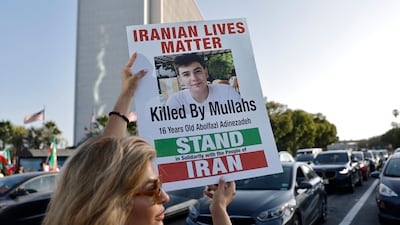
  • Supporters of regime change in Iran rally outside the Wilshire Federal Building in Los Angeles, California. The Los Angeles area holds the largest Iranian community in the world outside of Iran. AFP
    Supporters of regime change in Iran rally outside the Wilshire Federal Building in Los Angeles, California. The Los Angeles area holds the largest Iranian community in the world outside of Iran. AFP
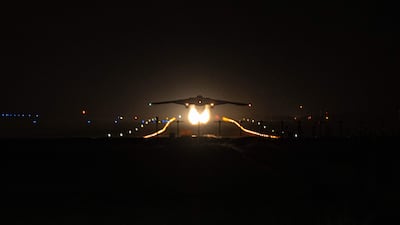
  • A US Air Force B-2 Spirit bomber takes off from Whiteman Air Force Base in Missouri to support Operation Midnight Hammer against Iran. AFP
    A US Air Force B-2 Spirit bomber takes off from Whiteman Air Force Base in Missouri to support Operation Midnight Hammer against Iran. AFP
  • Projectiles in the sky over Doha, Qatar, on June 23 as the US military base at Al Udeid is attacked by Iran. AFP
    Projectiles in the sky over Doha, Qatar, on June 23 as the US military base at Al Udeid is attacked by Iran. AFP
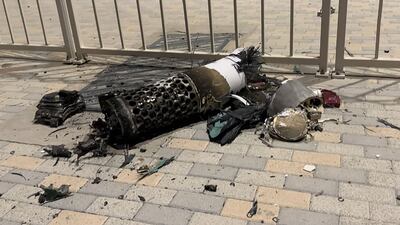
  • The remnants of an Iranian missile intercepted over Qatar. AFP
    The remnants of an Iranian missile intercepted over Qatar. AFP

As the dust settles, it’s unclear what was really accomplished by Israel’s “war of the cities” with Iran launched on June 13, with the important but hardly decisive American footnote last Saturday. Israel did manage to at least postpone what appeared to be promising US-Iranian talks, with an American proposal of Tehran joining a regional “consortium” for nuclear energy production with key Arab countries as a potential workaround for the vexed problem of Iran’s “right to enrich”.

The idea alarmed Israel sufficiently to unleash its barrage, and that, in turn, was successful enough to prompt Mr Trump to join the fray with a single action that was never intended to be the opening salvo of a protracted US bombing campaign against Iranian nuclear sites.

All three parties now find themselves in traps of their own making.

It’s unclear how much damage was done to Iran’s nuclear programme. But Tehran has taken some potent blows, including the devastation of its paramilitary leadership and a generation of top nuclear scientists. Tehran paid a heavy price for playing games with highly enriched uranium, as noted in a damning report from the International Atomic Energy Agency, and more broadly for reckless rhetoric about “destroying” Israel and absurd slogans like “death to America”.

However, Israel has certainly not ensured that Iran will never become a nuclear power. On the contrary, it may have ensured that while Iran proceeds with greater caution, the war has only amplified the already evident lesson that adversarial countries that don’t have a nuclear deterrent, like Iraq and Libya, are likely to face external attack while those that do, like North Korea, aren’t.

Iran has sought a nuclear deterrent since the Shah and that determination will undoubtedly have sharply increased, even among those implacably opposed to the current establishment. The Israelis may have thrown their best punch, leaving Iran bloodied and battered but more determined than ever to eventually become the second nuclear weapons power in the Middle East – Israel itself having long since introduced those weapons to the region.

How Israel deals with this new reality, unless it finds a way to resume warfare despite Mr Trump’s angry objections, remains to be seen. A satisfactory solution appears farther off than ever.

Even Mr Trump, albeit clearly less than his Iranian and Israeli counterparts, has put himself in an unenviable corner without an obvious escape route. His administration is already tying itself into rhetorical contortions over his insistence that the three Iranian nuclear sites he struck were “completely and totally obliterated”, at least in terms of enrichment. Even at the time, it was obvious that he couldn’t have been relying on any serious preliminary evaluation, and was simply engaging in his trademark “truthful hyperbole”, as he described his form of self-serving remarks in his ghost-written memoir, The Art of the Deal.

Leaked reports from the Defence Intelligence Agency – based on actual preliminary assessments, including new surveillance footage, signals intelligence and very possibly human intelligence from inside Iran – suggest that, on the contrary, while the bunker-buster bomb attacks may have badly damaged entranceways to the Fordow mountainside network, they did not render the interior facilities non-functional or even hard-hit. They concluded that Iran’s enrichment work there, and at other sites in question, will be disrupted for months, but hardly “obliterated”.

This is consistent with what one would expect from a strike that would have been only the opening salvo in existing US plans to actually obliterate that facility. These called for round-the-clock bunker-buster strikes over many days, if not weeks, before the tunnel network was collapsed on itself or rendered otherwise fully non-functional. That obviously wasn’t going to happen from a handful of impacts, even with such powerful weapons.

Israel, too, cannot fully know how much harm it has caused to Iran’s nuclear research and development programme. Even Iranian officials are most probably still assessing the true extent.

Israel was surely seeking to deliver a knockout blow to the programme, or rather to get Washington to do that for it. Neither seems to have occurred.

So, less than two weeks after Israel launched its supposedly decisive war, we are effectively back to square one, albeit with Iran having absorbed significant and painful losses that will take energy, resources and time that the impoverished country can ill afford. Whether Mr Trump can get Iran back to the negotiating table with renewed seriousness remains to be seen, although it would clearly be in Tehran’s interests to strike a deal with Washington even now.

However, we may eventually look back at this conflict as the moment in which Israel ensured that it would have to live alongside a nuclear-armed Iran rather than having permanently eliminated the prospects for that.

Bitter irony is often the greatest victor in warfare. She may yet again have prevailed.

UPI facts

More than 2.2 million Indian tourists arrived in UAE in 2023
More than 3.5 million Indians reside in UAE
Indian tourists can make purchases in UAE using rupee accounts in India through QR-code-based UPI real-time payment systems
Indian residents in UAE can use their non-resident NRO and NRE accounts held in Indian banks linked to a UAE mobile number for UPI transactions

KLOPP%20AT%20LIVERPOOL
%3Cp%3EYears%3A%20October%202015%20-%20June%202024%3Cbr%3ETotal%20games%3A%20491%3Cbr%3EWin%20percentage%3A%2060.9%25%3Cbr%3EMajor%20trophies%3A%206%20(Premier%20League%20x%201%2C%20Champions%20League%20x%201%2C%20FA%20Cup%20x%201%2C%20League%20Cup%20x%202%2C%20Fifa%20Club%20World%20Cup%20x1)%3C%2Fp%3E%0A

Mercer, the investment consulting arm of US services company Marsh & McLennan, expects its wealth division to at least double its assets under management (AUM) in the Middle East as wealth in the region continues to grow despite economic headwinds, a company official said.

Mercer Wealth, which globally has $160 billion in AUM, plans to boost its AUM in the region to $2-$3bn in the next 2-3 years from the present $1bn, said Yasir AbuShaban, a Dubai-based principal with Mercer Wealth.

Within the next two to three years, we are looking at reaching $2 to $3 billion as a conservative estimate and we do see an opportunity to do so,” said Mr AbuShaban.

Mercer does not directly make investments, but allocates clients’ money they have discretion to, to professional asset managers. They also provide advice to clients.

“We have buying power. We can negotiate on their (client’s) behalf with asset managers to provide them lower fees than they otherwise would have to get on their own,” he added.

Mercer Wealth’s clients include sovereign wealth funds, family offices, and insurance companies among others.

From its office in Dubai, Mercer also looks after Africa, India and Turkey, where they also see opportunity for growth.

Wealth creation in Middle East and Africa (MEA) grew 8.5 per cent to $8.1 trillion last year from $7.5tn in 2015, higher than last year’s global average of 6 per cent and the second-highest growth in a region after Asia-Pacific which grew 9.9 per cent, according to consultancy Boston Consulting Group (BCG). In the region, where wealth grew just 1.9 per cent in 2015 compared with 2014, a pickup in oil prices has helped in wealth generation.

BCG is forecasting MEA wealth will rise to $12tn by 2021, growing at an annual average of 8 per cent.

Drivers of wealth generation in the region will be split evenly between new wealth creation and growth of performance of existing assets, according to BCG.

Another general trend in the region is clients’ looking for a comprehensive approach to investing, according to Mr AbuShaban.

“Institutional investors or some of the families are seeing a slowdown in the available capital they have to invest and in that sense they are looking at optimizing the way they manage their portfolios and making sure they are not investing haphazardly and different parts of their investment are working together,” said Mr AbuShaban.

Some clients also have a higher appetite for risk, given the low interest-rate environment that does not provide enough yield for some institutional investors. These clients are keen to invest in illiquid assets, such as private equity and infrastructure.

“What we have seen is a desire for higher returns in what has been a low-return environment specifically in various fixed income or bonds,” he said.

“In this environment, we have seen a de facto increase in the risk that clients are taking in things like illiquid investments, private equity investments, infrastructure and private debt, those kind of investments were higher illiquidity results in incrementally higher returns.”

The Abu Dhabi Investment Authority, one of the largest sovereign wealth funds, said in its 2016 report that has gradually increased its exposure in direct private equity and private credit transactions, mainly in Asian markets and especially in China and India. The authority’s private equity department focused on structured equities owing to “their defensive characteristics.”

'Will%20of%20the%20People'
%3Cp%3E%3Cstrong%3EArtist%3A%20%3C%2Fstrong%3EMuse%3Cbr%3E%3Cstrong%3ELabel%3A%20%3C%2Fstrong%3EWarner%3Cbr%3E%3Cstrong%3ERating%3A%3C%2Fstrong%3E%202.5%2F5%3C%2Fp%3E%0A
'The Sky is Everywhere'

Director:Josephine Decker

Stars:Grace Kaufman, Pico Alexander, Jacques Colimon

Rating:2/5

MATCH INFO

Norwich 0

Watford 2 (Deulofeu 2', Gray 52')

Red card: Christian Kabasele (WatforD)

Our family matters legal consultant

Name: Hassan Mohsen Elhais

Position: legal consultant with Al Rowaad Advocates and Legal Consultants.

Who's who in Yemen conflict

Houthis: Iran-backed rebels who occupy Sanaa and run unrecognised government

Yemeni government: Exiled government in Aden led by eight-member Presidential Leadership Council

Southern Transitional Council: Faction in Yemeni government that seeks autonomy for the south

Habrish 'rebels': Tribal-backed forces feuding with STC over control of oil in government territory

The specs
 
Engine: 3.0-litre six-cylinder turbo
Power: 398hp from 5,250rpm
Torque: 580Nm at 1,900-4,800rpm
Transmission: Eight-speed auto
Fuel economy, combined: 6.5L/100km
On sale: December
Price: From Dh330,000 (estimate)
Infobox

Western Region Asia Cup Qualifier, Al Amerat, Oman

The two finalists advance to the next stage of qualifying, in Malaysia in August

Results

UAE beat Iran by 10 wickets

Kuwait beat Saudi Arabia by eight wickets

Oman beat Bahrain by nine wickets

Qatar beat Maldives by 106 runs

Monday fixtures

UAE v Kuwait, Iran v Saudi Arabia, Oman v Qatar, Maldives v Bahrain

J%20Street%20Polling%20Results
%3Cp%3E97%25%20of%20Jewish-Americans%20are%20concerned%20about%20the%20rise%20in%20anti-Semitism%3Cbr%3E%3Cbr%3E76%25%20of%20US%20Jewish%20voters%20believe%20Donald%20Trump%20and%20his%20allies%20in%20the%20Republican%20Party%20are%20responsible%20for%20a%20rise%20in%20anti-Semitism%3Cbr%3E%3Cbr%3E74%25%20of%20American%20Jews%20agreed%20that%20%E2%80%9CTrump%20and%20the%20Maga%20movement%20are%20a%20threat%20to%20Jews%20in%20America%22%3Cbr%3E%3C%2Fp%3E%0A
if you go

The flights

Air Astana flies direct from Dubai to Almaty from Dh2,440 per person return, and to Astana (via Almaty) from Dh2,930 return, both including taxes. 

The hotels

Rooms at the Ritz-Carlton Almaty cost from Dh1,944 per night including taxes; and in Astana the new Ritz-Carlton Astana (www.marriott) costs from Dh1,325; alternatively, the new St Regis Astana costs from Dh1,458 per night including taxes. 

When to visit

March-May and September-November

Visas

Citizens of many countries, including the UAE do not need a visa to enter Kazakhstan for up to 30 days. Contact the nearest Kazakhstan embassy or consulate.

Avatar: Fire and Ash

Director: James Cameron

Starring: Sam Worthington, Sigourney Weaver, Zoe Saldana

Rating: 4.5/5

The%20Beekeeper
%3Cp%3E%3Cstrong%3EDirector%3A%20%3C%2Fstrong%3EDavid%20Ayer%C2%A0%3C%2Fp%3E%0A%3Cp%3E%3Cstrong%3EStarring%3A%20%3C%2Fstrong%3EJason%20Statham%2C%20Josh%20Hutcherson%2C%20Emmy%20Raver-Lampman%2C%20Minnie%20Driver%2C%20Jeremy%20Irons%3C%2Fp%3E%0A%3Cp%3E%3Cstrong%3ERating%3A%20%3C%2Fstrong%3E3%2F5%3C%2Fp%3E%0A

'Manmarziyaan' (Colour Yellow Productions, Phantom Films)
Director: Anurag Kashyap​​​​​​​
Cast: Abhishek Bachchan, Taapsee Pannu, Vicky Kaushal​​​​​​​
Rating: 3.5/5

Dubai Women's Tour teams

Agolico BMC
Andy Schleck Cycles-Immo Losch
Aromitalia Basso Bikes Vaiano
Cogeas Mettler Look
Doltcini-Van Eyck Sport
Hitec Products – Birk Sport 
Kazakhstan National Team
Kuwait Cycling Team
Macogep Tornatech Girondins de Bordeaux
Minsk Cycling Club 
Pannonia Regional Team (Fehérvár)
Team Auvergne-Rhône-Alpes
Team Ciclotel
UAE Women’s Team
Under 23 Kazakhstan Team
Wheel Divas Cycling Team

The biog

Favourite food: Tabbouleh, greek salad and sushi

Favourite TV show: That 70s Show

Favourite animal: Ferrets, they are smart, sensitive, playful and loving

Favourite holiday destination: Seychelles, my resolution for 2020 is to visit as many spiritual retreats and animal shelters across the world as I can

Name of first pet: Eddy, a Persian cat that showed up at our home

Favourite dog breed: I love them all - if I had to pick Yorkshire terrier for small dogs and St Bernard's for big

Updated: June 28, 2025, 1:14 PM