


A century ago, TS Eliot mused about the world having ended, not with a bang, but with a whimper.
In his poem The Hollow Men, he described a generation unable to do anything with conviction, whether for good or ill, as societies, institutions and communities in Europe struggled with the new morality and the political upheaval following the devastation of the First World War.
“Between the idea
And the reality
Between the motion
And the act
Falls the Shadow”
The parallels between 1925 and 2025 are legion, but perhaps none has been as striking as the culture wars that have shaped the current public discourse. Trust in government, experts and institutions is at a low ebb. Amid such a divisive political landscape, it is little surprise that individuals with maverick personalities have grown in influence. Arguably, no one illustrates this point as strongly as Elon Musk.
His public image, cultivated through antics on X, meme culture and polarising rhetoric, has helped fuel a rise in his wealth and status as a business and technological prophet. Most pertinently, Mr Musk’s vision of the future has also lacked empathy. His dreams of Mars colonisation, AI-human interfaces and radical innovation are as ambitious as they are detached from societal needs or human connection.
There have also been actions that bring into question his ethics. For example, markets have been disrupted, if not manipulated, following his social media posts about Dogecoin and Tesla stock.
Yet, until now, Mr Musk had insulated himself from the ire that enveloped other tech leaders. He had avoided the political theatre in the US Congress that Meta’s Mark Zuckerberg, Google’s Sundar Pichai and Amazon’s Jeff Bezos were obligated to take part in. His purchase of X (when it was still called Twitter) and his subsequent alliance with the Republican Party seemed to keep regulators at bay while amplifying his influence.
His track record means very little now, however, after his spectacular falling out with US President Donald Trump. On Wednesday, the shockwaves from the detonation of the most famous political alliance of our time seemed to finally fade with the words: “I regret some of my posts about President Donald Trump last week. They went too far.”
Could Mr Musk’s post on X also be the waving of the white flag for his style of leadership?
With never-seen-before gusto, Mr Musk had supported Mr Trump’s presidential campaign and after the latter won the White House, he became a regular fixture in the Oval Office, even parading his four-year-old son in front of the cameras, such was the familiarity between the two men. It seemed a stunning triumph of his convictions.
Eventually Mr Musk seemed to tire as his personal behaviour and his brainchild, the Department of Government Efficiency, became magnets for sustained controversy. So, he stepped back from the front lines.
There had been a very clear cost, too, from such an unprecedented high-profile political affiliation. The Tesla share price is still down 14 per cent in 2025, but it had been even lower.
After he was no longer on the inside of the administration, it took only days for him to turn against the President, attacking the “One Big Beautiful Bill Act”, a key part of Mr Trump’s legislative agenda, and drawing return fire online and in the media from his one-time ally. Then, after Mr Musk made the explosive and since-retracted claim that Mr Trump appeared in the files related to the late financier and alleged sex trafficker Jeffrey Epstein, it became clear there could be no way back.
-

Tesla chief executive and X owner Elon Musk arrives at a Tesla event in Los Angeles in a robotaxi. All photos: Reuters -
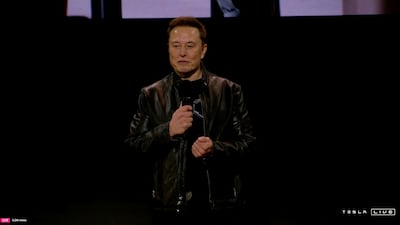
Mr Musk addresses the crowd -
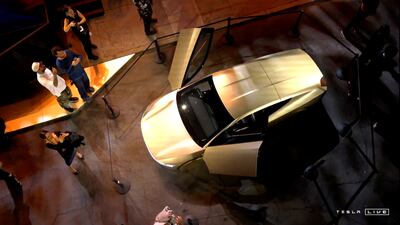
Tesla's robotaxi is displayed at the event -
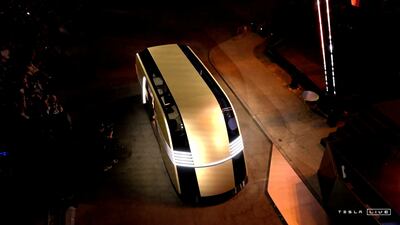
Tesla's robovan is also unveiled -
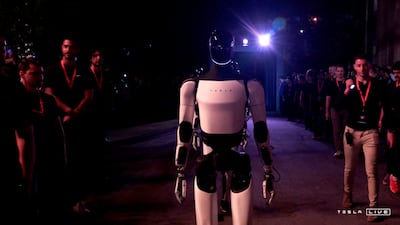
Tesla's Optimus robots also made an appearance -
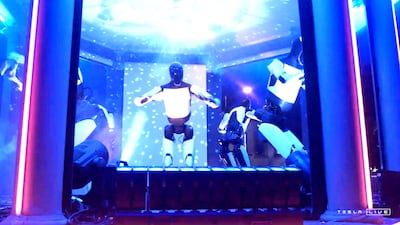
The robots dance to music


Not only is Mr Musk’s aura now diminished, but it could be the end of the techno-libertarian myth that has been at the root of so much divisiveness during the past decade.
Figures like Mr Musk and Peter Thiel – also a supporter of Mr Trump – championed the idea that private innovators could outpace and outthink the state. The equivalent of shadow nations grew out of Silicon Valley and undermined the ability of governments to govern, further eroding trust and bringing extreme ideas to the mainstream, enabled by an unregulated flood of technological advances.
The truth is, once any company achieves the scale of a country, it becomes nigh on untouchable. Mr Musk seemed to be trying to reach these heights while remaining bigger than his companies in the minds of the public.
The social media age helped him to try to do this, and his approach has been very much a blueprint for the broader rise of content creators and influencers. Yet, back in the 1920s, TS Eliot warned of the perils of such hollowness.
“Between the desire
And the spasm
Between the potency
And the existence
Between the essence
And the descent
Falls the Shadow”
Looking back 100 years from now, the Musk-Trump fallout will probably help mark the closing act of a cultural era defined by deficiencies in human connection and empathy for others.

