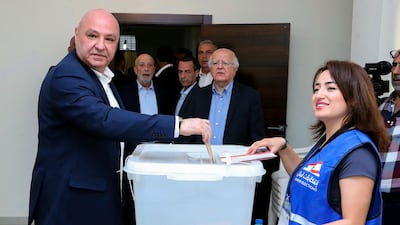
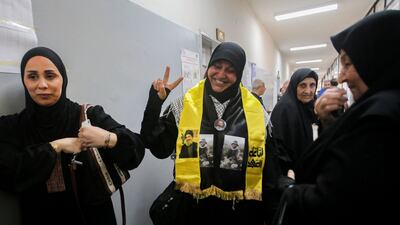
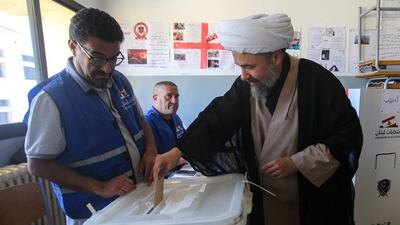
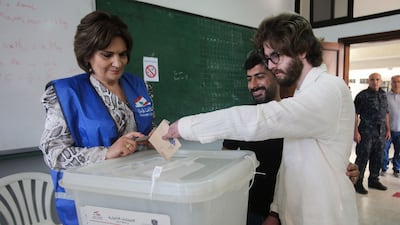
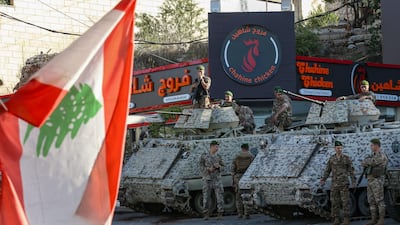
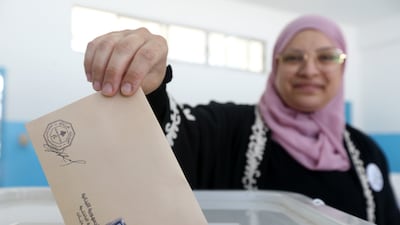
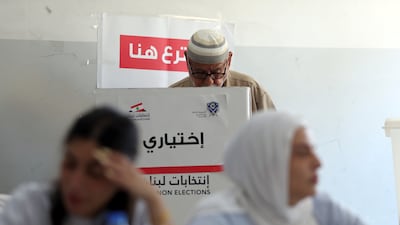
Lebanon recently finished the last round of its municipal elections, and the message was not reassuring. Lists backed by the country’s sectarian political parties were largely victorious. This anticipates a period of continued polarisation at a time when Lebanon needs to be unified around a project to benefit from the changing dynamics in the Middle East.
Writing in the US-based International Policy Digest, Mohammad Fheili, executive in residence at the American University of Beirut, expressed a more general mood in Lebanon about where the country was going. Commenting on US President Donald Trump’s recent tour of the Middle East, Mr Fheili noted that “Lebanon [was] conspicuously absent from the conversation. Lebanon wasn’t simply left off the agenda. It seems to have vanished from it altogether”.
The mood among leading parties inside Lebanon seems blithely detached from the broader shifts in the region. The main Christian political party, the Lebanese Forces, took pride in its victories in the towns of Jounieh and Zahleh, while doing well in other Christian bastions. For the party’s leader, Samir Geagea, this bodes well for parliamentary elections next year, when the Lebanese Forces hope to form an even larger bloc than the one they have today.
Of particular urgency for Mr Geagea is not only to marginalise the Free Patriotic Movement led by Gebran Bassil, but also to push back against any potential electoral challenge by candidates supported by President Joseph Aoun, whom Mr Geagea quietly regards as a rival.
Candidates backed by Hezbollah and the allied Amal Movement did well in the south and in the Baalbek-Hermel regions, but that was expected. Following the recent military defeat of Hezbollah by Israel, it was not likely that voters would oppose the party, displaying divisions that would only compound the Shiite community’s setbacks because of the war.
Similarly, in other areas, candidates backed by the political class did well. This was less visible in the Sunni community, given that Saad Hariri, once the dominant communal representative, failed to engage with the elections. However, renewed Saudi interest in Lebanon, albeit limited, and the downfall of the Assad government in Syria have helped revive a community that had often felt sidelined during the years of Hezbollah’s hegemony.
Yet if the elections were largely interpreted in domestic political terms by the sectarian political parties, Mr Fheili’s doubts were reaffirmed when it comes to the region. A fragmented country, led by self-interested political parties focused on short-term gains to secure communal ascendancy, is hardly one optimally prepared for regional transformations.
There may be exceptions to this. As my colleague Maha Yahya of Carnegie has noted, Mr Trump’s decision to lift sanctions on Syria may have positive repercussions on Lebanon’s banking lobby, which has systematically blocked financial reforms, fearing that banks may be forced to bear the greatest burden of losses from the financial collapse of 2019-2020.
Today, if reconstruction resumes in Syria, Lebanon’s banking sector anticipates playing a major role in the process. However, this can happen only if it agrees to a restructuring, allowing banks to refloat themselves. Until now, there has been resistance in the sector, both because there has been no agreement over who – banks, the state, or the central bank – would cover the largest share of losses and because restructuring may eliminate several banks.
The reality is that many nations appear to have lost patience with Lebanon, which over the years has thwarted numerous efforts to reform its economy. The country is a graveyard for new approaches, as it remains under the thumb of political, financial and commercial cartels that unfailingly shoot down most ideas aiming to break a debilitating stalemate.
Yet the message in Mr Trump’s visit to the region was fairly evident. He seeks a world in which economic relations and self-interest prevail, but also, it seems, one in which China, Russia and the US have their spheres of influence. If that’s his vision, the Middle East will remain an area of competition between the US and China, which implies that the countries of the region have much to gain by positioning themselves between rival superpowers.
Yet Lebanon, once the quintessential middle-man country, is devoid of ideas, and is struggling with a geopolitical situation that is catastrophic. Israel’s regional strategy has shifted to one of enhancing its security by fragmenting its Arab neighbours, and acting, or planning to act, with impunity inside their territories. This could be fatal for Lebanon.
In light of this, Lebanon must press forward in its dialogue with Hezbollah to secure the group’s disarmament. Only then will it be able to free the south of Israel’s occupation and normalise the situation enough to think strategically about its regional place. This would reassure outside countries that it is progressing enough for them to provide vital foreign investment.
But even that may not be enough if Lebanon doesn’t overcome its incapacitating sectarian factionalism. Unless this happens and the Lebanese come together to shape a common vision for the future, the country will remain an afterthought – a place bleeding its youth to the advantage of more vibrant societies. Like a dried flower, it will be both beautiful and dead.

Mercer, the investment consulting arm of US services company Marsh & McLennan, expects its wealth division to at least double its assets under management (AUM) in the Middle East as wealth in the region continues to grow despite economic headwinds, a company official said.
Mercer Wealth, which globally has $160 billion in AUM, plans to boost its AUM in the region to $2-$3bn in the next 2-3 years from the present $1bn, said Yasir AbuShaban, a Dubai-based principal with Mercer Wealth.
“Within the next two to three years, we are looking at reaching $2 to $3 billion as a conservative estimate and we do see an opportunity to do so,” said Mr AbuShaban.
Mercer does not directly make investments, but allocates clients’ money they have discretion to, to professional asset managers. They also provide advice to clients.
“We have buying power. We can negotiate on their (client’s) behalf with asset managers to provide them lower fees than they otherwise would have to get on their own,” he added.
Mercer Wealth’s clients include sovereign wealth funds, family offices, and insurance companies among others.
From its office in Dubai, Mercer also looks after Africa, India and Turkey, where they also see opportunity for growth.
Wealth creation in Middle East and Africa (MEA) grew 8.5 per cent to $8.1 trillion last year from $7.5tn in 2015, higher than last year’s global average of 6 per cent and the second-highest growth in a region after Asia-Pacific which grew 9.9 per cent, according to consultancy Boston Consulting Group (BCG). In the region, where wealth grew just 1.9 per cent in 2015 compared with 2014, a pickup in oil prices has helped in wealth generation.
BCG is forecasting MEA wealth will rise to $12tn by 2021, growing at an annual average of 8 per cent.
Drivers of wealth generation in the region will be split evenly between new wealth creation and growth of performance of existing assets, according to BCG.
Another general trend in the region is clients’ looking for a comprehensive approach to investing, according to Mr AbuShaban.
“Institutional investors or some of the families are seeing a slowdown in the available capital they have to invest and in that sense they are looking at optimizing the way they manage their portfolios and making sure they are not investing haphazardly and different parts of their investment are working together,” said Mr AbuShaban.
Some clients also have a higher appetite for risk, given the low interest-rate environment that does not provide enough yield for some institutional investors. These clients are keen to invest in illiquid assets, such as private equity and infrastructure.
“What we have seen is a desire for higher returns in what has been a low-return environment specifically in various fixed income or bonds,” he said.
“In this environment, we have seen a de facto increase in the risk that clients are taking in things like illiquid investments, private equity investments, infrastructure and private debt, those kind of investments were higher illiquidity results in incrementally higher returns.”
The Abu Dhabi Investment Authority, one of the largest sovereign wealth funds, said in its 2016 report that has gradually increased its exposure in direct private equity and private credit transactions, mainly in Asian markets and especially in China and India. The authority’s private equity department focused on structured equities owing to “their defensive characteristics.”
GRAN%20TURISMO
%3Cp%3E%3Cstrong%3EDirector%3A%3C%2Fstrong%3E%20Neill%20Blomkamp%3C%2Fp%3E%0A%3Cp%3E%3Cstrong%3EStars%3A%3C%2Fstrong%3E%20David%20Harbour%2C%20Orlando%20Bloom%2C%20Archie%20Madekwe%2C%20Darren%20Barnet%3C%2Fp%3E%0A%3Cp%3E%3Cstrong%3ERating%3A%3C%2Fstrong%3E%203%2F5%3C%2Fp%3E%0A
TO ALL THE BOYS: ALWAYS AND FOREVER
Directed by: Michael Fimognari
Starring: Lana Condor and Noah Centineo
Two stars
The%20BaaS%20ecosystem
%3Cp%3EThe%20BaaS%20value%20chain%20consists%20of%20four%20key%20players%3A%3C%2Fp%3E%0A%3Cp%3E%3Cstrong%3EConsumers%3A%3C%2Fstrong%3E%20End-users%20of%20the%20financial%20product%20delivered%3C%2Fp%3E%0A%3Cp%3E%3Cstrong%3EDistributors%3A%3C%2Fstrong%3E%20Also%20known%20as%20embedders%2C%20these%20are%20the%20firms%20that%20embed%20baking%20services%20directly%20into%20their%20existing%20customer%20journeys%3C%2Fp%3E%0A%3Cp%3E%3Cstrong%3EEnablers%3A%3C%2Fstrong%3E%20Usually%20Big%20Tech%20or%20FinTech%20companies%20that%20help%20embed%20financial%20services%20into%20third-party%20platforms%3C%2Fp%3E%0A%3Cp%3E%3Cstrong%3EProviders%3A%3C%2Fstrong%3E%20Financial%20institutions%20holding%20a%20banking%20licence%20and%20offering%20regulated%20products%3C%2Fp%3E%0A
Avatar: Fire and Ash
Director: James Cameron
Starring: Sam Worthington, Sigourney Weaver, Zoe Saldana
Rating: 4.5/5
The%C2%A0specs%20
%3Cp%3E%3Cstrong%3EEngine%3A%20%3C%2Fstrong%3Etwo%20permanent%20magnet%20synchronous%20motors%3Cbr%3E%3Cstrong%3ETransmission%3A%20%3C%2Fstrong%3Etwo-speed%3Cbr%3E%3Cstrong%3EPower%3A%20%3C%2Fstrong%3E625hp%3Cbr%3E%3Cstrong%3ETorque%3A%20%3C%2Fstrong%3E850Nm%3Cbr%3E%3Cstrong%3ERange%3A%20%3C%2Fstrong%3E456km%3Cbr%3E%3Cstrong%3EPrice%3A%20%3C%2Fstrong%3Efrom%20Dh737%2C480%3Cbr%3E%3Cstrong%3EOn%20sale%3A%20%3C%2Fstrong%3Enow%3C%2Fp%3E%0A
THE 12 BREAKAWAY CLUBS
England
Arsenal, Chelsea, Liverpool, Manchester City, Manchester United, Tottenham Hotspur
Italy
AC Milan, Inter Milan, Juventus
Spain
Atletico Madrid, Barcelona, Real Madrid
Tree of Hell
Starring: Raed Zeno, Hadi Awada, Dr Mohammad Abdalla
Director: Raed Zeno
Rating: 4/5
BAD%20BOYS%3A%20RIDE%20OR%20DIE
%3Cp%3E%3Cstrong%3EDirector%3A%3C%2Fstrong%3E%20Adil%20El%20Arbi%20and%20Bilall%20Fallah%3C%2Fp%3E%0A%3Cp%3E%3Cstrong%3EStarring%3A%20%3C%2Fstrong%3EWill%20Smith%2C%20Martin%20Lawrence%2C%20Joe%20Pantoliano%3C%2Fp%3E%0A%3Cp%3E%3Cstrong%3ERating%3A%3C%2Fstrong%3E%203.5%2F5%3C%2Fp%3E%0A
Islamophobia definition
A widely accepted definition was made by the All Party Parliamentary Group on British Muslims in 2019: “Islamophobia is rooted in racism and is a type of racism that targets expressions of Muslimness or perceived Muslimness.” It further defines it as “inciting hatred or violence against Muslims”.
COMPANY%20PROFILE
%3Cp%3E%3Cstrong%3ECompany%20name%3A%3C%2Fstrong%3E%20Alaan%3Cbr%3E%3Cstrong%3EStarted%3A%3C%2Fstrong%3E%202021%3Cbr%3E%3Cstrong%3EBased%3A%3C%2Fstrong%3E%20Dubai%3Cbr%3E%3Cstrong%3EFounders%3A%3C%2Fstrong%3E%20Parthi%20Duraisamy%20and%20Karun%20Kurien%3Cbr%3E%3Cstrong%3ESector%3A%3C%2Fstrong%3E%20FinTech%3Cbr%3E%3Cstrong%3EInvestment%20stage%3A%3C%2Fstrong%3E%20%247%20million%20raised%20in%20total%20%E2%80%94%20%242.5%20million%20in%20a%20seed%20round%20and%20%244.5%20million%20in%20a%20pre-series%20A%20round%3Cbr%3E%3Cbr%3E%3C%2Fp%3E%0A
Quick pearls of wisdom
Focus on gratitude: And do so deeply, he says. “Think of one to three things a day that you’re grateful for. It needs to be specific, too, don’t just say ‘air.’ Really think about it. If you’re grateful for, say, what your parents have done for you, that will motivate you to do more for the world.”
Know how to fight: Shetty married his wife, Radhi, three years ago (he met her in a meditation class before he went off and became a monk). He says they’ve had to learn to respect each other’s “fighting styles” – he’s a talk it-out-immediately person, while she needs space to think. “When you’re having an argument, remember, it’s not you against each other. It’s both of you against the problem. When you win, they lose. If you’re on a team you have to win together.”
THE BIO
Favourite car: Koenigsegg Agera RS or Renault Trezor concept car.
Favourite book: I Am Pilgrim by Terry Hayes or Red Notice by Bill Browder.
Biggest inspiration: My husband Nik. He really got me through a lot with his positivity.
Favourite holiday destination: Being at home in Australia, as I travel all over the world for work. It’s great to just hang out with my husband and family.
COMPANY%20PROFILE%20
%3Cp%3EName%3A%20DarDoc%3Cbr%3EBased%3A%20Abu%20Dhabi%3Cbr%3EFounders%3A%20Samer%20Masri%2C%20Keswin%20Suresh%3Cbr%3ESector%3A%20HealthTech%3Cbr%3ETotal%20funding%3A%20%24800%2C000%3Cbr%3EInvestors%3A%20Flat6Labs%2C%20angel%20investors%20%2B%20Incubated%20by%20Hub71%2C%20Abu%20Dhabi's%20Department%20of%20Health%3Cbr%3ENumber%20of%20employees%3A%2010%3C%2Fp%3E%0A
Jetour T1 specs
Engine: 2-litre turbocharged
Power: 254hp
Torque: 390Nm
Price: From Dh126,000
Available: Now
Our legal columnist
Name: Yousef Al Bahar
Advocate at Al Bahar & Associate Advocates and Legal Consultants, established in 1994
Education: Mr Al Bahar was born in 1979 and graduated in 2008 from the Judicial Institute. He took after his father, who was one of the first Emirati lawyers
Nayanthara: Beyond The Fairy Tale
Starring: Nayanthara, Vignesh Shivan, Radhika Sarathkumar, Nagarjuna Akkineni
Director: Amith Krishnan
Rating: 3.5/5
COMPANY%20PROFILE
%3Cp%3E%3Cstrong%3EDate%20started%3A%3C%2Fstrong%3E%202020%3Cbr%3E%3Cstrong%3EFounders%3A%3C%2Fstrong%3E%20Khaldoon%20Bushnaq%20and%20Tariq%20Seksek%3Cbr%3E%3Cstrong%3EBased%3A%3C%2Fstrong%3E%20Abu%20Dhabi%20Global%20Market%3Cbr%3E%3Cstrong%3ESector%3A%3C%2Fstrong%3E%20HealthTech%3Cbr%3E%3Cstrong%3ENumber%20of%20staff%3A%3C%2Fstrong%3E%20100%3Cbr%3E%3Cstrong%3EFunding%20to%20date%3A%3C%2Fstrong%3E%20%2415%20million%3C%2Fp%3E%0A
KILLING OF QASSEM SULEIMANI
SERIES INFO
Afghanistan v Zimbabwe, Abu Dhabi Sunshine Series
All matches at the Zayed Cricket Stadium, Abu Dhabi
Test series
1st Test: Zimbabwe beat Afghanistan by 10 wickets
2nd Test: Wednesday, 10 March – Sunday, 14 March
Play starts at 9.30am
T20 series
1st T20I: Wednesday, 17 March
2nd T20I: Friday, 19 March
3rd T20I: Saturday, 20 March
TV
Supporters in the UAE can watch the matches on the Rabbithole channel on YouTube