


The US and Israel are scheduled to hold strategic talks in Washington in the coming week, with their primary focus being on Iran’s nuclear weapons programme. However, the consultations will also cover the war in Gaza, border negotiations between Lebanon and Israel, and Tehran’s broader regional activities.
US President Donald Trump has given the Iranian leadership a two-month window to negotiate a new nuclear deal, warning in his letter to the nation’s supreme leader, Ayatollah Ali Khamenei, that military strikes against its nuclear facilities remain on the table if no agreement is reached. Israeli Prime Minister Benjamin Netanyahu’s government is seeking close co-ordination with Washington with a view to produce a joint action plan, convinced that the chances of striking a deal with Iran are slim and that escalation towards military confrontation is inevitable.
Both the US and Israel appear firmly committed to preventing Tehran from advancing its nuclear weapons programme.
The countdown has begun, either towards a deal that brings the programme under oversight extending beyond the International Atomic Energy Agency to include nations such as the US, as Mr Trump proposed; or towards US-approved military strikes on Iran’s nuclear facilities, a threat implicitly conveyed in Mr Trump’s letter. But Mr Khamenei isn’t likely to yield, for the establishment in Tehran perceives its nuclear weapons programme as a vital safeguard for its survival.
Mr Trump’s approach to securing a deal with Iran marks a radical departure from that of former US president Barack Obama, who yielded to Tehran’s demand to exclude its regional conduct from a future nuclear agreement. This concession left the latter free to pursue destabilising activities inside sovereign nations such as Iraq, Lebanon, Syria and Yemen through a network of militias.
-
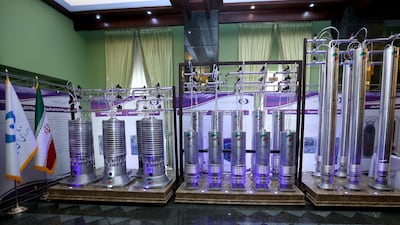
New generation Iranian centrifuges on display for Iran's National Nuclear Energy Day in Tehran, in April 2021. Iranian Presidency Office / Wana -

President Ebrahim Raisi, second right, is accompanied by Atomic Energy Organisation of Iran chief Mohammad Eslami, at Nuclear Technology Day in Tehran in April 2022. Iranian presidency / AFP -
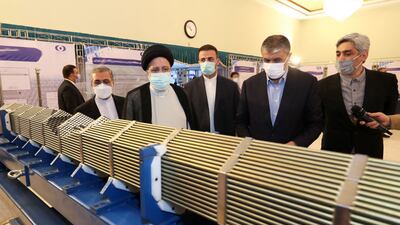
Mr Raisi and Mr Eslami at the April 2022 event. Iranian presidency / AFP -
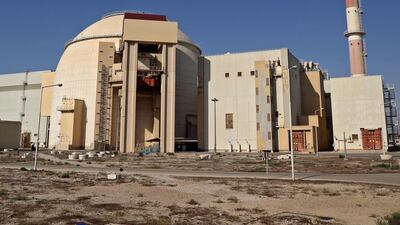
The Bushehr Nuclear Power Plant during a visit by Mr Raisi in October 2021. Iranian Presidency / AFP -
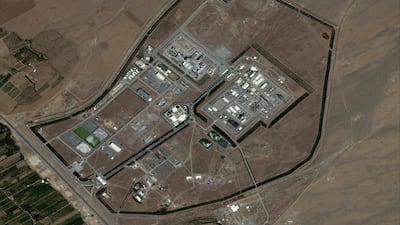
Iran's Arak Heavy Water Reactor complex, south of the capital Tehran in January 2020. Maxar Technologies / AFP -
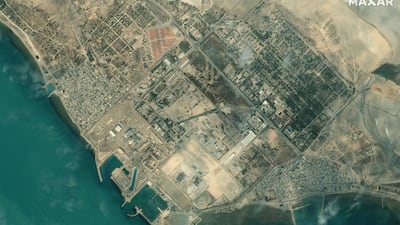
A satellite image of Iran's Bushehr Nuclear Power Plant in January 2020. Maxar Technologies / AFP -
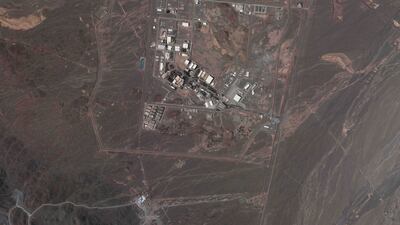
A satellite image of Iran's underground Natanz nuclear site in May 2022. Planet Labs PBC / AP -
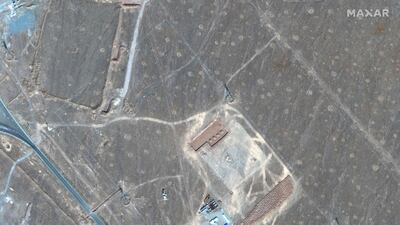
A satellite image in January 2020 of Iran's Fordow Fuel Enrichment Plant, north-east of the city of Qom. Maxar Technologies / AFP -
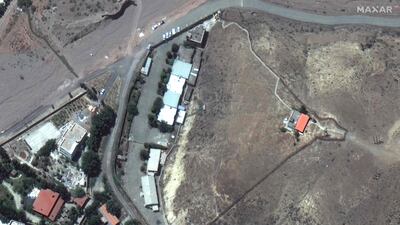
The Sanjarian nuclear centre, east of Tehran, in May 2021. Maxar Technologies / AFP


Iran’s strategy at this stage is centred on distancing itself from the conflicts in Gaza, Lebanon and Yemen, all of which it considers to be secondary to its nuclear weapons programme. As long as these conflicts remain outside Iranian territory, it can maintain the illusion of plausible deniability while continuing to push its narrative of “resistance” through its regional proxies.
The US President’s strategy centres on confronting these proxies. He is particularly insistent about cutting off Hamas and appears to have endorsed Israel’s renewed offensive to destroy the group’s presence in Gaza. He is also committed to dismantling the Houthi leadership through a direct military campaign in Yemen – to stop the group’s disruption of international shipping as well as to send Tehran a message that Washington is prepared for direct military action.
Moreover, Mr Trump seems ready to give Israel the green light to escalate its ongoing operations against Hezbollah in Lebanon, should the government in Beirut not fulfil the terms of its ceasefire agreement with Israel, which includes disarming Hezbollah and Palestinian factions based in the country. Israel will persist with its attacks on Hezbollah targets and its occupation of Lebanese land as long as it has a pretext to do so.
The Lebanese government must also avoid bowing to Hezbollah’s rejection of probable negotiations with Israel on the false pretext that such talks amount to normalisation between the two countries.
First, such negotiations don’t constitute normalisation. The time has come for the Lebanese state to assert its right to engage in talks aimed at removing Israeli occupation from the 13 disputed border points and the five additional positions the latter recently seized.
Second, Lebanon and Israel have previously engaged in negotiations through a trilateral mechanism involving the UN. This mechanism can, and should, be expanded from its purely military function to include political negotiations necessary to end the occupation.
Third, Lebanon and Israel demarcated their maritime borders with Hezbollah’s approval two years ago. So why shouldn’t Beirut insist on a structured diplomatic process to demarcate land borders, too – and, in the process, thwart Israel’s territorial ambitions?
Likewise, there is no justification for delaying the demarcation of Lebanon’s borders with both Israel and Syria, especially when UN Security Council Resolution 1680 calls for this step as a pathway to peace following the end of occupation. It is in the strategic interests of both Lebanon and Syria to settle their borders with Israel and with each other.
These actions are not just advisable; they are urgent and essential, particularly given the looming regional crisis, which presents a deeply unsettling picture. Iran appears determined to stand its ground on the nuclear issue, refusing any flexibility, while preparing for a high-stakes military confrontation with Israel – particularly if Mr Trump follows through on his threats to strike its nuclear facilities.
Tehran might then see no alternative but to retaliate by launching attacks on Israel, with the goal of crippling its infrastructure and placing Mr Trump in a political and strategic bind. If this is indeed the contingency plan, as I am given to understand, it could be mere posturing – a desperate attempt to mask Iran’s growing vulnerabilities and to give Mr Trump pause. Or it may well be to signal Iran’s readiness to risk an all-out war with devastating consequences for the region.
Either way, Mr Trump is unlikely to back down easily. That is precisely why the Middle East is teetering on the edge of an extremely dangerous moment right now.
Iran’s leadership must know that it finds itself increasingly isolated on the issue of its nuclear weapons programme. Neither Russia nor China is certain to stand by its side, and its regional proxies have either been weakened or neutralised. In other words, Tehran’s continued defiance won’t shield it from the consequences of its actions.

