

“Free speech for me, but not for thee” is a double standard dating back to the earliest days of the American republic and the free speech rights guaranteed by the First Amendment to the US Constitution.
Historically, American democracy has compared favourably with societies such as Britain and Canada. US Vice President JD Vance even made a speech at the Munich Security Conference accusing European leaders of censoring free speech on the continent. Yet there are always exceptions, and harsh criticism of Israel has always been difficult and dangerous in most US contexts.
Recent years have seen increasing efforts to go beyond the informal methods of suppressing pro-Palestinian perspectives such as often false accusations of anti-Semitism, ostracism, or negative professional consequences. States and state-run institutions have been increasingly attempting to legislate financial, professional, contractual and other penalties for criticism of Israel and its occupation that began in 1967.
During last year’s election campaign, US President Donald Trump vowed to crush such views. He described student opposition to the Gaza war as part of a “radical revolution” that “has to be stopped now”, so “we’re going to set that movement back 25 or 30 years”. This did not appear to faze the numerous Arab and Muslim Americans who voted for Mr Trump or, at least, helped him by staying home or supporting irrelevant candidates.
-

A vigil is held on the grounds of Brown University, in Providence, Rhode Island, US. Reuters -
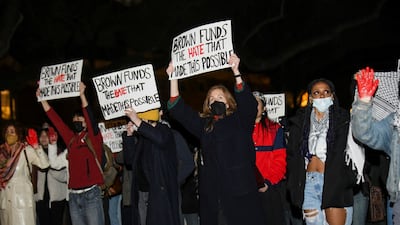
Protesters hold up signs following the vigil at Brown University. Reuters -

Jason J Eaton, 48, who was arrested in connection with the shooting of three college students of Palestinian descent in Burlington, appears at his court arraignment from the Northwest State Correctional Facility in Swanton, Vermont, US. Reuters -
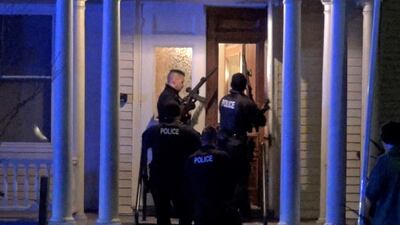
Police search a house after a gunman shot and wounded three 20-year-old college students of Palestinian descent in Burlington, Vermont, eastern US. Reuters -
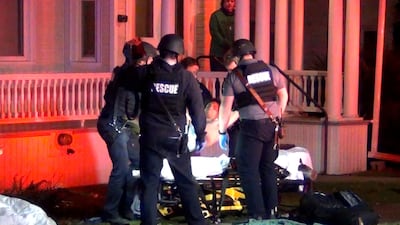
Emergency services treat one of the victims. Reuters -
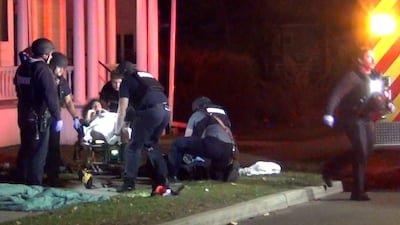
Two were reported to be in a stable condition, while one suffered more serious injuries. Reuters -
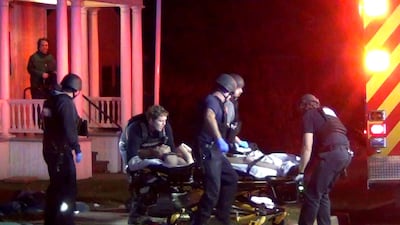
Police in Vermont have not released information about a motive. Reuters -
The students, Hisham Awartani, Tahseen Ali and Kenan Abdulhamid, were reportedly shot while on the way to a family dinner. Photo: Husam Zomlot


In a new executive order, Mr Trump has banned entry into, or deportation from, the country by foreign nationals deemed to “espouse the hateful ideology” of anti-Semitism, which it appears to equate with protests against the Gaza war. An accompanying fact sheet claims that following the October 7, 2023 attack on southern Israel, “pro-Hamas aliens and left-wing radicals began a campaign of intimidation, vandalism, and violence on the campuses and streets of America”.
Some of that certainly happened, but much of the worst violence – including a prolonged mob attack on peaceful anti-war protesters, unprotected for hours by apparently unconcerned police officers, at UCLA in May last year, or the shooting of three Palestinian-American students, one of whom remains paralysed, at Brown University in December 2023, to cite only two such instances – were directed against, not by, protesters.
Mr Trump’s edicts ignore that there has been a documented and demonstrable rise in both anti-Semitic and anti-Arab/Muslim hate crimes and intimidation. They don’t acknowledge that the overwhelming majority of anti-war protests were peaceful, orderly and often within the best traditions of civic engagement and responsible citizenship – or that many of the protesters are Jewish. Genuine anti-Semitism is an unacceptable moral outrage, but so is silence and apathy in the face of such carnage.

Universities have come under heavy pressure to do everything possible to stop public opposition to Israel’s rampage of vengeance in Gaza. Their responses range from the vicious and petty to the downright absurd.
Harvard faculty lost library privileges for taping anti-war signs on to their laptops or even silently reading books about free speech, Palestine or similar intolerable topics. Harvard claimed that such silent, virtually invisible, gestures constituted disruptive protesting because they were “designed to capture people’s attention”. It was a miserable capitulation to pro-Israel political correctness by cowardly administrators at an institution (that’s yet again) prepared to corrupt its dignity and educational mission to escape criticism because many students and faculty were appalled by the horrors in Gaza.
Mr Trump’s executive order will exacerbate this national atmosphere of attempted repression, but it’s not just coming from the political right. There’s a generational divide roiling the US left, with many liberals under the age of 30 (including many Jewish Americans) largely or entirely unaffected by the emotional, ideological or religious attachment their parents and grandparents often feel towards Israel.
Right-wing criticism of Israel comes primarily from avowed racists and neo-Nazis. But there’s a common phenomenon of conservative Americans who are in certain ways anti-Semitic, harbouring stereotypes of Jewish Americans, yet who are also passionately pro-Israel.
Many of them may not like Jews much, yet they see Israel as key to a war of Armageddon that will initiate the second coming of Jesus Christ – or, in a secular vein, as an admirably “civilised” and essentially western society that should be emulated in its disregard for the UN, international law, global opinion and the rights of a colonised people.
Mr Trump himself embodies a particularly complex, subtle version of such cognitive dissonance, having made numerous anti-Semitic comments and addressing Jewish Americans as if they were Israelis, while happily allowing his daughter to convert to Judaism.
Younger liberals, however, are often neither interested in Armageddon nor supportive of colonisation and the virtual apartheid system Israel imposes in the occupied territories. This is a problem for their elders, though, because incisive criticism of Israel has been effectively a taboo in much of American society, especially outside of academia, for decades. So, both the left and the right have been attempting to use institutional, and increasingly governmental, power to enforce a moribund and intellectually indefensible political correctness.
Over the past decade, important efforts have united left, right and centre activists to counter efforts by liberals to “cancel” speech they deem racist, sexist, homophobic or otherwise intolerant, and by the right to use the power of state, and now the federal, government to prohibit primary and secondary schools from teaching about past and present racism. Unfortunately, even in these circles, a Palestinian exception is normative.
Usually the right to vociferously criticise Israel passes unmentioned, though that is by far the largest target of attempted suppression in the contemporary US, or, when the subject is forced, it typically elicits a distinct lack of enthusiasm, efforts to change the subject or explain the carve-out. But that’s cowardice and hypocrisy.
Arabs and Muslims everywhere, as a top priority, must zealously and vigilantly reject and denounce genuine anti-Semitism, which is both an intellectual and a moral poison and a disaster for the Palestinian cause. But they must not be silenced either. There’s no basis in US law, culture or tradition for singling out Israel as virtually immune from harsh criticism, especially when it behaves atrociously, or viewing Palestinians as less valuable humans.
More than 200 years of US history demonstrates that the censorious position is ultimately, and almost invariably, the losing one. Mr Trump, various governors, university administrators and others may hope to force this genie back into its bottle. But they, and their Israeli friends, will discover in fairly short order that an honest American national conversation about Israel and the Palestinians is, at long last, rapidly and inexorably approaching.

