

There will, quite understandably, be widespread concerns about the fate of the upcoming meeting between US President Donald Trump and Israeli Prime Minister Benjamin Netanyahu. One of the concerns is likely to be that the ambitions of both leaders could fundamentally reshape the Middle East, for better or worse.
A key aspect of analysing what emerges – or does not emerge – from the meeting is recognising Mr Trump’s negotiation style. He often sets a high initial bar, using it as a starting point for negotiations or, at times, to impose a fait accompli.
The focus of the meeting will be on Gaza, Lebanon and Syria, from the perspective of Israel’s geopolitical calculus, but it will also take stock of Iran’s moves, including its nuclear ambitions and its influence in Yemen and Iraq. The US-Saudi relationship, as envisioned by Mr Trump, will be present in the talks, too, given that one of the US President’s strategic objectives is securing the so-called “Deal of the Century” that aims to bring Israel closer to the Arab and Islamic worlds.
It is important to note that not everything Mr Trump says will necessarily translate into immediate policy. For instance, when he talks about withdrawing US troops from Syria, it need not mean an imminent departure. Some troops may remain if the military establishment deems it necessary. Rather, it should be understood that Mr Trump often speaks in terms of long-term goals rather than immediate tactical steps.
His policy on Syria, for instance, aligns with his broader strategic framework when he states that “Syria is not our fight”. Indeed, he prefers that Turkey and its partners take on the responsibility of preventing the resurgence of ISIS rather than having American soldiers pay the price.
At this stage, the US is following a policy of delegating its policies. Thus, Mr Trump seeks to leave Ankara with the task of preventing ISIS from rebuilding itself while offering intelligence support to the new Syrian government bearing in mind that Washington previously shared intelligence with Hayat Tahrir Al Sham through back channels despite classifying it as a terrorist group. Turkey also remains crucial to Mr Trump’s aim to balance against the admittedly shrinking Russian and Iranian influence in Syria.
During his visit to Damascus last week, Russian envoy Mikhail Bogdanov was told by Syrian authorities that they are unwilling to renew the two nations’ agreement concerning the Tartus and Hmeimim military bases. While they agreed that discussions would continue, there is no agreement yet on Moscow’s role in Syria’s reconstruction or whether it will retain its bases in return for paying high rents. Thus, a return to the old alliance from the Bashar Al Assad era remains highly unlikely.
Syrian authorities have also asked Russia to extradite Mr Al Assad to Damascus to be tried, to which the response was that the final decision lies with Moscow’s leadership. Given all this, Washington may have little concern about Russia regaining influence in Syria.
Mr Trump may also consider distancing himself from the Kurdish-led Syrian Democratic Forces in north-eastern Syria, and align closer with Ankara, though he is unlikely to abandon them entirely. One reason is that thousands of ISIS fighters remain in Kurdish detention camps in Syria.
Another critical aspect of US-Turkey relations, from Washington’s perspective, may be the latter’s potential role – whatever form that might be in – if the US plans to take military action against Iran were the latter to refuse to comply with Mr Trump’s demands regarding its nuclear weapons programme.
Circling back to the Trump-Netanyahu meeting, it’s important to point out that the US needs Israel for it to pursue Washington’s aforementioned delegation strategy. At the same time, Mr Trump is aware that Mr Netanyahu seeks to drag the US into Israeli wars. Mr Trump is determined not to fall into this trap; there is a difference between delegation and entanglement, and he understands that distinction well.
Mr Trump might employ a “good cop, bad cop” approach with Mr Netanyahu. I am given to understand that he wants to establish new rules of engagement in the Middle East, and build a new regional order, though it remains unclear what that means in practical terms.
-

Panic at a Beirut hospital after thousands, including Hezbollah fighters and medics, were injured when the pagers they used to communicate exploded across Lebanon. Several people were killed. Reuters -
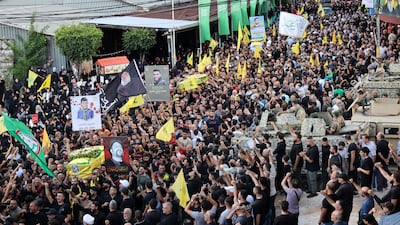
Mourners in Beirut's southern suburbs carry the coffins of people killed after hundreds of paging devices exploded, in a mass funeral on September 18, 2024. AFP -
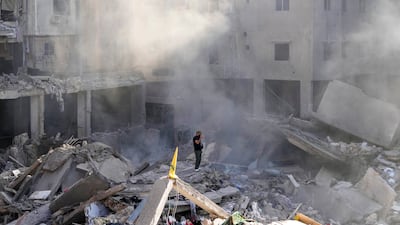
A man stands on the rubble of buildings near the site of the assassination of Hezbollah leader Hassan Nasrallah in Beirut's southern suburbs on September 29, 2024. AP -
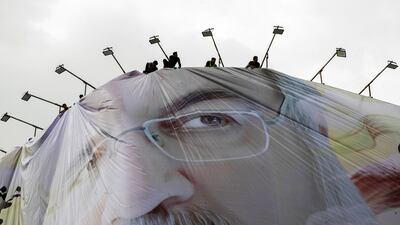
Workers drape a building in a vast banner depicting Nasrallah in Tehran, two days after his assassination by Israeli forces in Beirut. Getty Images -
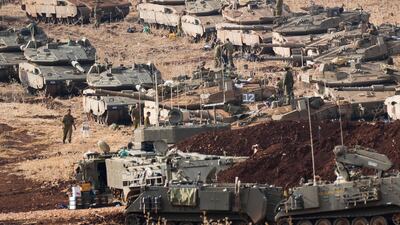
Israeli soldiers work on tanks at a staging post near the border with Lebanon on October 1, 2024. AP -

Israeli soldiers rest in an operation zone near Naqoura, southern Lebanon on October 13, 2024, after a ground invasion was launched. Getty Images -

People take cover by a roadside in Tel Aviv as a siren sounds after Iran fired a salvo of ballistic missiles at Israel. Reuters -

Iranian-launched projectiles being intercepted by Israel above Jerusalem on October 1, 2024. AFP -

The aftermath of a rocket salvo in Petah Tikva, near Tel Aviv, on November 24, 2024. Hezbollah said it launched the missiles from Lebanon at an Israeli army intelligence base. AFP -

Residents in Petah Tikva check the damage after the rockets were fired from Lebanon. AFP


The US President is expected to make significant pronouncements during or after his meeting, although I am told that it is unlikely to include endorsing the idea proposed by extremists in the Israeli cabinet of turning Jordan into an alternative homeland for the Palestinians.
As US President, it is not permissible for Mr Trump to use rhetoric that implicitly supports the forced displacement of Palestinians from Gaza or the West Bank, even if he frames it as a temporary measure for security and reconstruction purposes. Mr Trump must, therefore, use Mr Netanyahu’s visit to insist on the two-state solution and the establishment of a Palestinian state, as this is a key condition for Saudi Arabia to normalise relations with Israel.
The biggest challenge remains Israel’s rejection of the two-state solution, a stance that enjoys considerable support in American political and intellectual circles. Some in Washington speak of phasing out the Oslo Accords that promised a Palestinian state and replace it with a new framework. This includes possibly postponing the creation of a Palestinian state while merely keeping the idea “floating” on the agenda.
Israel argues that it cannot agree to a Palestinian state because this would be seen as a reward for the Hamas-led attacks of October 7, 2023. At the same time, it cannot reject the concept, as that would undermine Mr Trump’s desire for a grand bargain.
The fate of Lebanon will also be discussed, because the Israel-Hezbollah ceasefire remains as fragile as the one in Gaza due to violations by both sides. Israel’s insistence on maintaining control over some strategic positions in Lebanon could adversely affect border demarcation efforts between the two countries. Mr Trump should press Mr Netanyahu on the importance of border delineation deals not just with Lebanon but with Syria as well, as this would facilitate the broader normalisation process Mr Trump seeks between Israel and the Arab and Islamic worlds.
Mr Netanyahu will, no doubt, secure some gains due to the strong US-Israel alliance. However, Mr Trump is unlikely to unconditionally give Mr Netanyahu everything he wants. Israel, after all, remains the primary beneficiary of its relationship with the US – not the other way around.

