


Over the past year, there has been a lot of talk about democracy being in “danger”. The joint US-German Bertelsmann Foundation warns that “democratic decline in the US and Europe is weakening the transatlantic relationship and undermining its influence around the world”. The International Institute for Democracy and Electoral Assistance in Sweden concurs, stating that “the bedrocks of democracy are weakening across the globe, with half of countries suffering democratic declines”.
Some, not all, of this has been connected to the re-election of Donald Trump, who will be inaugurated as president of the US this coming Monday. A recent commentary in Vox sums the extremist reaction up: “It’s not alarmist: A second Trump term really is an extinction-level threat to democracy,” ran the headline.
I disagree. I think the facts suggest that democracy is actually in pretty good health around the world. Let’s start with Mr Trump.
A clear majority of American voters expressed their preference for him, and he was duly elected. Last month, Mikheil Kavelashvili became Georgia’s President, after being endorsed by the country’s 300-member College of Electors, despite all the foreign pressure against him and the departing, pro-western president Salome Zourabichvili’s insistence that she was the “only legitimate president”.
South Korea has survived an attempt to impose martial law, and President Yoon Suk Yeol has just been arrested to face charges of insurrection. In Indonesia, at the beginning of last year, Prabowo Subianto won the presidency on his third attempt. As he had also stood once for the vice presidency, no one can suggest that the country’s people did not know what they were going to get; he won nearly 60 per cent of the vote.
Indian Prime Minister Narendra Modi remained in power after last June’s election, but with a reduced majority. And in Canada, Prime Minister Justin Trudeau’s Liberals are deeply unpopular, and look likely to be voted out at the next election, which must be held by October.
This is democracy working as it’s supposed to. The will of the people is expressed through the ballot box and is reflected in the results. Processes hold and the constitution prevails, as happened in both Georgia and South Korea.
There may well be a threat to democracy, and indeed to public order and governments of all kinds, from misinformation. But that’s not what those wringing their hands about “democratic backsliding” are talking about. What they mean is: people are voting for parties they don’t like.
They may well be right that a certain form of liberal democratic politics, consisting of parties nominally of the centre-left – but which have often given up on anything historically recognisable as socialism or social democracy – and the mainstream right, is in trouble in large parts of the world. That isn’t surprising given their records in government over the past quarter century.
What have they bequeathed to their peoples? Devastating drops in purchasing power for the middle and working classes. Disastrous wars of choice. Banks unpunished for catastrophic failure during the global financial crisis of 2007-2008. Their leaders celebrate disruption, but that translates to the death of job security for the ordinary people who are told to look forward to the excitement of changing careers in their lifetime; in reality, they may be holding down several jobs just to get by.
The term “populist” is often used as an insult, but it may be that so-called populists of the genuine left and genuine right are just more in tune with what a lot of ordinary people want. Part of that is a feeling that many of the mainstream political parties have lost touch with what used to be considered common sense and have an odd sense of priorities.
-
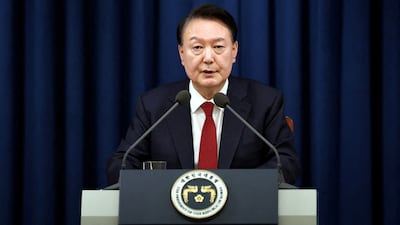
South Korean President Yoon Suk Yeol delivers a speech to declare martial law in Seoul, South Korea, on Tuesday. Reuters -
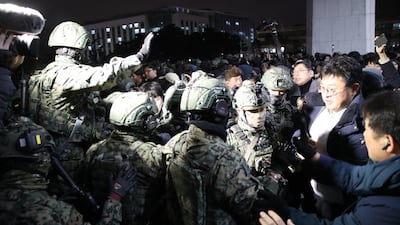
South Korean soldiers try to get into the National Assembly on December 4 in Seoul. Getty Images -
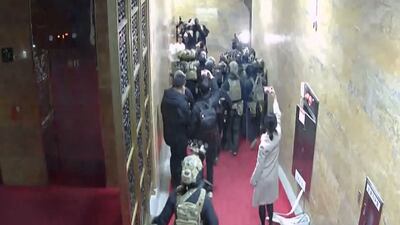
South Korean troops enter the parliament building in Seoul during President Yoon Suk Yeol's short-lived attempt to impose martial law. AFP -
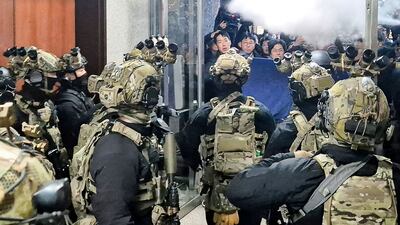
Soldiers try to enter the main hall of the National Assembly. AFP -

Barricades at the National Assembly. Getty Images -

Members of South Korea's main opposition Democratic Party set up barricades at an entrance to the National Assembly building. AFP -
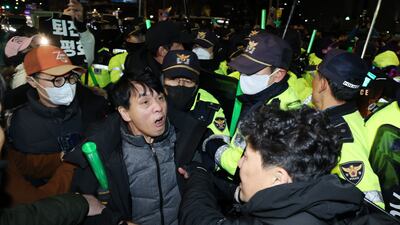
Protesters clash with police officers. EPA -
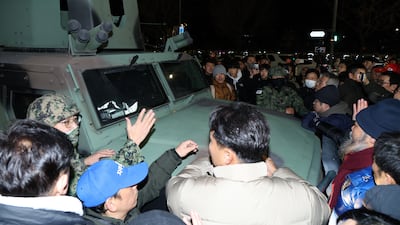
People surround a military vehicle. EPA -
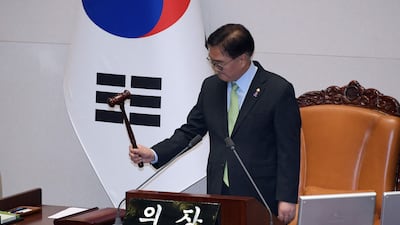
South Korea's National Assembly speaker Woo Won-shik passes a resolution demanding the immediate lifting of martial law at the National Assembly. AFP -
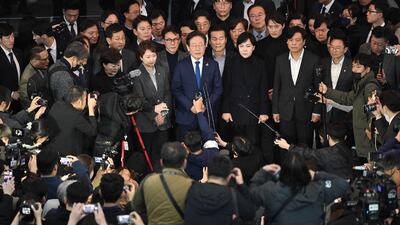
South Korea's main opposition Democratic Party leader Lee Jae-myung speaks to the media at the National Assembly. AFP -
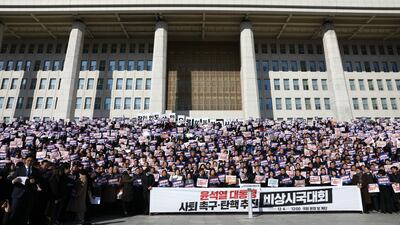
Lawmakers and members of the South Korea's main opposition Democratic Party demonstrate against the country's president at the National Assembly. Getty images -
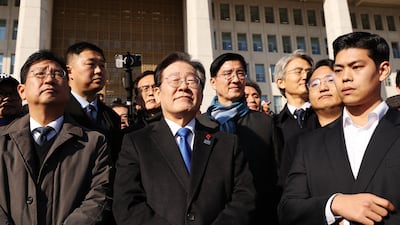
Lee Jae-Myung, centre, leader of the opposition Democratic Party, stands in front of the National Assembly. EPA -
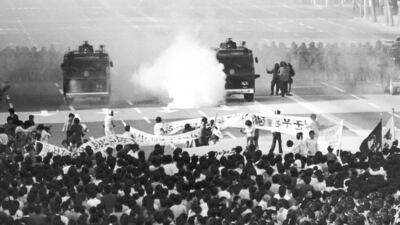
Police vehicle sprays tear gas at tens of thousands of student demonstrators in downtown Seoul. AP


For me there is one example that stands for much of this. The UK is still the world’s sixth-largest economy, yet over the past 15 years more and more people have had to go to food banks. According to former prime minister Gordon Brown, the Trussell Trust provided 35 of them in 2010. “With the addition of independent food banks, today’s 2,800 food banks and emergency food suppliers are now as recognisable a feature of the British landscape as the local secondary school,” he wrote last June. “Food banks are opening as fast as high street banks have been closing down.”
I find that absolutely scandalous. The “established” UK political class evidently can tolerate that, however – otherwise they would have made it an urgent priority. But a huge swathe of them can't tolerate anyone not signing up to a gender ideology that old-fashioned feminists decry.
Take that as representative of the disconnect, and it’s clear that when people vote for Mr Trump, or Reform UK’s Nigel Farage, or Georgian Dream, or the left-wing alliance that topped the poll in France’s legislative election last summer, or Indonesia’s Mr Prabowo, they are choosing politicians who they believe are more aligned with their real interests and values. And who is to say they are wrong when, in power, they start a programme to provide free meals to nearly a third of the population that might otherwise go hungry, as Mr Prabowo has done, or attempted an audit of the US Defence Department (for the first time ever), to ensure taxpayers dollars aren’t wasted, as Mr Trump did?
If that constitutes a rejection of an established elite class of politicians who often seem to be enamoured by weird ideologies, are out of touch with the challenges ordinary people face, and whose dismal record does not deserve renewal at the ballot box, then so be it. But that is not democracy in danger. That’s democracy in action.

