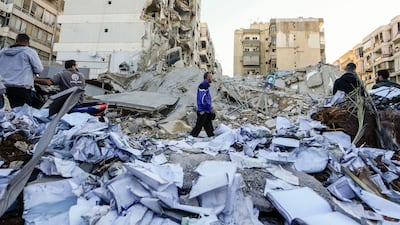
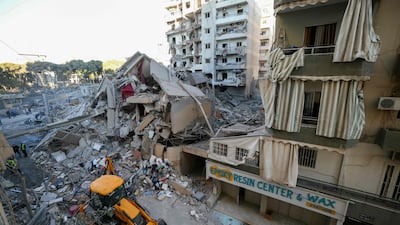
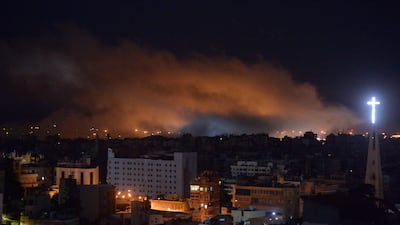
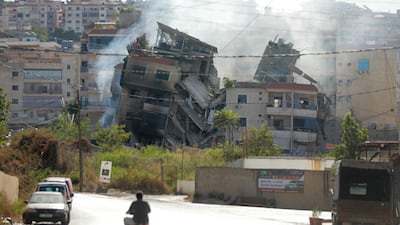
A Lebanese soldier in an armoured personnel carrier at the site of an Israeli air strike in Beirut's southern suburbs, on September 23. AP


Lebanon’s best hope is its Armed Forces


Nickolay Mladenov
Nickolay Mladenov
  • English
  • Arabic

October 22, 2024

Lebanon is teetering on the edge, struggling with a devastating war between Hezbollah and Israel, political paralysis and economic freefall. The US is reportedly seeking to use Israel's offensive as an opportunity to weaken the militant group's longstanding influence, break the two-year political deadlock caused by Hezbollah’s influence and push the Lebanese political elite to elect a president.

But Lebanon doesn’t just need a new face at the helm, it needs a strong backbone. And that backbone can be provided by the Lebanese Armed Forces. By shifting the focus from political optics to empowering the army, Lebanon’s friends can pave the way for real security, sovereignty and lasting recovery.

To halt the ongoing Israeli offensive against Hezbollah, Lebanon needs a multi-faceted diplomatic and security package. Immediate efforts should focus on brokering a ceasefire that allows for the army to take control of the country’s border areas with Israel.

Accelerating the posting of the army in southern Lebanon with an enhanced Unifil mandate can serve as a visible commitment to border security, reducing the pretext for Israeli military actions. Unifil, or the UN Interim Force in Lebanon, is a peacekeeping mission established in 1978 to monitor the cessation of hostilities, support the Lebanese government in extending its authority in the south and ensure security along the border with Israel. As the Hezbollah threat to Israel in southern Lebanon diminishes, and the army asserts control, guarantees should be put in place to avoid escalation in the future.

Lebanese soldiers secure the site outside an apartment building hit by an Israeli air strike in Beirut's Cola district, on September 30. AFP

Meanwhile, the political stalemate in Beirut is not just a reflection of internal divisions but is compounded by the shifting dynamics of regional power. External players view Lebanon through the lens of their respective strategic interests. In this environment, the army stands out as a rare pillar of stability in Lebanon’s fragmented landscape. It commands respect across the political spectrum and remains one of the few institutions capable of bridging the country’s deep divides.

Yet, the push to install a new president under pressure and as the country is reeling from Israeli attacks on Hezbollah could inflame tensions and deepen divisions. As a first step, the army must be front and centre of international efforts to support Lebanon, empowering the armed forces to take on the urgent task of securing the borders and creating a safe space for political and economic revival.

Recent history has shown that leadership changes alone have been insufficient to stabilise the country. The 2016 election of Michel Aoun as president did little to curb the economic collapse or reduce Hezbollah’s influence. Strengthening the army, however, should not be just a military priority – it is a national necessity. A comprehensive support package, including financial aid, modern equipment and strategic backing from regional and international allies, can transform the army into a force capable of leading Lebanon’s recovery.

Since 2019, the country's economic collapse has led to severe pay cuts for soldiers, reducing their salaries from an average of around $800 a month to less than $100 a month. But money isn’t the only factor. The army also needs ammunition, fuel, uniforms and advanced training to operate as a modern, disciplined force. With such support in place, it can turn its attention to securing the borders, starting with the south. UN Security Council Resolution 1701 remains the basis for a ceasefire with Israel and its full implementation both by Lebanon and Israel is critical.

Moreover, Lebanon's stability is intertwined with the situation in Syria. The influx of Syrian refugees has placed additional strain on Lebanon’s fragile economy and social fabric. The government estimates that the country hosts 1.5 million refugees since the beginning of the Syrian refugee crisis. Meanwhile, the UN reports that in the past two weeks, about 250,000 Syrians have returned home fleeing Israeli attacks in Lebanon. The eastern frontier with Syria is a key battleground in the fight to control the flow of weapons, militants and illegal drugs such as Captagon.

The army should be supported to shut down illegal crossings and secure official entry points. This requires a co-ordinated effort with Syria and the backing of international partners to provide the technology and training needed to do the job right. Strong borders mean less room for outside actors to manipulate Lebanon’s security situation by supporting non-state militias, allowing the country to reclaim its sovereignty.

No one is suggesting that Lebanon can ignore its political stalemate. Electing a president remains a vital step, but it is critical to avoid the pitfalls of solutions imposed by outsiders. External actors, while influential, must recognise the country’s political complexities, which may not be addressed by a single election. The international community must resist the temptation to pick winners and losers in the process. The army’s role in providing stability buys time and space for the political process to unfold naturally, rather than being rushed into decisions that could backfire.

Economic recovery must go together with security reforms. International aid should prioritise rebuilding Lebanon’s shattered infrastructure, helping displaced communities, and restoring vital services such as electricity, water and health care. The economic collapse has drained public trust in state institutions, making it even more crucial for aid to be delivered transparently and equitably. But even this must be done with care: if the army succeeds in providing security, it must extend that protection to the most marginalised communities, including the Shiite population.

Lebanon’s future won’t be decided by a single election, nor will it come from the outside. It rests in the hands of its people and the institutions that serve them. And right now, the army is the country’s best hope. By focusing on a strong, independent military, it can reclaim its sovereignty and set the stage for political renewal.


TO A LAND UNKNOWN

Director: Mahdi Fleifel

Starring: Mahmoud Bakri, Aram Sabbah, Mohammad Alsurafa

Rating: 4.5/5

FULL%20FIGHT%20CARD
%3Cp%3EFeatherweight%20Bout%3A%0D%20Abdullah%20Al%20Qahtani%20v%20Taha%20Bendaoud%0D%3Cbr%3EBantamweight%20Bout%3A%0D%20Ali%20Taleb%20v%20Nawras%20Abzakh%0D%3Cbr%3EBantamweight%20Bout%3A%0D%20Xavier%20Alaoui%20v%20Rachid%20El%20Hazoume%0D%3Cbr%3EFeatherweight%20Bout%3A%0D%20Islam%20Reda%20v%20Adam%20Meskini%0D%3Cbr%3EBantamweight%20Bout%3A%0D%20Tariq%20Ismail%20v%20Jalal%20Al%20Daaja%0D%3Cbr%3EBantamweight%20Bout%3A%0D%20Elias%20Boudegzdame%20v%20Hassan%20Mandour%0D%3Cbr%3EAmateur%20Female%20Atomweight%20Bout%3A%0D%20Hattan%20Al%20Saif%20v%20Nada%20Faheem%0D%3Cbr%3EFeatherweight%20Bout%3A%0D%20Maraoune%20Bellagouit%20v%20Motaz%20Askar%0D%3Cbr%3EFeatherweight%20Bout%3A%0D%20Ahmed%20Tarek%20v%20Abdelrahman%20Alhyasat%0D%3Cbr%3EShowcase%20Featherweight%20Bout%3A%0D%20Mido%20Mohamed%20v%20Yazeed%20Hasanain%0D%3Cbr%3EShowcase%20Flyweight%20Bout%3A%0D%20Malik%20Basahel%20v%20Harsh%20Pandya%0D%3C%2Fp%3E%0A
Everton%20Fixtures
%3Cp%3EApril%2015%20-%20Chelsea%20(A)%3Cbr%3EApril%2021%20-%20N.%20Forest%20(H)%3Cbr%3EApril%2024%20-%20Liverpool%20(H)%3Cbr%3EApril%2027%20-%20Brentford%20(H)%3Cbr%3EMay%203%20-%20Luton%20Town%20(A)%3Cbr%3EMay%2011%20-%20Sheff%20Utd%20(H)%3Cbr%3EMay%2019%20-%20Arsenal%20(A)%3C%2Fp%3E%0A
The President's Cake

Director: Hasan Hadi

Starring: Baneen Ahmad Nayyef, Waheed Thabet Khreibat, Sajad Mohamad Qasem 

Rating: 4/5

Paatal Lok season two

Directors: Avinash Arun, Prosit Roy 

Stars: Jaideep Ahlawat, Ishwak Singh, Lc Sekhose, Merenla Imsong

Rating: 4.5/5

DIVINE%20INTERVENTOIN
%3Cp%3EStarring%3A%20Elia%20Suleiman%2C%20Manal%20Khader%2C%20Amer%20Daher%3C%2Fp%3E%0A%3Cp%3EDirector%3A%20Elia%20Suleiman%3C%2Fp%3E%0A%3Cp%3ERating%3A%204.5%2F5%3C%2Fp%3E%0A
Specs%3A%202024%20McLaren%20Artura%20Spider
%3Cp%3E%3Cstrong%3EEngine%3A%3C%2Fstrong%3E%203.0-litre%20twin-turbo%20V6%20and%20electric%20motor%3Cbr%3E%3Cstrong%3EMax%20power%3A%3C%2Fstrong%3E%20700hp%20at%207%2C500rpm%3Cbr%3E%3Cstrong%3EMax%20torque%3A%3C%2Fstrong%3E%20720Nm%20at%202%2C250rpm%3Cbr%3E%3Cstrong%3ETransmission%3A%3C%2Fstrong%3E%20Eight-speed%20dual-clutch%20auto%3Cbr%3E%3Cstrong%3E0-100km%2Fh%3A%3C%2Fstrong%3E%203.0sec%3Cbr%3E%3Cstrong%3ETop%20speed%3A%20%3C%2Fstrong%3E330kph%3Cbr%3E%3Cstrong%3EPrice%3A%3C%2Fstrong%3E%20From%20Dh1.14%20million%20(%24311%2C000)%3Cbr%3E%3Cstrong%3EOn%20sale%3A%3C%2Fstrong%3E%20Now%3C%2Fp%3E%0A
The specs: 2018 Nissan 370Z Nismo

The specs: 2018 Nissan 370Z Nismo
Price, base / as tested: Dh182,178
Engine: 3.7-litre V6
Power: 350hp @ 7,400rpm
Torque: 374Nm @ 5,200rpm
Transmission: Seven-speed automatic
​​​​​​​Fuel consumption, combined: 10.5L / 100km

While you're here
COMPANY%20PROFILE
%3Cp%3E%3Cstrong%3ECompany%20name%3A%3C%2Fstrong%3E%20Revibe%20%0D%3Cbr%3E%3Cstrong%3EStarted%3A%3C%2Fstrong%3E%202022%0D%3Cbr%3E%3Cstrong%3EFounders%3A%3C%2Fstrong%3E%20Hamza%20Iraqui%20and%20Abdessamad%20Ben%20Zakour%20%0D%3Cbr%3E%3Cstrong%3EBased%3A%3C%2Fstrong%3E%20UAE%20%0D%3Cbr%3E%3Cstrong%3EIndustry%3A%3C%2Fstrong%3E%20Refurbished%20electronics%20%0D%3Cbr%3E%3Cstrong%3EFunds%20raised%20so%20far%3A%3C%2Fstrong%3E%20%2410m%20%0D%3Cbr%3E%3Cstrong%3EInvestors%3A%20%3C%2Fstrong%3EFlat6Labs%2C%20Resonance%20and%20various%20others%0D%3C%2Fp%3E%0A
MATCH INFO

Syria v Australia
2018 World Cup qualifying: Asia fourth round play-off first leg
Venue: Hang Jebat Stadium, Malayisa
Kick-off: Thursday, 4.30pm (UAE)
Watch: beIN Sports HD

* Second leg in Australia on October 10

Getting there
Flydubai flies direct from Dubai to Tbilisi from Dh1,025 return including taxes

PROFILE OF HALAN

Started: November 2017

Founders: Mounir Nakhla, Ahmed Mohsen and Mohamed Aboulnaga

Based: Cairo, Egypt

Sector: transport and logistics

Size: 150 employees

Investment: approximately $8 million

Investors include: Singapore’s Battery Road Digital Holdings, Egypt’s Algebra Ventures, Uber co-founder and former CTO Oscar Salazar

TERMINAL HIGH ALTITUDE AREA DEFENCE (THAAD)

What is THAAD?

It is considered to be the US's most superior missile defence system.

Production:

It was created in 2008.

Speed:

THAAD missiles can travel at over Mach 8, so fast that it is hypersonic.

Abilities:

THAAD is designed to take out  ballistic missiles as they are on their downward trajectory towards their target, otherwise known as the "terminal phase".

Purpose:

To protect high-value strategic sites, such as airfields or population centres.

Range:

THAAD can target projectiles inside and outside the Earth's atmosphere, at an altitude of 150 kilometres above the Earth's surface.

Creators:

Lockheed Martin was originally granted the contract to develop the system in 1992. Defence company Raytheon sub-contracts to develop other major parts of the system, such as ground-based radar.

UAE and THAAD:

In 2011, the UAE became the first country outside of the US to buy two THAAD missile defence systems. It then stationed them in 2016, becoming the first Gulf country to do so.

Mercer, the investment consulting arm of US services company Marsh & McLennan, expects its wealth division to at least double its assets under management (AUM) in the Middle East as wealth in the region continues to grow despite economic headwinds, a company official said.

Mercer Wealth, which globally has $160 billion in AUM, plans to boost its AUM in the region to $2-$3bn in the next 2-3 years from the present $1bn, said Yasir AbuShaban, a Dubai-based principal with Mercer Wealth.

Within the next two to three years, we are looking at reaching $2 to $3 billion as a conservative estimate and we do see an opportunity to do so,” said Mr AbuShaban.

Mercer does not directly make investments, but allocates clients’ money they have discretion to, to professional asset managers. They also provide advice to clients.

“We have buying power. We can negotiate on their (client’s) behalf with asset managers to provide them lower fees than they otherwise would have to get on their own,” he added.

Mercer Wealth’s clients include sovereign wealth funds, family offices, and insurance companies among others.

From its office in Dubai, Mercer also looks after Africa, India and Turkey, where they also see opportunity for growth.

Wealth creation in Middle East and Africa (MEA) grew 8.5 per cent to $8.1 trillion last year from $7.5tn in 2015, higher than last year’s global average of 6 per cent and the second-highest growth in a region after Asia-Pacific which grew 9.9 per cent, according to consultancy Boston Consulting Group (BCG). In the region, where wealth grew just 1.9 per cent in 2015 compared with 2014, a pickup in oil prices has helped in wealth generation.

BCG is forecasting MEA wealth will rise to $12tn by 2021, growing at an annual average of 8 per cent.

Drivers of wealth generation in the region will be split evenly between new wealth creation and growth of performance of existing assets, according to BCG.

Another general trend in the region is clients’ looking for a comprehensive approach to investing, according to Mr AbuShaban.

“Institutional investors or some of the families are seeing a slowdown in the available capital they have to invest and in that sense they are looking at optimizing the way they manage their portfolios and making sure they are not investing haphazardly and different parts of their investment are working together,” said Mr AbuShaban.

Some clients also have a higher appetite for risk, given the low interest-rate environment that does not provide enough yield for some institutional investors. These clients are keen to invest in illiquid assets, such as private equity and infrastructure.

“What we have seen is a desire for higher returns in what has been a low-return environment specifically in various fixed income or bonds,” he said.

“In this environment, we have seen a de facto increase in the risk that clients are taking in things like illiquid investments, private equity investments, infrastructure and private debt, those kind of investments were higher illiquidity results in incrementally higher returns.”

The Abu Dhabi Investment Authority, one of the largest sovereign wealth funds, said in its 2016 report that has gradually increased its exposure in direct private equity and private credit transactions, mainly in Asian markets and especially in China and India. The authority’s private equity department focused on structured equities owing to “their defensive characteristics.”

What is graphene?

Graphene is a single layer of carbon atoms arranged like honeycomb.

It was discovered in 2004, when Russian-born Manchester scientists Andrei Geim and Kostya Novoselov were "playing about" with sticky tape and graphite - the material used as "lead" in pencils.

Placing the tape on the graphite and peeling it, they managed to rip off thin flakes of carbon. In the beginning they got flakes consisting of many layers of graphene. But as they repeated the process many times, the flakes got thinner.

By separating the graphite fragments repeatedly, they managed to create flakes that were just one atom thick. Their experiment had led to graphene being isolated for the very first time.

At the time, many believed it was impossible for such thin crystalline materials to be stable. But examined under a microscope, the material remained stable, and when tested was found to have incredible properties.

It is many times times stronger than steel, yet incredibly lightweight and flexible. It is electrically and thermally conductive but also transparent. The world's first 2D material, it is one million times thinner than the diameter of a single human hair.

But the 'sticky tape' method would not work on an industrial scale. Since then, scientists have been working on manufacturing graphene, to make use of its incredible properties.

In 2010, Geim and Novoselov were awarded the Nobel Prize for Physics. Their discovery meant physicists could study a new class of two-dimensional materials with unique properties. 


GAC GS8 Specs

Engine: 2.0-litre 4cyl turbo

Power: 248hp at 5,200rpm

Torque: 400Nm at 1,750-4,000rpm

Transmission: 8-speed auto

Fuel consumption: 9.1L/100km

On sale: Now

Price: From Dh149,900

Springsteen: Deliver Me from Nowhere

Director: Scott Cooper

Starring: Jeremy Allen White, Odessa Young, Jeremy Strong

Rating: 4/5

88 Video's most popular rentals

Avengers 3: Infinity War: an American superhero film released in 2018 and based on the Marvel Comics story.  

Sholay: a 1975 Indian action-adventure film. It follows the adventures of two criminals hired by police to catch a vagabond. The film was panned on release but is now considered a classic.

Lucifer: is a 2019 Malayalam-language action film. It dives into the gritty world of Kerala’s politics and has become one of the highest-grossing Malayalam films of all time.

MATCH INFO

Serie A

Juventus v Fiorentina, Saturday, 8pm (UAE)

Match is on BeIN Sports

Updated: October 22, 2024, 10:38 AM