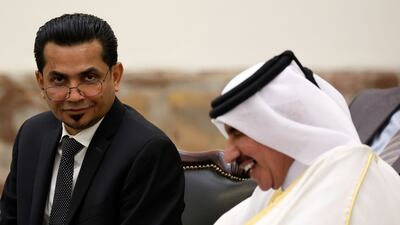
Dr Mudhafar Al-Jbori is the Iraqi ambassador to the UAE, and an expert in international law
October 04, 2024
Iraq, a nation steeped in history and endowed with geopolitical importance, occupies a strategic position in the heart of the Middle East. This location has presented opportunities and challenges alike, drawing the country into various regional conflicts while offering the potential for economic transformation.
Iraq’s $17 billion Development Road megaproject has emerged as a pivotal initiative aimed at using the country’s location to establish it as a major trade hub. By creating a vital link between the Gulf and the Mediterranean, Iraq aspires to enable billions of dollars in trade, promising prosperity and stability for its economy and the wider region.
This is part of Iraq’s broader strategy to assert itself within East-West trade corridors. Competing initiatives include the Chinese-backed Middle Corridor, the Russian-supported North-South Corridor and the India-Middle East-Europe Economic Corridor that connects the UAE, Saudi Arabia and Europe through Greece.
Unlike some of its competitors, Iraq’s corridor seeks to engage regional stakeholders rather than exclude them. This inclusive strategy could position the country as a cornerstone of international trade, addressing the challenges that have historically undermined its ambitions. Further, the project has the potential to stabilise the Middle East by offering a new, competitive trade route.
The Development Road project is poised to become the largest of its kind in the region and includes a 1,200km motorway as well as a parallel railway system that will enable business diversification, strengthen the economy and create new job opportunities. Central to this initiative is the modernisation of the Grand Faw Port and Umm Qasr Port, both in Iraq’s southern Basra governate.
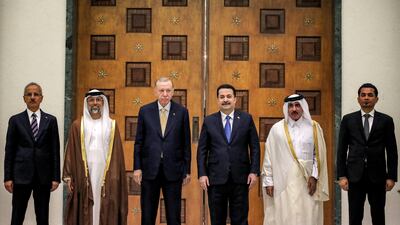
Suhail Al Mazrouei, UAE Minister of Energy and Infrastructure, second left, with Turkey's President Recep Tayyip Erdogan, third left, Iraq's Prime Minister Mohammed Shia Al Sudani, third right, Qatar's Minister of Transport Jassim Al Sulaiti, second right, Iraq's Transport Minister Razzaq Al Saadawi, right, and Turkey's Transport Minister Abdulkadir Uraloglu, left, during the signing of the Development Road framework agreement on security, economy, and development in Baghdad. Reuters
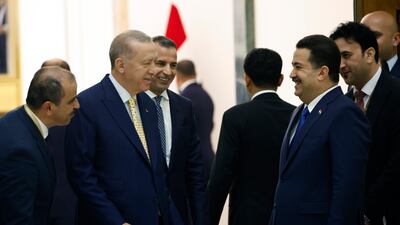
Mr Erdogan and Mr Al Sudani share a lighter moment, during the signing of the memorandum of understanding between Iraq, Turkey, Qatar and the UAE. AP
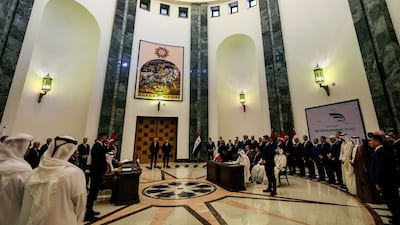
Iraq launched the $17 billion project last year to link a major commodities port on its southern coast by rail and road to the border with Turkey. EPA
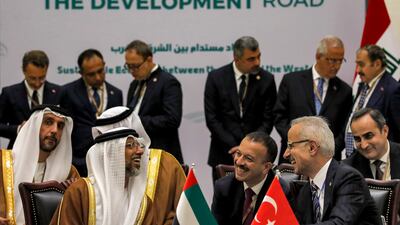
Mr Al Mazrouei, left, and Mr Uraloglu, right, during the signing of the agreement. EPA
Mr Al Saadawi, left, and Mr Al Sulaiti. EPA
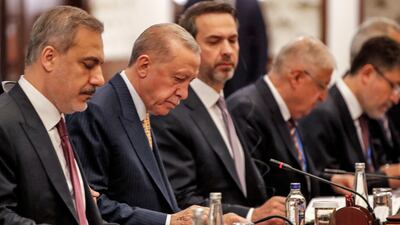
Mr Erdogan, second left, and Turkey's Foreign Minister Hakan Fidan, left, follow proceedings. Reuters
With its record-breaking 15km breakwater, the Grand Faw Port symbolises Iraq’s commitment to enhancing its trade capabilities while also reducing environmental effects. As construction progresses, the project aims to connect the Gulf to Turkey, offering a safer and faster alternative route for trade. If successful, this corridor could provide Iraq with economic independence and prosperity, with far-reaching implications for the wider region. The Grand Faw Port is expected to generate about 250,000 jobs and yield up to $4 billion annually in freight transit fees for the Iraqi government.
The economic benefits of such an Iraqi corridor are substantial, with job creation and increased freight transit fees at the forefront. Iraq stands to tap into burgeoning East-West commerce; socially, the project promises to revitalise rural areas and alleviate demographic pressures in major cities, fostering local business growth and regional development.
Traffic forecast assessments indicate that the Iraqi corridor is an attractive alternative compared to other trade routes. For instance, freight transit from Shanghai to Rotterdam could save time and costs by reducing transit for Asian exports to Europe by up to 10 days. The Iraqi project is designed to meet expected demand until 2038 by adopting a multimodal system – railway and motorway – as rail systems alone would be saturated by 2028 due to anticipated traffic demand.
Domestically, the project’s railway, which will run for more than 1,160km, will serve 28 million people – about 66 per cent of Iraq’s population – through 14 strategically located stations. Meanwhile, the motorway will stretch for 1,190km. Both the motorway and railway are designed to be strategically distanced from major urban centres, ensuring accessibility while minimising urban disruption. Specifically, both are 8km from the centre of Basra, making them easily accessible from this major city. They are also 15km from Nasiriyah and 12km from Diwaniyah, providing convenient connections to these urban centres. Their distance from Baghdad is 36km with Rabiah, located 5km away, being 28km from the Turkish border. This network of distances underscores the centrality of the motorway and railway within the broader context of these important Iraqi cities.
The India-Middle East-Europe Economic Corridor project, established by President Sheikh Mohamed, US President Joe Biden, Indian Prime Minister Narendra Modi and other leaders, is one of a few competing trade corridors. UAE Presidential Court
Iraq’s diplomatic efforts have significantly bolstered its regional relationships, particularly with influential neighbours such as Turkey, the UAE and Qatar. Indeed, the Emirates and Qatar have expressed support for the Development Road project, recognising its potential to reshape regional trade dynamics. However, challenges remain, necessitating strategic manoeuvres to mitigate tensions.
This ambitious endeavour faces competition from parallel initiatives and the complexities of regional geopolitics; historical tensions cast doubt on the feasibility of such large-scale projects. The potential emergence of competing ports in the region highlights the necessity of strategic planning and execution.
The success and attractiveness of the Development Road project will also rely heavily on the co-operation and infrastructure capabilities of the countries it traverses, including Turkey, Bulgaria, Romania, Serbia and others. The project involves crossing 1,200km in Iraq, 1,600km on Turkish territory and 2,000km across Europe. This demands a high level of reliability, efficiency and safety to ensure its viability. Each country involved will need to invest in robust infrastructure, seamless logistics and stringent safety protocols to enable smooth operations.
The project has the potential to transform Iraq into a cornerstone of international trade. A stable Iraq is crucial for the Middle East, and this project could play a pivotal role in reshaping global trade routes and fostering regional co-operation. As Iraq navigates its challenges, the success of this initiative could herald a new era of economic growth and geopolitical influence, positioning Iraq as a unifying force in the region.
The strategic significance of this project extends beyond mere economic benefits; it embodies Iraq’s aspirations for a prosperous future, rooted in collaboration, stability and a commitment to become a vital player in the global trade landscape.

'The Coddling of the American Mind: How Good Intentions and Bad Ideas are Setting up a Generation for Failure'
Greg Lukianoff and Jonathan Haidt, Penguin Randomhouse
MATCH INFO
Cricket World Cup League Two
Oman, UAE, Namibia
Al Amerat, Muscat
Results
Oman beat UAE by five wickets
UAE beat Namibia by eight runs
Namibia beat Oman by 52 runs
UAE beat Namibia by eight wickets
UAE v Oman - abandoned
Oman v Namibia - abandoned
What the law says
Micro-retirement is not a recognised concept or employment status under Federal Decree Law No. 33 of 2021 on the Regulation of Labour Relations (as amended) (UAE Labour Law). As such, it reflects a voluntary work-life balance practice, rather than a recognised legal employment category, according to Dilini Loku, senior associate for law firm Gateley Middle East.
“Some companies may offer formal sabbatical policies or career break programmes; however, beyond such arrangements, there is no automatic right or statutory entitlement to extended breaks,” she explains.
“Any leave taken beyond statutory entitlements, such as annual leave, is typically regarded as unpaid leave in accordance with Article 33 of the UAE Labour Law. While employees may legally take unpaid leave, such requests are subject to the employer’s discretion and require approval.”
If an employee resigns to pursue micro-retirement, the employment contract is terminated, and the employer is under no legal obligation to rehire the employee in the future unless specific contractual agreements are in place (such as return-to-work arrangements), which are generally uncommon, Ms Loku adds.
LILO & STITCH
Starring:Sydney Elizebeth Agudong, Maia Kealoha, Chris Sanders
Director: Dean Fleischer Camp
Rating: 4.5/5
England World Cup squad
Eoin Morgan (capt), Moeen Ali, Jofra Archer, Jonny Bairstow, Jos Buttler (wkt), Tom Curran, Liam Dawson, Liam Plunkett, Adil Rashid, Joe Root, Jason Roy, Ben Stokes, James Vince, Chris Woakes, Mark Wood
Mercer, the investment consulting arm of US services company Marsh & McLennan, expects its wealth division to at least double its assets under management (AUM) in the Middle East as wealth in the region continues to grow despite economic headwinds, a company official said.
Mercer Wealth, which globally has $160 billion in AUM, plans to boost its AUM in the region to $2-$3bn in the next 2-3 years from the present $1bn, said Yasir AbuShaban, a Dubai-based principal with Mercer Wealth.
“Within the next two to three years, we are looking at reaching $2 to $3 billion as a conservative estimate and we do see an opportunity to do so,” said Mr AbuShaban.
Mercer does not directly make investments, but allocates clients’ money they have discretion to, to professional asset managers. They also provide advice to clients.
“We have buying power. We can negotiate on their (client’s) behalf with asset managers to provide them lower fees than they otherwise would have to get on their own,” he added.
Mercer Wealth’s clients include sovereign wealth funds, family offices, and insurance companies among others.
From its office in Dubai, Mercer also looks after Africa, India and Turkey, where they also see opportunity for growth.
Wealth creation in Middle East and Africa (MEA) grew 8.5 per cent to $8.1 trillion last year from $7.5tn in 2015, higher than last year’s global average of 6 per cent and the second-highest growth in a region after Asia-Pacific which grew 9.9 per cent, according to consultancy Boston Consulting Group (BCG). In the region, where wealth grew just 1.9 per cent in 2015 compared with 2014, a pickup in oil prices has helped in wealth generation.
BCG is forecasting MEA wealth will rise to $12tn by 2021, growing at an annual average of 8 per cent.
Drivers of wealth generation in the region will be split evenly between new wealth creation and growth of performance of existing assets, according to BCG.
Another general trend in the region is clients’ looking for a comprehensive approach to investing, according to Mr AbuShaban.
“Institutional investors or some of the families are seeing a slowdown in the available capital they have to invest and in that sense they are looking at optimizing the way they manage their portfolios and making sure they are not investing haphazardly and different parts of their investment are working together,” said Mr AbuShaban.
Some clients also have a higher appetite for risk, given the low interest-rate environment that does not provide enough yield for some institutional investors. These clients are keen to invest in illiquid assets, such as private equity and infrastructure.
“What we have seen is a desire for higher returns in what has been a low-return environment specifically in various fixed income or bonds,” he said.
“In this environment, we have seen a de facto increase in the risk that clients are taking in things like illiquid investments, private equity investments, infrastructure and private debt, those kind of investments were higher illiquidity results in incrementally higher returns.”
The Abu Dhabi Investment Authority, one of the largest sovereign wealth funds, said in its 2016 report that has gradually increased its exposure in direct private equity and private credit transactions, mainly in Asian markets and especially in China and India. The authority’s private equity department focused on structured equities owing to “their defensive characteristics.”
Who's who in Yemen conflict
Houthis: Iran-backed rebels who occupy Sanaa and run unrecognised government
Yemeni government: Exiled government in Aden led by eight-member Presidential Leadership Council
Southern Transitional Council: Faction in Yemeni government that seeks autonomy for the south
Habrish 'rebels': Tribal-backed forces feuding with STC over control of oil in government territory
Janet Yellen's Firsts
In 2014, she became the first woman to lead the US Federal Reserve
In 1999, she became the first female chair of the White House Council of Economic Advisers
BIOSAFETY LABS SECURITY LEVELS
Biosafety Level 1
The lowest safety level. These labs work with viruses that are minimal risk to humans.
Hand washing is required on entry and exit and potentially infectious material decontaminated with bleach before thrown away.
Must have a lock. Access limited. Lab does not need to be isolated from other buildings.
Used as teaching spaces.
Study microorganisms such as Staphylococcus which causes food poisoning.
Biosafety Level 2
These labs deal with pathogens that can be harmful to people and the environment such as Hepatitis, HIV and salmonella.
Working in Level 2 requires special training in handling pathogenic agents.
Extra safety and security precautions are taken in addition to those at Level 1
Biosafety Level 3
These labs contain material that can be lethal if inhaled. This includes SARS coronavirus, MERS, and yellow fever.
Significant extra precautions are taken with staff given specific immunisations when dealing with certain diseases.
Infectious material is examined in a biological safety cabinet.
Personnel must wear protective gowns that must be discarded or decontaminated after use.
Strict safety and handling procedures are in place. There must be double entrances to the building and they must contain self-closing doors to reduce risk of pathogen aerosols escaping.
Windows must be sealed. Air from must be filtered before it can be recirculated.
Biosafety Level 4
The highest level for biosafety precautions. Scientist work with highly dangerous diseases that have no vaccine or cure.
All material must be decontaminated.
Personnel must wear a positive pressure suit for protection. On leaving the lab this must pass through decontamination shower before they have a personal shower.
Entry is severely restricted to trained and authorised personnel. All entries are recorded.
Donald Trump and Kim Jong-un shake hands ahead of one-on-one discussion
US and North Korean teams sit down for bilateral summit
Kim: “I believe this is a good prelude for peace."
Trump: “We will solve it, we will be successful.”
All times UTC 4
Volvo ES90 Specs
Engine: Electric single motor (96kW), twin motor (106kW) and twin motor performance (106kW)
Power: 333hp, 449hp, 680hp
Torque: 480Nm, 670Nm, 870Nm
On sale: Later in 2025 or early 2026, depending on region
Price: Exact regional pricing TBA
The specs
AT4 Ultimate, as tested
Engine: 6.2-litre V8
Power: 420hp
Torque: 623Nm
Transmission: 10-speed automatic
Price: From Dh330,800 (Elevation: Dh236,400; AT4: Dh286,800; Denali: Dh345,800)
On sale: Now
Lexus LX700h specs
Engine: 3.4-litre twin-turbo V6 plus supplementary electric motor
Power: 464hp at 5,200rpm
Torque: 790Nm from 2,000-3,600rpm
Transmission: 10-speed auto
Fuel consumption: 11.7L/100km
On sale: Now
Price: From Dh590,000
Origin
Dan Brown
Doubleday
If you go
The flights
There are direct flights from Dubai to Sofia with FlyDubai (www.flydubai.com) and Wizz Air (www.wizzair.com), from Dh1,164 and Dh822 return including taxes, respectively.
The trip
Plovdiv is 150km from Sofia, with an hourly bus service taking around 2 hours and costing $16 (Dh58). The Rhodopes can be reached from Sofia in between 2-4hours.
The trip was organised by Bulguides (www.bulguides.com), which organises guided trips throughout Bulgaria. Guiding, accommodation, food and transfers from Plovdiv to the mountains and back costs around 170 USD for a four-day, three-night trip.
Emirates exiles
Will Wilson is not the first player to have attained high-class representative honours after first learning to play rugby on the playing fields of UAE.
Jonny Macdonald
Abu Dhabi-born and raised, the current Jebel Ali Dragons assistant coach was selected to play for Scotland at the Hong Kong Sevens in 2011.
Jordan Onojaife
Having started rugby by chance when the Jumeirah College team were short of players, he later won the World Under 20 Championship with England.
Devante Onojaife
Followed older brother Jordan into England age-group rugby, as well as the pro game at Northampton Saints, but recently switched allegiance to Scotland.
Dubai launched the pilot phase of its real estate tokenisation project last month.
The initiative focuses on converting real estate assets into digital tokens recorded on blockchain technology and helps in streamlining the process of buying, selling and investing, the Dubai Land Department said.
Dubai’s real estate tokenisation market is projected to reach Dh60 billion ($16.33 billion) by 2033, representing 7 per cent of the emirate’s total property transactions, according to the DLD.
ENGLAND WORLD CUP SQUAD
Eoin Morgan (captain), Moeen Ali, Jonny Bairstow, Jos Buttler (wicketkeeper), Tom Curran, Joe Denly, Alex Hales, Liam Plunkett, Adil Rashid, Joe Root, Jason Roy, Ben Stokes, David Willey, Chris Woakes, Mark Wood