


It’s not always helpful to look back. That’s especially the case in fields such as climate, energy and sustainability, which forces us to look forwards and plan for the future. But sometimes, by reflecting on what has been, we can draw up a blueprint for what needs to be done.
For instance, this time last year, with the global spotlight on the UAE, there was as much anticipation as there was scepticism that we, as hosts of Cop28, could unite, align and rally the world around a global climate action agenda. Today, the UAE Consensus is mentioned in the same breath as the Paris Climate Agreement as two towering testaments to the power of determined and co-operative climate diplomacy.
While the negotiated texts of Cop21 and Cop28 have become common knowledge, what is less well known and often overlooked is that partnerships and collaboration held the keys to their ratification. These breakthrough compacts also serve as a reminder that climate action is – as it must be at its very core – a collective endeavour. Though disproportionately, the climate crisis affects us all: every layer and level of every society, economy and community.
Fulfilling the global commitments that parties signed up to in Paris in 2015, and in Dubai last year, requires every layer of governance and society to step up, partner up and prioritise the climate actions they can take to help keep the global threshold temperature of 1.5°C within reach.
Nationally Determined Contributions are key to the step-change required to move the needle on climate change. NDCs, the commitments made by each country to reduce national emissions, represent a crucial foundation and opportunity to deliver effective climate action at every level of society: national, subnational and individual.
As nations prepare to submit their third round of NDCs in 2025, we face a critical question: how do we ensure that targets translate into tangible, real-world outcomes?
It is no secret that countries, especially developing economies, face unique and significant challenges in meeting their NDCs. Many of these hurdles are rooted in three core issues: the global climate financial architecture, local implementation capacity and international support for climate frontline communities.
First and foremost, the funding gap remains a formidable obstacle. Climate finance for mitigation and adaptation projects continues to fall short of what is needed. Developing economies, in particular, struggle to access the resources required to implement their NDCs. Without targeted financial support, many ambitions will remain beyond their reach.
Second, there is the challenge of empowering subnational actors. While national governments set the targets, regional and local governments are often responsible for implementing them. Yet many countries lack the mechanisms to engage these critical actors in meaningful climate action. Without an effective bridge between national commitments and local implementation, progress will remain stalled.
Noting a real opportunity to drive swift and tangible impact through the NDCs, the Coalition for High-Ambition Multilevel Partnerships for Climate Action was established at Cop28 to help set national targets in closer collaboration with subnational governments and close the emissions gap.
Today, only 27 per cent of national pledges under the Paris Agreement include strong urban content, according to the UN-Habitat, the UN programme focused on human settlements and sustainable urban development. What’s more, cities, states and regions are ready to take action. With the right support and partnerships in place, subnational actors can simultaneously rapidly reduce up to 90 per cent of their emissions, and also create high-quality jobs and long-term prosperity.
In the UAE, for example, the federal government is constantly engaging with subnational actors and private-sector stakeholders to enhance economy-wide participation and contributions to the UAE’s efforts to achieving net zero by 2050, through the Ministry of Climate Change and Environment’s National Dialogue on Climate Ambition initiative.
-

People from all around the world, including the small island nation of Tuvalu, descend on Cop28 in Dubai. Chris Whiteoak / The National -

Performance artist Marius Diaconu leads a Unity Dance on the opening day at Expo City. Chris Whiteoak / The National -

British Foreign Secretary David Cameron at the second day of the summit. Chris Whiteoak / The National -

Visitors from Ecuador at the event. Chris Whiteoak / The National -

The Saudi pavilion turned heads. Chris Whiteoak / The National -

Protesters held flags reading: 'No climate justice without human rights.' Chris Whiteoak / The National -

Global cultures on full display on day three. Chris Whiteoak / The National -
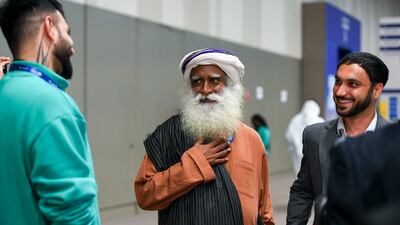
Sadhguru, founder and head of India's Isha Foundation, on day three. Khushnum Bhandari / The National -
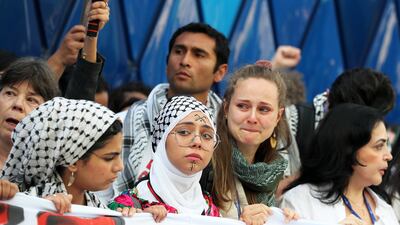
Cop28 demonstrators call for a ceasefire in Gaza. Pawan Singh / The National -

Brazil's popular pavilion. Chris Whiteoak / The National -

Expo City's impressive dome at night. Chris Whiteoak / The National -

Commissioned artwork titled The Choice by Tristan Eaton at Expo City. Chris Whiteoak / The National -
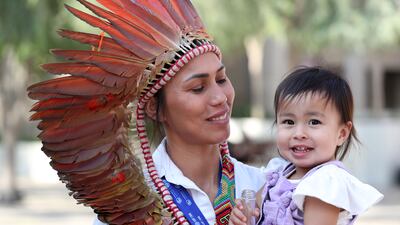
Visitors young and old at the site. Chris Whiteoak / The National -
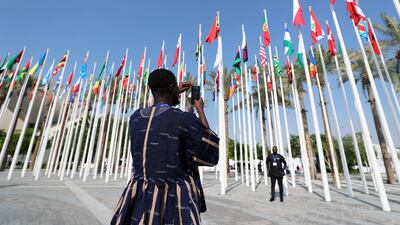
The summit is a global affair. Chris Whiteoak / The National -

Activists air their hopes at the site. Chris Whiteoak / The National -

Local and international communities are working together to secure a greener future. Chris Whiteoak / The National -

Visitors arrive for day six of the summit. Chris Whiteoak / The National -

Young activists from Engajamundo protest about smog being created from deforestation in the Amazon. Chris Whiteoak / The National -

Colours on display on day six. Chris Whiteoak / The National -

Members of a Sikh human rights group in attendence. Chris Whiteoak / The National -

Egyptian comic Bassem Youssef attends a talk on the sixth day. Chris Whiteoak / The National -

The Wake up experience with Sadhguru. Chris Whiteoak / The National -

The Wake up experience with Sadhguru. Chris Whiteoak / The National -

The first week of talks finished on a high, with hard negotiations planned for the second one. Khushnum Bhandari / The National -

Protestors call for a ban on fossil fuels. Khushnum Bhandari / The National -

Day seven's Sustainable Fashion show. Pawan Singh / The National -

Talks resumed on day nine, after a one-day break. Chris Whiteoak / The National -

Friends for Future protest to phase out fossil fuels on day nine. Chris Whiteoak / The National -

Global Campaign to Demand Climate Justice also demonstrate. Chris Whiteoak / The National -

International visitors at the site on day 11. Chris Whiteoak / The National -

People protest about 'no climate justice without human rights'. Chris Whiteoak / The National -

Mariam Almheiri, minister of Climate Change and Environment, speaks at the launch ceremony of the environmental identity. Chris Whiteoak / The National -

Visitors watch the protests. Chris Whiteoak / The National -

Day 11 at Cop28. Chris Whiteoak / The National -

Day 11 at Cop28. Chris Whiteoak / The National -

Indonesian dancers perform on day 12. Chris Whiteoak / The National -

Day 12 at Cop28. Chris Whiteoak / The National -

Negotiations remain under way on day 12. Chris Whiteoak / The National -

Messages left at the Indonesian pavilion. Chris Whiteoak / The National -

Protestors call for climate action to extend to food systems. Chris Whiteoak / The National -

Nuclear for Climate demonstrators. Chris Whiteoak / The National -
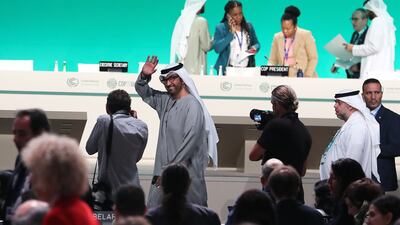
Dr Sultan Al Jaber, Cop28 President, arriving for the plenary session on day 14. Pawan Singh / The National


And thirdly, we must address the specific needs and priorities of developing economies. Communities on the frontlines of climate change, while bearing the brunt of the crisis, often have the least capacity to respond. Support, in the form of capacity building, knowledge sharing and technology transfers, is invaluable in helping them mitigate and adapt to our rapidly warming planet.
And this is where the power of partnership plays a vital role – an area where the UAE is, once again, leading the charge.
In yet another demonstration of its climate leadership, the UAE recently announced a strategic partnership with the International Renewable Energy Agency to support developing countries in strengthening their NDCs through the NDC Partnership – an initiative that enables countries to access technical and financial knowledge resources to build local capacities and accelerate climate action through specific national targets.
The UAE-Irena partnership, announced on the sidelines of the 79th UN General Assembly, will assist 20 developing economies in enhancing their climate commitments and implementing renewable energy projects. By partnering with Irena, the UAE’s leadership is extending beyond its borders, by helping to facilitate the transfer of knowledge, resources and technologies to countries that need it most.
Through its collaboration with Irena under the NDC Partnership, the UAE is helping to build capacities in developing countries, readying them to integrate renewable energy targets into their NDCs and laying the groundwork for a just and inclusive energy transition.
But our work is far from over. The path to a climate-positive future will be neither easy nor straightforward. It will require a doubling-down on collaboration, an unwavering political will and sustained action across all sectors of society.
It’s time for every country, every government and every organisation to join the global effort. The UAE has laid the foundation – now it’s up to all of us to build on it, together.

