


In US presidential elections, early September initiates a typically combative, fluctuating last two months. Vice President Kamala Harris has a small lead over former president Donald Trump, but the race remains a toss-up, ripe for daily intensification.
This campaign stage typically features accusations of flip-flopping, interrogating how and why candidates have altered their previous positions.
Ms Harris has clear exposure but also some protective padding. Most of her independent positions predate becoming President Joe Biden’s running mate in 2020. She has shifted on several important issues, such as petroleum extraction through fracking (which she now supports), single-payer public health care (now opposes), and immigration (now much tougher).
Ms Harris and the Democratic Party in general have shifted significantly to the centre. On immigration, in particular, it was stunning to watch her convention pledge to sign the “Langford bill” – a virtual wish list for Republicans on border issues – greeted with thunderous cheers by a Democratic crowd. And she is using Mr Trump’s cynical opposition to the bill as a powerful rebuttal on border-related criticism.
Confronted with such so-called flip-flops in a recent interview, she acknowledged some of her views have changed, but insisted her values haven’t. She suggested that she’s learnt a great deal after almost four years in the White House, and developed a keener appreciation of the need to “build consensus”, a clear nod to lessons from Mr Biden who has championed bipartisanship. Spending the past four years perforce supporting Mr Biden’s positions allows her to insist that his popular policies will continue but his unpopular ones won’t.
Mr Trump’s relationship with political, or other, consistency is far more tenuous. Despite decades as a public gadfly in New York and almost 10 years in national politics, it’s much easier to list the few issues on which he’s held firm: opposition to immigration and free trade, plus a long track record of racist and misogynistic words and deeds.

But on most policy issues, he’s highly flexible. He began as a liberal Democrat (except on racial matters), dabbled with libertarian and independent platforms, and is now a conservative Republican. But the public and the media have largely given him a pass on his pre-2015 stances.
It’s pointless to look for such consistency because Mr Trump doesn’t “do policy”. He does politics, and he appears mainly guided by how he thinks his base will react to developments in a 12-hour news cycle. In 2020, the Republican Party dispensed with issuing a platform altogether, simply affirming support for any of his positions – apparently because they couldn’t anticipate what he might come to favour.
This free-form flip-flopping is virtually priced into his political persona. For instance, few voters are likely to learn or care that he now supports decriminalisation of marijuana in his home state of Florida, though he was a hardline anti-drug president.
Nonetheless, he’s having extreme difficulty with the policy surely most associated with his presidency: prohibiting abortion.
Evangelical and other conservative Christians were initially sceptical, but in 2016 he persuaded them that he was serious about appointing Supreme Court justices who would prioritise ending almost 50 years of constitutionally protected access to early-term abortions. They eventually became the rock-solid cornerstone of his adoring base.
Through good fortune and cynical Senate chicanery, he appointed three of the nine current justices, and in 2022 that court indeed overturned the constitutional right to choice for American women. Mr Trump then spent years boasting that he was personally, if not single-handedly, responsible.
But in 2024, that’s all become a liability.
The court ruling, and widespread pushback against abortion access (and other vital women’s healthcare provisions) in conservative states is so unpopular that, ever since, in every competitive election in which reproductive health care has been a major issue, liberals have won (even in hyper-conservative states such as Alabama). Yet the new Republican party platform suggests that embryos do, or should, have unspecified constitutional rights, signalling a nationwide total abortion ban.
Mr Trump is clearly nervous, and with good reason.
-

The Supreme Court has overturned Roe v Wade, the major ruling that for nearly 50 years has guaranteed a constitutional right to abortion. EPA -
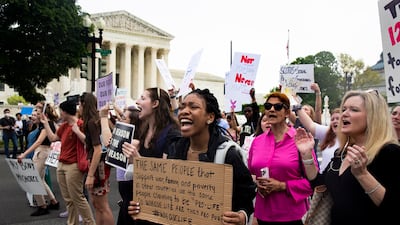
Abortion rights advocates march outside the Supreme Court in Washington. EPA -
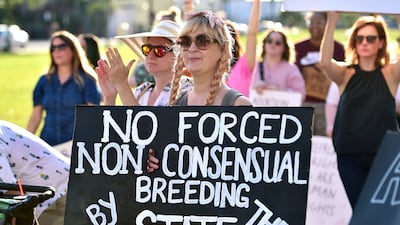
Emily Milford holds her protest sign during a rally in front of the Duval County Courthouse in Jacksonville, Florida. The Florida Times-Union / AP -

People participate in a protest in Foley Square, in New York City, New York, New York. Reuters -
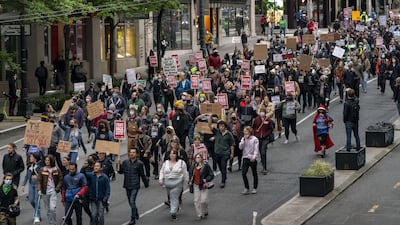
Demonstrators march through downtown following a rally in support of abortion rights in Seattle, Washington. Getty Images / AFP -
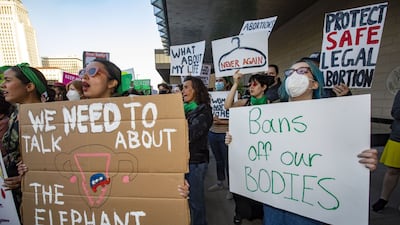
Demonstrators during an abortion rights protest outside a courthouse in Los Angeles, California. Bloomberg -
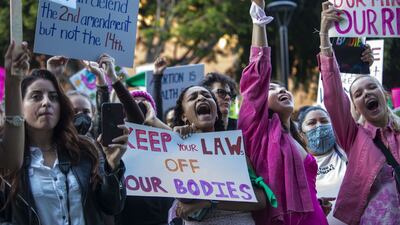
Demonstrators during an abortion rights protest in Los Angeles, California. Bloomberg -
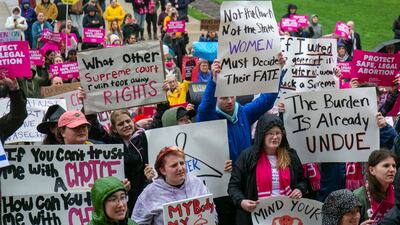
Protesters gather at the steps of the Michigan State Capitol in Lansing during a rally organised by Planned Parenthood. The Grand Rapids Press via AP -
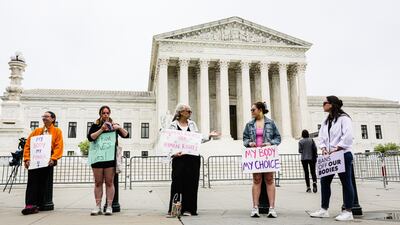
Protesters demonstrate outside the US Supreme Court in Washington. Bloomberg -
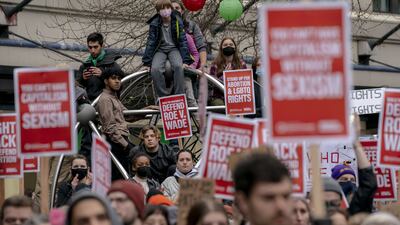
Demonstrators gather during a rally in support of abortion rights in Seattle, Washington. Getty Images / AFP -
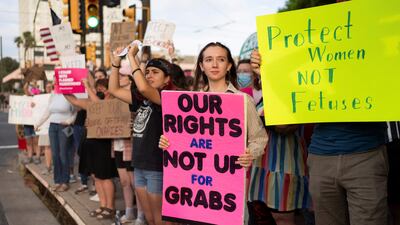
Abortion rights campaigners demonstrate outside of the US Federal Courthouse in Tucson, Arizona. Reuters -
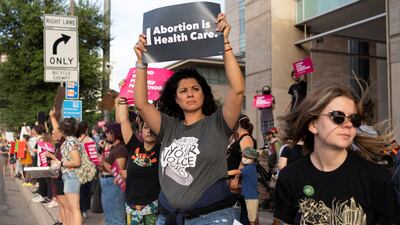
Women protest outside a courthouse in Tucson. Reuters -

Demonstrators make signs at a rally in Tucson. Reuters -
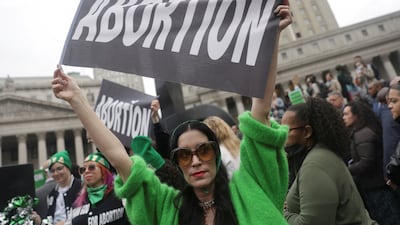
A woman holds up a flag during a protest in Foley Square in New York. Reuters -

The Supreme Court's decision to overturn Roe v Wade ends women's right to abortions. Reuters -
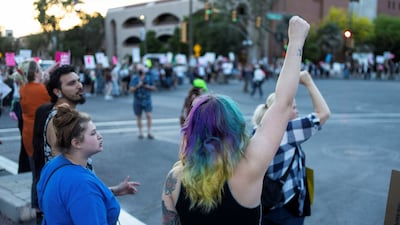
People demonstrate during an abortion rights rally in Tucson. Reuters -

Protesters blocks streets during an abortion rights rally in Tucson. Reuters -

Demonstrators march in the streets after protesting outside of the US Courthouse in Los Angeles, California, after a draft of the court's decision was released several weeks ago. AP -
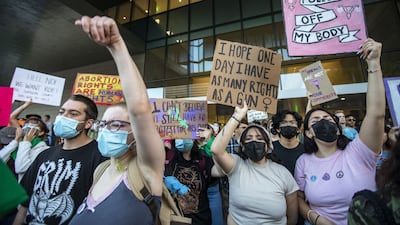
Demonstrators hold placards and shout slogans during an abortion rights protest in Los Angeles. Bloomberg -
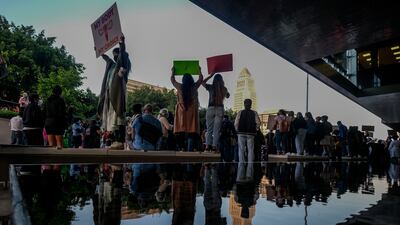
Demonstrators protest outside of the US Courthouse in Los Angeles. AP -

Two police officers are surrounded by a group of abortion rights demonstrators near Pershing Square in Los Angeles. AP


Eyebrows were raised when he insisted that another Trump term would be “great for women and their reproductive rights”. But his implication that he might vote for a referendum in Florida overturning the state’s highly restrictive six-week limit (when women often have no idea that they’ve become pregnant) made many of his anti-abortion supporters livid.
Inundated with criticism, he “clarified” that he would vote no, falsely claiming that the referendum would allow abortions through the ninth month. Such hyperbole is nothing new, since he has been wrongly insisting for years that Democrats support and allow for “after-birth abortions”, which is murder and unlawful everywhere.
Just as Mr Trump has failed to develop an effective counter to Ms Harris – his latest nickname for her, “Comrade Kamala”, unsurprisingly isn’t catching on – he hasn’t found a stance that accommodates his existing and possibly epoch-shaping anti-abortion policies while attenuating the price at the ballot box.
His main strategy in recent weeks has been to advocate leaving the matter to each state. That hasn’t appeased anyone, and it’s annoyed many on his side.
He even recently suggested universal coverage for in vitro fertilisation, which is considered murderous by much of his base. But it’s likely to prove one of his offhanded trial balloons, like his recent suggestion that graduating international students at US universities be given green cards, that end up on history’s cutting room floor.
The Harris campaign is so invested in reproductive rights that it’s highlighting them through a 50-stop national bus tour, beginning near Mr Trump’s home in Florida.
The candidates are bound to vigorously confront each other at the upcoming debate. Mr Trump would be wise not to again accuse Ms Harris of flip-flopping on her mixed racial identity by suddenly “turning black”. And she’s best advised to foreground women’s health care and force Mr Trump to either stand by or backtrack further from his strong restrictionist track record. His instincts for throwing red meat to his strongest supporters could help her task, although he’s likely to stick to his “leave it to each state” formula.
Flip-flopping accusations are largely ineffective political cliches. But Mr Trump’s close association with one of the most unpopular socio-political upheavals in recent history is almost certainly the biggest liability facing either candidate this year.

