Nick Donaldson / AFP


A new conflict is brewing in north-east Syria


Dareen Khalifa
Dareen Khalifa
  • English
  • Arabic

June 28, 2024

It has been five years since ISIS lost control of its last stronghold in its self-proclaimed caliphate. The group that once controlled territory eight times the size of Lebanon is no longer a global menace. However, the mission that brought together a global coalition of more than 60 states to fight it remains unfinished.

As an adaptable insurgency, ISIS has shifted its tactics. It relies on veteran, more decentralised cells to carry out a steady stream of small-scale yet deadly operations across parts of Syria, as well as some regions of Iraq. It extorts local businesses while simultaneously recruiting a new generation of fighters. Much as when its predecessor, Al Qaeda in Iraq, was on the ropes about 15 years ago, this approach keeps ISIS in the game, and generates revenue as it awaits an opportunity for resurgence.

North-east Syria remains especially vulnerable. The region that comprises ISIS’s former de facto capital, Raqqa, is currently controlled by Kurdish-led fighters best known as the Syrian Democratic Forces, or SDF. The SDF built its reputation as an effective counter-ISIS force on its ability to hold and secure the areas it captured. Yet this capacity is tied to continued American support and protection. Although few in number, the US troops and air assets based in the area deter the Syrian regime and its Russian and Iranian backers from attempting to retake the north-east by force. The American deployment also helps keep neighbouring Turkey from moving in to crush the SDF, whose parent organisation the Kurdistan Workers’ Party, or PKK, has fought an insurgency in Turkey since the early 1980s and is designated by Ankara (as well as Brussels and Washington) as a terrorist organisation.

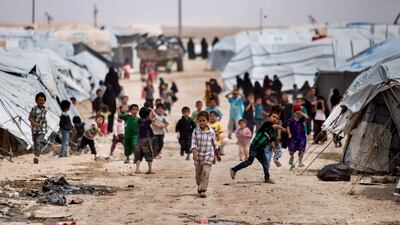
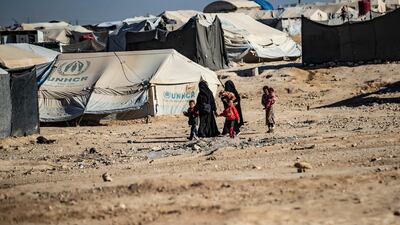
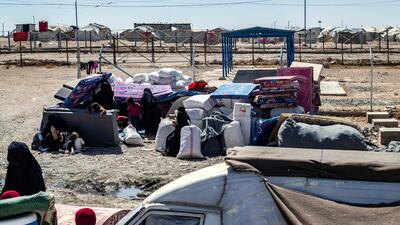
  • Al Hol camp in Al Hasakeh province, Syria, houses families of ISIS fighters. AP
    Al Hol camp in Al Hasakeh province, Syria, houses families of ISIS fighters. AP
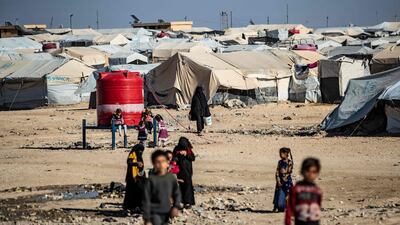
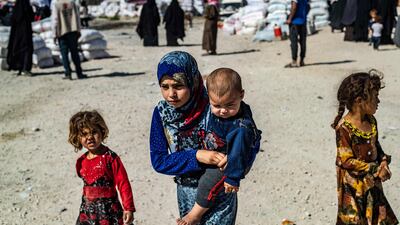
  • About 56,000 people, mostly women and children, live in crowded conditions in the camp. AFP
    About 56,000 people, mostly women and children, live in crowded conditions in the camp. AFP
  • Many of its residents have been there since ISIS was defeated in Syria in 2019. AFP
    Many of its residents have been there since ISIS was defeated in Syria in 2019. AFP
  • About 10,000 people at Al Hol are non-Arab foreign citizens, with the rest mostly from Syria and Iraq. AFP
    About 10,000 people at Al Hol are non-Arab foreign citizens, with the rest mostly from Syria and Iraq. AFP
  • The Al Hol camp, which holds relatives of suspected ISIS group fighters. AFP
    The Al Hol camp, which holds relatives of suspected ISIS group fighters. AFP
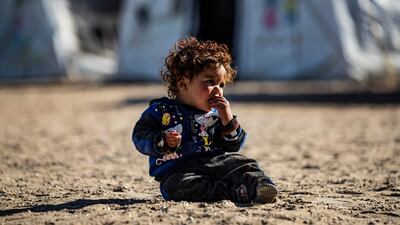
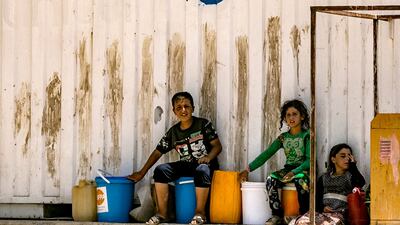
  • UK charity Save the Children says 40,000 children from 60 countries live in dire conditions in Syria's Roj and Al Hol camps. AFP
    UK charity Save the Children says 40,000 children from 60 countries live in dire conditions in Syria's Roj and Al Hol camps. AFP
  • Families at Al Hol gather their belongings as they prepare to return home to Syria's northern Raqqa region. AFP
    Families at Al Hol gather their belongings as they prepare to return home to Syria's northern Raqqa region. AFP
  • Two children die at the camp every week, Save the Children has said. AFP
    Two children die at the camp every week, Save the Children has said. AFP
  • There have been reports of women in the camp being detained and tortured by ISIS supporters. AFP
    There have been reports of women in the camp being detained and tortured by ISIS supporters. AFP
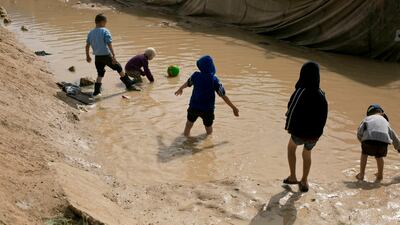
  • Children play in a mud puddle at Al Hol camp. AP
    Children play in a mud puddle at Al Hol camp. AP

But despite its earlier gains in battles against ISIS, the SDF is limited in its ability to keep a lid on ISIS cells in the area. SDF-held territory is relatively rich in natural resources, notably oil and gas, and has informal economic ties to the rest of Syria and Iraq. Relying on racketeering, extortion and smuggling, ISIS has been able to fund small-scale attacks, continue recruiting, support the families of its fighters and pay bribes to secure ISIS releases from SDF custody. As deadly cells continue to assassinate and threaten locals, they sow fear, thus hampering the SDF and US-led coalition’s efforts to collect the intelligence needed to mop up ISIS remnants.

The detention centres and camps holding ISIS inmates, affiliated women, and children are equally vulnerable. The SDF has been housing families of foreign and Syrian ISIS fighters in makeshift camps, with the largest one located in Al Hol, Hasakah. In 2019, thousands of people who fled the militants’ last stronghold in Deir Ezzor were placed in this camp as a "temporary measure". Five years later, the camp not only still exists, but security and humanitarian conditions inside it have deteriorated significantly, with ISIS visibly active in parts of it. Today, the camp houses more than 40,000 people, mostly children (thousands of whom are undocumented) and female relatives of suspected ISIS militants from diverse backgrounds and affiliations, many of them Iraqis. They are living in horrendous conditions and continuously attempt to escape.

A full US withdrawal from Syria would likely put Kurdish-led fighters in direct confrontation with powerful adversaries

These camps have received a good deal of attention from western policy makers, but little has changed. Al Hol camp in particular has become infamous, regularly appearing in media headlines and as the focus of numerous US government meetings. Yet this coverage and scrutiny have not translated into a strategy by the SDF or the coalition to provide an acceptable and humane exit for those who remain trapped there; apart from thousands of Iraqis who have been repatriated, most efforts have focused on the camp’s smaller group of Europeans. Likewise, the SDF’s arduous – and arguably thankless – mission to hold families suspected of ISIS affiliation has led to opposition from rights groups and criticism from locals who want the SDF's resources directed to improving governance and security in their areas.

The SDF has accused European governments of dragging their feet on repatriating their citizens. Conversely, western officials have accused the SDF of using the camps as a bargaining chip. Both sides have a point. Some European governments have even revoked the citizenship of their stranded nationals, in an attempt to absolve themselves of the problem. Meanwhile, the SDF has tried to leverage the situation, seeking political recognition in exchange for keeping the foreign detainees away from Europe. Despite American diplomatic efforts, this continuing standoff has hindered any decisive resolution to the crisis in the camps.

The fates of these camps and their residents are tied to the continuation of a shaky status quo. The SDF has spent significant bandwidth and resources to secure and maintain the camps, and it is highly unlikely that it would voluntarily ease its grip over them. But a lot could go wrong. It could find itself in a very precarious situation if Donald Trump were to return to power.

During his last term, Mr Trump expressed his desire – more than once – to pull American troops out of Syria, and showed little concern for the consequences of the precipitous US military drawdown he ordered. A ull American withdrawal from Syria, or perhaps even the sense that one might be imminent, would probably put the SDF in direct confrontation with adversaries much more powerful than itself, be it Turkey, Damascus and its Russian and Iranian backers, or all of the above. In this scenario, it’s hard to see the SDF prioritising guarding the camps over protecting its own territory.

Today this very real risk is buried down a list of more pressing international conflicts, but the fear is that if and when it happens, it might be too late to do much about it. And if the war in Gaza has taught us anything, it’s that ignoring problems in the Middle East will not make them go away.


THE SPECS


Engine: 1.5-litre


Transmission: 6-speed automatic


Power: 110 horsepower 


Torque: 147Nm 


Price: From Dh59,700 


On sale: now  


Leap of Faith

Michael J Mazarr

Public Affairs

Dh67
 

The%20US%20Congress%20explained
%3Cp%3E-%20Congress%20is%20one%20of%20three%20branches%20of%20the%20US%20government%2C%20and%20the%20one%20that%20creates%20the%20nation's%20federal%20laws%3C%2Fp%3E%0A%3Cp%3E-%20Congress%20is%20divided%20into%20two%20chambers%3A%20The%20House%20of%20Representatives%20and%20the%20Senate%3C%2Fp%3E%0A%3Cp%3E-%C2%A0The%20House%20is%20made%20up%20of%20435%20members%20based%20on%20a%20state's%20population.%20House%20members%20are%20up%20for%20election%20every%20two%20years%3C%2Fp%3E%0A%3Cp%3E-%20A%20bill%20must%20be%20approved%20by%20both%20the%20House%20and%20Senate%20before%20it%20goes%20to%20the%20president's%20desk%20for%20signature%3C%2Fp%3E%0A%3Cp%3E-%20A%20political%20party%20needs%20218%20seats%20to%20be%20in%20control%20of%20the%20House%20of%20Representatives%3C%2Fp%3E%0A%3Cp%3E-%20The%20Senate%20is%20comprised%20of%20100%20members%2C%20with%20each%20state%20receiving%20two%20senators.%20Senate%20members%20serve%20six-year%20terms%3C%2Fp%3E%0A%3Cp%3E-%20A%20political%20party%20needs%2051%20seats%20to%20control%20the%20Senate.%20In%20the%20case%20of%20a%2050-50%20tie%2C%20the%20party%20of%20the%20president%20controls%20the%20Senate%3C%2Fp%3E%0A
Panipat

Director Ashutosh Gowariker

Produced Ashutosh Gowariker, Rohit Shelatkar, Reliance Entertainment

Cast Arjun Kapoor, Sanjay Dutt, Kriti Sanon, Mohnish Behl, Padmini Kolhapure, Zeenat Aman

Rating 3 /stars

The Lowdown

Kesari

Rating: 2.5/5 stars
Produced by: Dharma Productions, Azure Entertainment
Directed by: Anubhav Singh
Cast: Akshay Kumar, Parineeti Chopra


Dust and sand storms compared

Sand storm

  • Particle size: Larger, heavier sand grains
  • Visibility: Often dramatic with thick "walls" of sand
  • Duration: Short-lived, typically localised
  • Travel distance: Limited 
  • Source: Open desert areas with strong winds

Dust storm

  • Particle size: Much finer, lightweight particles
  • Visibility: Hazy skies but less intense
  • Duration: Can linger for days
  • Travel distance: Long-range, up to thousands of kilometres
  • Source: Can be carried from distant regions
Lexus LX700h specs

Engine: 3.4-litre twin-turbo V6 plus supplementary electric motor

Power: 464hp at 5,200rpm

Torque: 790Nm from 2,000-3,600rpm

Transmission: 10-speed auto

Fuel consumption: 11.7L/100km

On sale: Now

Price: From Dh590,000

The specs

Engine: 4.0-litre V8 twin-turbocharged and three electric motors

Power: Combined output 920hp

Torque: 730Nm at 4,000-7,000rpm

Transmission: 8-speed dual-clutch automatic

Fuel consumption: 11.2L/100km

On sale: Now, deliveries expected later in 2025

Price: expected to start at Dh1,432,000

Ten tax points to be aware of in 2026

1. Domestic VAT refund amendments: request your refund within five years

If a business does not apply for the refund on time, they lose their credit.

2. E-invoicing in the UAE

Businesses should continue preparing for the implementation of e-invoicing in the UAE, with 2026 a preparation and transition period ahead of phased mandatory adoption. 

3. More tax audits

Tax authorities are increasingly using data already available across multiple filings to identify audit risks. 

4. More beneficial VAT and excise tax penalty regime

Tax disputes are expected to become more frequent and more structured, with clearer administrative objection and appeal processes. The UAE has adopted a new penalty regime for VAT and excise disputes, which now mirrors the penalty regime for corporate tax.

5. Greater emphasis on statutory audit

There is a greater need for the accuracy of financial statements. The International Financial Reporting Standards standards need to be strictly adhered to and, as a result, the quality of the audits will need to increase.

6. Further transfer pricing enforcement

Transfer pricing enforcement, which refers to the practice of establishing prices for internal transactions between related entities, is expected to broaden in scope. The UAE will shortly open the possibility to negotiate advance pricing agreements, or essentially rulings for transfer pricing purposes. 

7. Limited time periods for audits

Recent amendments also introduce a default five-year limitation period for tax audits and assessments, subject to specific statutory exceptions. While the standard audit and assessment period is five years, this may be extended to up to 15 years in cases involving fraud or tax evasion. 

8. Pillar 2 implementation 

Many multinational groups will begin to feel the practical effect of the Domestic Minimum Top-Up Tax (DMTT), the UAE's implementation of the OECD’s global minimum tax under Pillar 2. While the rules apply for financial years starting on or after January 1, 2025, it is 2026 that marks the transition to an operational phase.

9. Reduced compliance obligations for imported goods and services

Businesses that apply the reverse-charge mechanism for VAT purposes in the UAE may benefit from reduced compliance obligations. 

10. Substance and CbC reporting focus

Tax authorities are expected to continue strengthening the enforcement of economic substance and Country-by-Country (CbC) reporting frameworks. In the UAE, these regimes are increasingly being used as risk-assessment tools, providing tax authorities with a comprehensive view of multinational groups’ global footprints and enabling them to assess whether profits are aligned with real economic activity. 

Contributed by Thomas Vanhee and Hend Rashwan, Aurifer

Mercer, the investment consulting arm of US services company Marsh & McLennan, expects its wealth division to at least double its assets under management (AUM) in the Middle East as wealth in the region continues to grow despite economic headwinds, a company official said.

Mercer Wealth, which globally has $160 billion in AUM, plans to boost its AUM in the region to $2-$3bn in the next 2-3 years from the present $1bn, said Yasir AbuShaban, a Dubai-based principal with Mercer Wealth.

Within the next two to three years, we are looking at reaching $2 to $3 billion as a conservative estimate and we do see an opportunity to do so,” said Mr AbuShaban.

Mercer does not directly make investments, but allocates clients’ money they have discretion to, to professional asset managers. They also provide advice to clients.

“We have buying power. We can negotiate on their (client’s) behalf with asset managers to provide them lower fees than they otherwise would have to get on their own,” he added.

Mercer Wealth’s clients include sovereign wealth funds, family offices, and insurance companies among others.

From its office in Dubai, Mercer also looks after Africa, India and Turkey, where they also see opportunity for growth.

Wealth creation in Middle East and Africa (MEA) grew 8.5 per cent to $8.1 trillion last year from $7.5tn in 2015, higher than last year’s global average of 6 per cent and the second-highest growth in a region after Asia-Pacific which grew 9.9 per cent, according to consultancy Boston Consulting Group (BCG). In the region, where wealth grew just 1.9 per cent in 2015 compared with 2014, a pickup in oil prices has helped in wealth generation.

BCG is forecasting MEA wealth will rise to $12tn by 2021, growing at an annual average of 8 per cent.

Drivers of wealth generation in the region will be split evenly between new wealth creation and growth of performance of existing assets, according to BCG.

Another general trend in the region is clients’ looking for a comprehensive approach to investing, according to Mr AbuShaban.

“Institutional investors or some of the families are seeing a slowdown in the available capital they have to invest and in that sense they are looking at optimizing the way they manage their portfolios and making sure they are not investing haphazardly and different parts of their investment are working together,” said Mr AbuShaban.

Some clients also have a higher appetite for risk, given the low interest-rate environment that does not provide enough yield for some institutional investors. These clients are keen to invest in illiquid assets, such as private equity and infrastructure.

“What we have seen is a desire for higher returns in what has been a low-return environment specifically in various fixed income or bonds,” he said.

“In this environment, we have seen a de facto increase in the risk that clients are taking in things like illiquid investments, private equity investments, infrastructure and private debt, those kind of investments were higher illiquidity results in incrementally higher returns.”

The Abu Dhabi Investment Authority, one of the largest sovereign wealth funds, said in its 2016 report that has gradually increased its exposure in direct private equity and private credit transactions, mainly in Asian markets and especially in China and India. The authority’s private equity department focused on structured equities owing to “their defensive characteristics.”

PROFILE OF CURE.FIT

Started: July 2016

Founders: Mukesh Bansal and Ankit Nagori

Based: Bangalore, India

Sector: Health & wellness

Size: 500 employees

Investment: $250 million

Investors: Accel, Oaktree Capital (US); Chiratae Ventures, Epiq Capital, Innoven Capital, Kalaari Capital, Kotak Mahindra Bank, Piramal Group’s Anand Piramal, Pratithi Investment Trust, Ratan Tata (India); and Unilever Ventures (Unilever’s global venture capital arm)

COMPANY%20PROFILE%20
%3Cp%3E%3Cstrong%3ECompany%20name%3A%20%3C%2Fstrong%3EAlmouneer%3Cbr%3E%3Cstrong%3EStarted%3A%3C%2Fstrong%3E%202017%3Cbr%3E%3Cstrong%3EFounders%3A%3C%2Fstrong%3E%20Dr%20Noha%20Khater%20and%20Rania%20Kadry%3Cbr%3E%3Cstrong%3EBased%3A%20%3C%2Fstrong%3EEgypt%3Cbr%3E%3Cstrong%3ENumber%20of%20staff%3A%20%3C%2Fstrong%3E120%3Cbr%3E%3Cstrong%3EInvestment%3A%20%3C%2Fstrong%3EBootstrapped%2C%20with%20support%20from%20Insead%20and%20Egyptian%20government%2C%20seed%20round%20of%20%3Cbr%3E%243.6%20million%20led%20by%20Global%20Ventures%3Cbr%3E%3C%2Fp%3E%0A
Dengue%20fever%20symptoms
%3Cp%3EHigh%20fever%20(40%C2%B0C%2F104%C2%B0F)%3Cbr%3ESevere%20headache%3Cbr%3EPain%20behind%20the%20eyes%3Cbr%3EMuscle%20and%20joint%20pains%3Cbr%3ENausea%3Cbr%3EVomiting%3Cbr%3ESwollen%20glands%3Cbr%3ERash%26nbsp%3B%3C%2Fp%3E%0A
In numbers

1,000 tonnes of waste collected daily:

  • 800 tonnes converted into alternative fuel
  • 150 tonnes to landfill
  • 50 tonnes sold as scrap metal

800 tonnes of RDF replaces 500 tonnes of coal

Two conveyor lines treat more than 350,000 tonnes of waste per year

25 staff on site


Our family matters legal consultant

Name: Hassan Mohsen Elhais

Position: legal consultant with Al Rowaad Advocates and Legal Consultants.

Tamkeen's offering
  • Option 1: 70% in year 1, 50% in year 2, 30% in year 3
  • Option 2: 50% across three years
  • Option 3: 30% across five years 
Updated: July 01, 2024, 3:52 PM