


Recent work by the Tourism and Archaeology Department of Umm Al Quwain has brought to light an ancient pearling town and Christian monastery on Sinniyah Island. The archaeologists working on the project – of whom I am one – believe that these remains can be identified with the “lost city” of Tu’am.
But what, exactly, does this claim entail and why is it significant to the history of the Emirates?
Tu’am is described by Arabic geographical and historical sources written in the Golden Age of Islam. However, these sources were in turn based on earlier material, including poetry and tribal traditions, that reached back to the pre-Islamic period.
Accordingly, the 11th-century Spanish geographer Al Bakri made the following entry on Tu’am:
“It is a place in Bahrain and it is pearl fishery. Tu’am is a local capital in Oman. It neighbours Oman at the sea named Tu’am and it neighbours the land known as Sohar. In Tu’am there is a pearl fishery and to Tu’am is attributed the Tu’amian Pearl.”
In this period “Bahrain” was used to refer to north-east Arabia and “Oman” was used to refer to south-east Arabia.
Additional information was collected by the 13th-century Syrian geographer Yaqut Al Hamawi, who wrote:
“Tu’am is the name of a local capital of Oman comprising that which neighbours the coast and Sohar is its [ie Oman’s] local capital comprising that which neighbours the mountains. Pearls are associated with it and there are many villages in it.”
The geographers understood the Omani Peninsula divided the Arabian Gulf and Indian Ocean, with Tu’am and Sohar as the main towns of the respective shores.
Tu’am is described as a qasabah – “local capital” – a word some readers may be familiar with from the famous casbahs of Morocco. Yet it possessed “many villages” and must therefore also have been a region. As such, it may be regarded as a proto-emirate: a local capital surrounded by a hinterland territory of the same name.
-

What is believed to be part of the lost city of 'Tu’am', with remnants of tenements on right. All photos: Umm Al Quwain Department of Tourism and Archaeology -
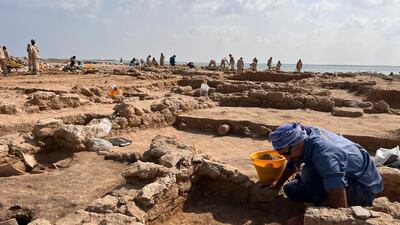
Archaeologists worked at the site on Sinniyah Island in Umm Al Quwain from January to March. -
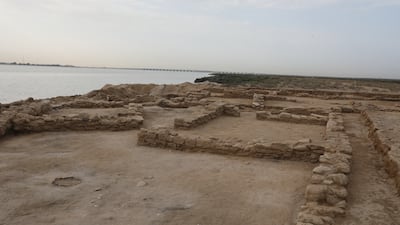
The settlement was once an important coastal city. -

Dr Michele Degli Esposti, head of the Italian Archaeological Mission in Umm Al Quwain and researcher at the Polish Academy of Sciences, surveys part of the site. -
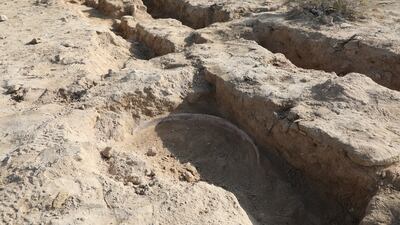
A jar popping out from the soil. Experts believe this may have been one of the tannour ovens or used for storage. -
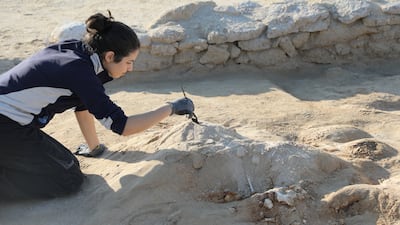
Experts examine the site of a mass burial in the monastery area of the site. -

Prof Tim Power of UAE University said it was major find. Chris Whiteoak / The National -
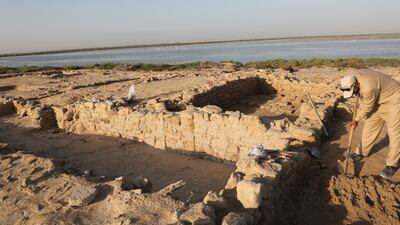
The site sits on Sinniyah Island close to the Khor Al Beida lagoon. -
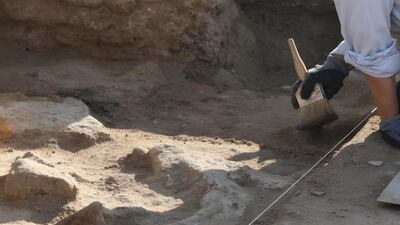
Four seasons of work have now been completed at the site. -
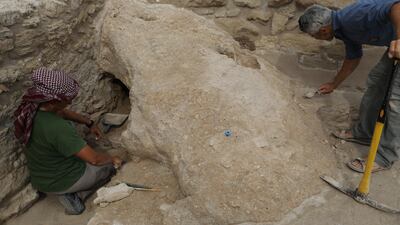
Experts examine part of the monastery area. -

An aerial view of the central core of the monastic centre, with surrounding isolated buildings which could have been accommodation for monks.


While the Arabic geographies are clear about the where and what of Tu’am – it was the leading pearling town of the Gulf coast of the Emirates with a hinterland territory containing many villages – they are quite hazy about the when. The Islamic historical tradition fortunately provides the answer.
The 18th-century Omani historian Al Izkawi, drawing on much older sources, describes the role of Tu’am in pre-Islamic Arab migration:
“The tribe of the Azd ceased not to migrate to Oman, until at last they became numerous therein, and their power and fame increased. At length, they overran the country and extended as far as Bahrain … Then came to Oman Sama bin Lu’ayy bin Ghalib [of Quraysh] who settled at Tu’am in the vicinity of the Azd. Sama married his daughter to Azd bin Imran bin Amr.”
This marriage cemented a powerful tribal confederation and constitutes a key episode in the Arabisation of the region. According to the ninth-century Iraqi polymath Al Asma'i, “the progeny of Imran bin Amr bin Amir seized Oman from its people”. Tu’am was therefore the launchpad for the final chapter in the legendary Arab conquest of south-east Arabia.
When the Arabisation of the Emirates occurred remains a matter of scholarly debate. Arguably, it may be placed in the aftermath of the collapse of the indigenous Mleiha civilisation in the third and fourth centuries of the Common Era.
Tu’am was last mentioned, albeit obliquely, in connection with the Umayyad invasion in the early eighth century. The 19th-century Omani historian Salil ibn Raziq, again drawing on earlier source material, reports that “a man of people of Tu’am” brought news of the impending invasion fleet, which fits with a coastal location described by the earlier Arabic geographers.
Thereafter, Julfar in neighbouring Ras Al Khaimah became the principal coastal settlement of the Emirates, and remained so for the Islamic Middle Ages. The shift from Tu’am to Julfar probably occurred between the seventh and eighth centuries when the region was brought into the administrative structure of the caliphate.
A thousand years later, Omani historians in the 18th and 19th centuries encountered Tu’am in the earlier sources they were using. The problem, however, was that Tu’am had long since passed from memory and its location was no longer known. They vaguely knew it to be somewhere to the north and identified it with Buraimi and Al Ain.
This is not perhaps entirely inaccurate. Since Tu’am was both town and territory, it may have reached as far inland as the oases of Al Ain and Buraimi. Nevertheless, the 10th-century Palestinian geographer Al Muqaddasi instead refers to Hafit, “abounding in palms”, a name more closely associated with Al Ain that survives to this day.
The identification of Tu’am with Al Ain and Buraimi was reproduced uncritically by British colonialists and Arab nationalists in the 1960s and '70s, which coincided with the creation of the United Arab Emirates. The result was a roundabout and hospital in Al Ain named after Tu’am, an attempt to give deep roots to the new nation.
Tu’am means “twins” in Arabic. This curious name hides a deeper significance. Arabic Tu’am is equivalent to Syriac T’ome, rendered into Greek and ultimately English as Thomas. And who was this Thomas? None other than St Thomas the Apostle, of whom the fourth-century church historian Eusebius wrote:
“When the Holy Apostles and disciples of our Saviour were scattered over all the world, Thomas, so the tradition has it, obtained as his portion the Parthian Empire.”
Tu’am seems, therefore, to have been named in honour of St Thomas the Apostle of the East.
This leads us back to Sinniyah Island and its Christian monastery. The History of St Jonah, a Syriac hagiography composed sometime between the sixth and eighth centuries, describes the journey of a miracle-working saint. He stayed at the Monastery of St Thomas, located on an island off the Gulf coast of the Emirates.
Given the meaning of the place name Tu’am, we cannot help but wonder if the Monastery of St Thomas described in this text is the same as the Sinniyah Monastery.
The historical sources briefly outlined above, therefore, describe a Christianised pearling town on the Gulf coast of the Emirates that thrived in the centuries before the rise of Islam. That very closely fits the pearling town and Christian monastery found on Sinniyah Island.
Although we cannot be sure that the archaeological remains on Sinniyah Island represent the Tu’am of the historical sources, nothing else comparable has ever been found despite 70 years of archaeological prospection. Sinniyah thus constitutes the best-known candidate for Tu’am.
The identification of Tu’am with Sinniyah is of major importance for the UAE, given the historic role of Tu’am in the Arabisation and Islamisation of this Muslim Arab nation. These far-reaching events can now be placed in and around Sinniyah Island in the lagoon of Umm Al Quwain.

