

In more sensible times, the mobilisation of students in a vast anti-war movement would be grounds for inspiration. In a world of reason and truth, peaceful protesters calling for an end to an ongoing massacre would be anointed heroes, applauded as pillars of democratic society, maybe even awarded medals.
In normal times, there would be no controversy about opposing an indiscriminate military attack against a besieged, occupied territory by a nuclear power reducing it to rubble. There would be no confusion about who the victim is. There should be no confusion.
Chants such as “Free, Free, Palestine” and “End the siege on Gaza now” resonating across US college campuses, from Columbia University and Massachusetts Institute of Technology to New York University, should be met with praise from American authorities. At the very least, with an acknowledgment, and – if I dare be so idealistic – a change in policy.
They should be the catalyst to an end of the White House’s military and political support to the Israeli government – a government that has killed more than 34,400 Palestinians, according to local health authorities in Gaza since October 7, all in the name of eradicating Hamas.
Unfortunately, the present period is neither sensible nor reasonable, and far from ideal. We are, as it is becoming clearer every day, a long way from normal democratic practice. Instead of protecting protesters, the police are once again attacking them. Instead of listening to students, authorities from the US to France are vilifying them.

While Israeli Prime Minister Benjamin Netanyahu described those protesting against his war as “horrific” – a word better suited to describe the mass graves that his troops allegedly left behind in Nasser Hospital in Khan Younis rather than the young men and women holding peace banners in America – he was far from the only leader to do so. In the US, Speaker of the House of Representatives Mike Johnson claimed that Hamas backed the Columbia protests, peddling misinformation to justify the assault on the protesters.
In the past few weeks, students at Columbia have faced insurmountable intimidation from faculty members and authorities alike.
According to several reports, student protesters calling for a ceasefire in Gaza, some of whom are brilliant minds I personally know, have been called “terrorists” and “Hamas”. They have been accused – either without proof or on the basis of disparate, albeit serious, incidents – of leading an anti-Semitic movement.
No matter how many of the students, in official and personal capacity, have renounced the grave accusation, no matter the clear and unequivocal affirmation that Jews are as much part of the protests as anyone else, and no matter the dedication of the student body to fight discrimination in all its kinds, we continue to see this heinous crime instrumentalised against pro-Palestinian voices since October 7, in order to crack down on any form of criticism of Israel.
It does not stop there. A small group of extremists supporting Israel have assaulted protesters. In one incident, they reportedly launched skunk bombs at them, injuring more than a dozen. Rather than mediate and defend its student protesters, the universities too have attempted time and again to end the movement.
As student activists set up their first encampment, which has become a political hub for anti-war thinkers and activists calling on their university to divest from Israeli investments, the administration responded by calling the police. As the encampments spread across student networks in other universities and countries, so did the tools of repression, from one campus to the other, from one state to the next.
-
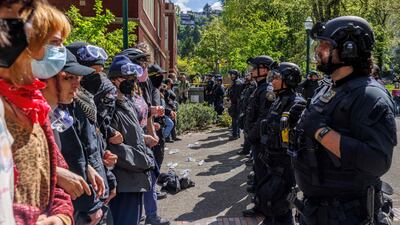
Students and activists protesting against the Gaza war face police after demonstrators were evicted from the library at Portland State University in Oregon. AFP -

A car is damaged after it was driven towards protesters at Portland State University. AFP -
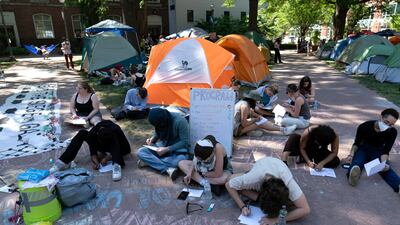
Students write letters in support of Palestinians in Gaza at an encampment at George Washington University, in Washington. AP -
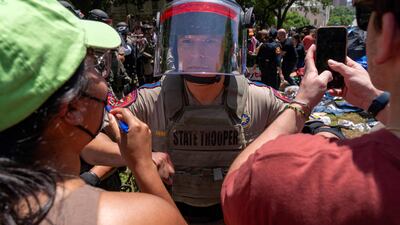
Pro-Palestinian protesters confront a state trooper at the University of Texas in Austin. AFP -
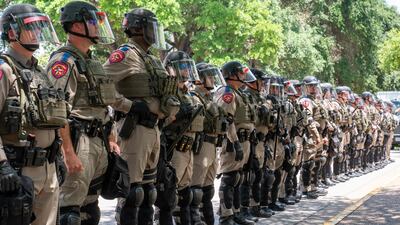
Texas State troopers stand guard at the University of Texas. AFP -
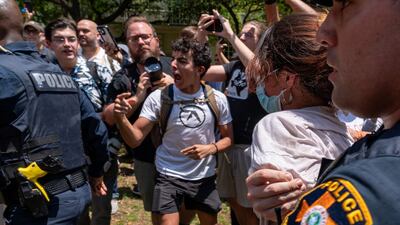
A protester confronts University of Texas police. AFP -

A demonstrator protests outside the encampment established in support of Palestinians in Gaza at Columbia University, in New York City. AFP -
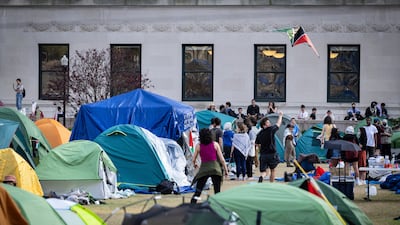
A student protester flies a kite inside the protest encampment at Columbia University. AP -
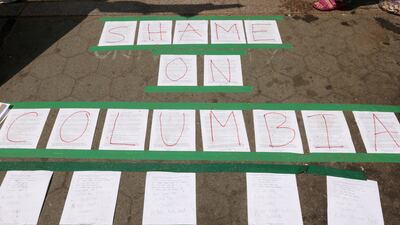
Students at Columbia University write a message as the conflict between Israel and Hamas continues. Reuters -
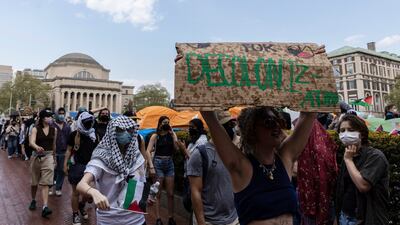
Student protesters march round their encampment at Columbia University. AP -
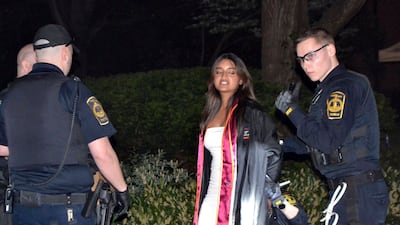
A student is arrested at a protest encampment on the Virginia Tech campus in Blacksburg. AP -
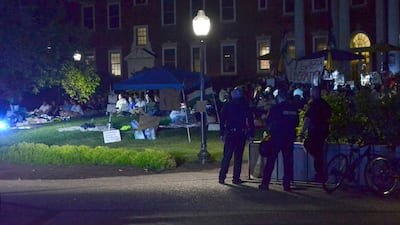
Police move to bring down an encampment after several days of protests by pro-Palestinian activists on the Virginia Tech campus. AP -

Vish Gill, a prominent figure at pro-Palestine protests, is arrested at Virginia Tech campus. AP -
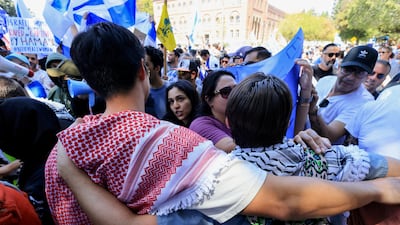
Pro-Israel counter-protesters gather at a pro-Palestine demonstration at the University of California, Los Angeles. Reuters -
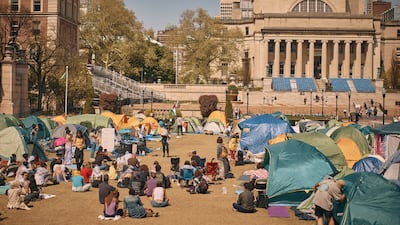
Pro-Palestine demonstrators gather on the campus of Columbia University. AP


The attacks, both verbal and physical, continue. As I flew back to Beirut from a stay in Cambridge, Boston, in the state that’s home to esteemed academic institutions, my mind kept going back to the young, promising students with their lives ahead of them who have been suspended and kicked out of programmes, vilified and aggressed, simply for standing up for what is right.
There’s no other word to describe it. Despite the efforts to complicate it, the truth about what is right is simple. Though it’s long overdue, almost every legitimate and credible entity on the planet acknowledges Israel’s assault on the Palestinian people, in one way or another.
From the International Court of Justice to the UN, Israel’s actions have been described as amounting to genocidal. The killing of civilians, women, children, aid workers, journalists and doctors is documented, and evidence gathered. The destruction of Gaza is ongoing, the occupation of the West Bank is steadfast, and the historical facts of the past 75 years are written for those who care to read. This is all undeniable, and yet there are those who will deny students’ rights to denounce it, right here in the US.
I published, a few days ago, a video in solidarity with the parents of those students. As a father myself, I am deeply affected by the challenges and uncertainties that we navigate to protect our children, and encourage their struggle. I reflect, in the video, on the story of Tamara Rasamny, the daughter of my good friend Walid, who was suspended from Columbia just days ahead of her graduation. Her dedication to these peaceful protests for justice, for basic human rights, highlights courage.
What we are witnessing is a dangerous assault on protests and free speech. Worse, we’re witnessing it on college campuses, in the very nations that have prided themselves on defending democratic values.
Universities have long been the focal sites of change. They are where ideas clash, not people, and where new worlds are built. This is truer today than ever, and we should support the students today as they ask for a world of peace, of justice and equality for all.

