


The recent escalation between Iran and Israel has raised concerns in Gulf countries, particularly their collective desire to defuse regional tensions and their preference for diplomatic solutions over military ones. The recent developments have added even more fuel to the already raging fire that is the tragic war in the Gaza Strip, which has consequences for the Middle East as a whole.
In this context, recent Gulf diplomacy sends a clear message that there is no retreating from the region’s emphasis on expanding the portfolio of economic, investment and development projects.
The GCC countries will continue to maintain a two-pronged approach. They believe that positive and constructive engagement with turbulent geopolitical developments and reiterating their call for de-escalation and calm do not conflict with maintaining progress and keeping up with rapid developments in technology, artificial intelligence and economic reconstruction to adapt and prepare for the post-oil era.
-
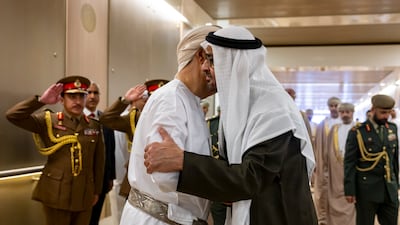
President Sheikh Mohamed bids farewell to Sultan Haitham of Oman, at the Presidential Airport in Abu Dhabi. All photos: UAE Presidential Court -
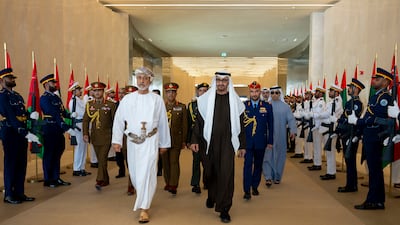
President Sheikh Mohamed bids farewell to Sultan Haitham of Oman, at the Presidential Airport in Abu Dhabi -
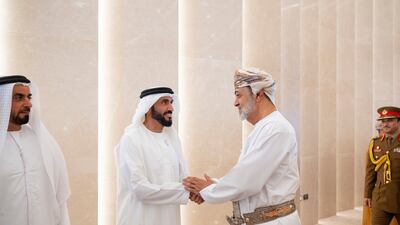
Sheikh Saif bin Zayed, Deputy Prime Minister and Minister of Interior, and Sheikh Nahyan Bin Zayed, Chairman of the Board of Trustees of Zayed bin Sultan Al Nahyan Charitable and Humanitarian Foundation, bid farewell to Sultan Haitham -
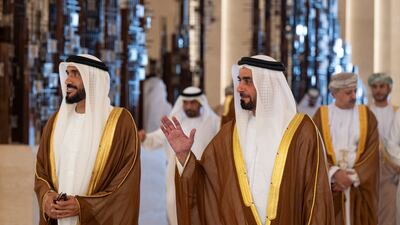
Sheikh Saif bin Zayed, Deputy Prime Minister and Minister of Interior, and Sheikh Nahyan Bin Zayed, Chairman of the Board of Trustees of Zayed bin Sultan Al Nahyan Charitable and Humanitarian Foundation, await the departure of Sultan Haitham (not shown), at the Presidential Airport -
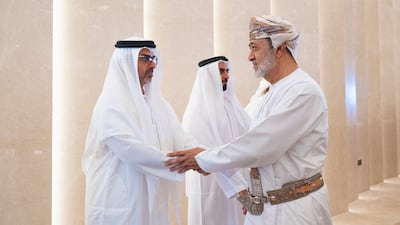
Sheikh Hamed bin Zayed bids farewell to Sultan Haitham -
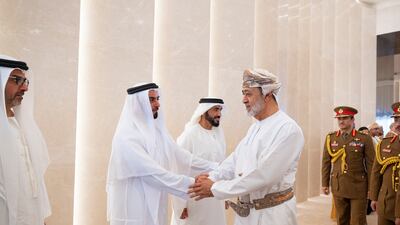
Sheikh Saif bin Zayed, Deputy Prime Minister and Minister of Interior, Sheikh Nahyan Bin Zayed, Chairman of the Board of Trustees of Zayed bin Sultan Al Nahyan Charitable and Humanitarian Foundation, and Sheikh Hamed bin Zayed, bid farewell to Sultan Haitham -
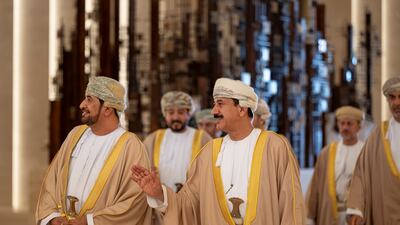
Members of the Omani Delegation await the departure of Sultan Haitham at the Presidential Airport -
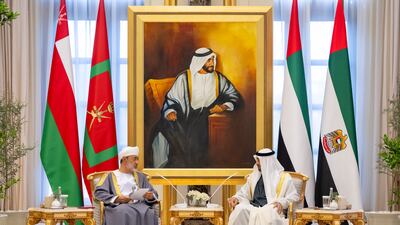
President Sheikh Mohamed and Sultan Haitham witnessed the signing of agreements aimed at further strengthening relations between the Gulf neighbours -
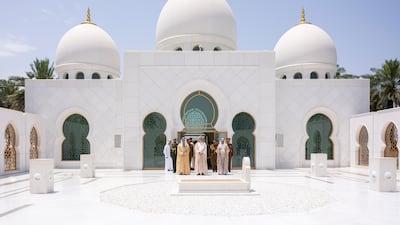
Sheikh Mansour bin Zayed, Vice President, Deputy Prime Minister and Chairman of the Presidential Court, and Sultan Haitham, pray at the tomb of UAE Founding Father, the late Sheikh Zayed bin Sultan Al Nahyan, at the Sheikh Zayed Grand Mosque -
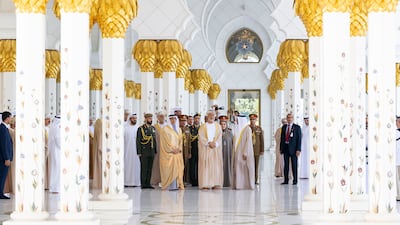
Sultan Haitham and Sheikh Mansour at the Sheikh Zayed Grand Mosque -
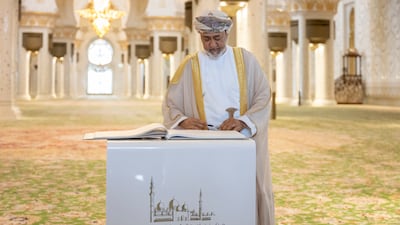
Sultan Haitham signs a guest book during a visit the Sheikh Zayed Grand Mosque -
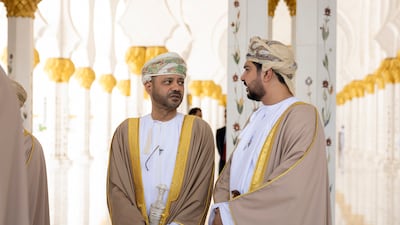
Oma's Foreign Minister Sayyid Badr bin Hamad and Commerce Minister Qais Al Yousef at the Sheikh Zayed Grand Mosque -
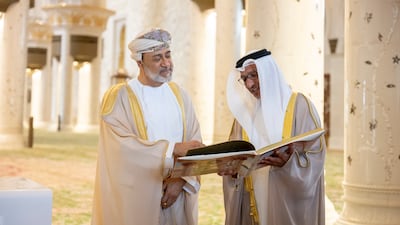
Sultan Haitham visit to the UAE was aimed at promoting relations on a range of issues -
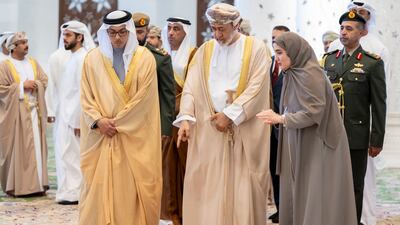
Sultan Haitham and Sheikh Mansour at the Sheikh Zayed Grand Mosque -

President Sheikh Mohamed hosts a dinner reception for Sultan Haitham at Qasr Al Watan -
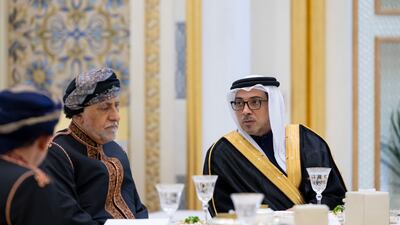
Sheikh Mansour with Sayyid Shihab Al Said, Oman's Deputy Prime Minister for Defence Affairs, at the dinner reception -
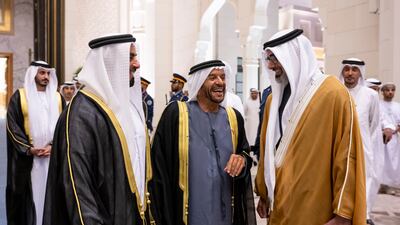
Sheikh Saif bin Zayed, Deputy Prime Minister and Minister of Interior, Sheikh Khaled bin Mohamed, Crown Prince of Abu Dhabi, and Sheikh Suroor bin Mohamed attend the dinner reception -
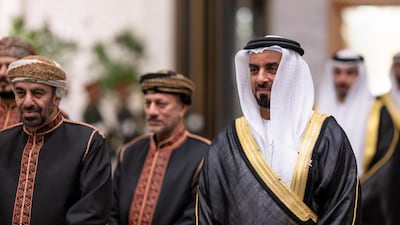
Sheikh Saif at the dinner reception for Sultan Haitham -
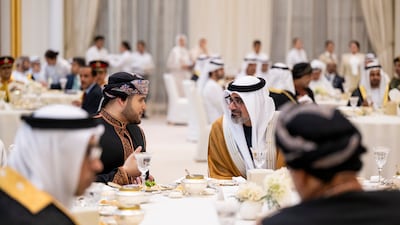
Sheikh Khaled in discussion with Oman's Sayyid Bilarab bin Haitham -
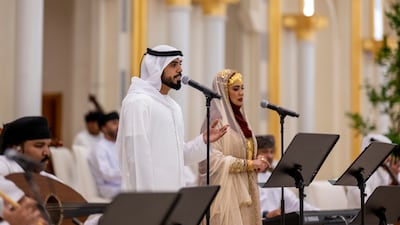
Musicians perform during the dinner reception -
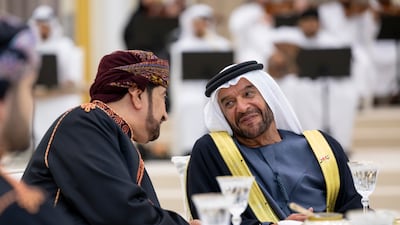
Sheikh Suroor bin Mohamed and Sayyid Khalid bin Hilal Al Busaidi, Minister of Diwan of the Royal Court of Oman -
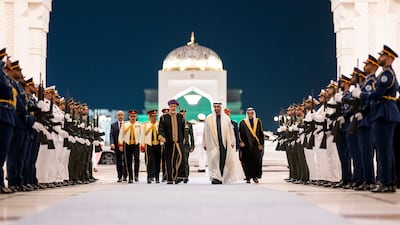
President Sheikh Mohamed arrives for a dinner reception for Sultan Haitham of Oman -

President Sheikh Mohamed and Sultan Haitham -

President Sheikh Mohamed receives Sultan Haitham of Oman for a state visit -
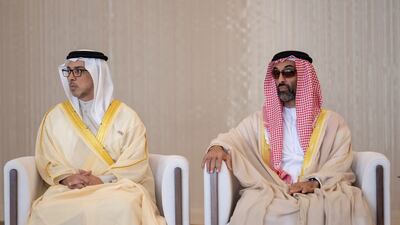
Sheikh Mansour and Sheikh Tahnoun bin Zayed, National Security Adviser and Deputy Ruler of Abu Dhabi, at the reception for Sultan Haitham -
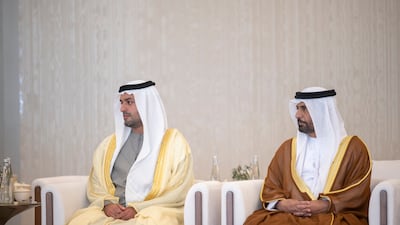
Sheikh Mohammed bin Hamad, Adviser for Special Affairs at the Presidential Court, and Mohammed Al Dhaheri, UAE ambassador to Oman, attend the reception at the Presidential Airport -
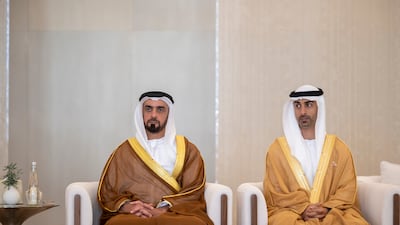
Sheikh Saif and Sheikh Hamdan bin Mohamed attend the reception for Sultan Haitham at the Presidential Airport -
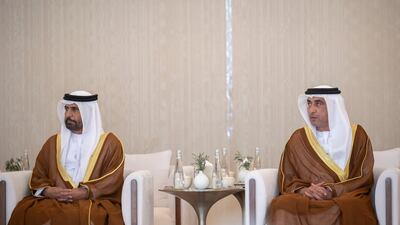
Mohammed Al Dhaheri, UAE ambassador to Oman, attends the reception at the Presidential Airport -
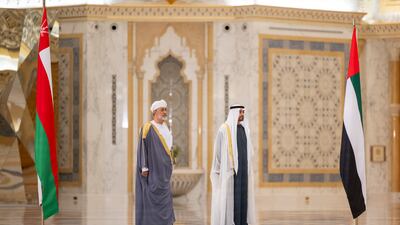
President Sheikh Mohamed and Sultan Haitham stand for the national anthems during a state visit reception at Qasr Al Watan in Abu Dhabi -
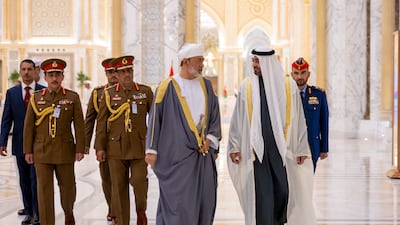
Sheikh Mohamed hosts a state visit reception for Sultan Haitham at Qasr Al Watan -

Sheikh Mohamed escorts Sultan Haitham to the state reception at Qasr Al Watan


A visit to the UAE by Sultan Haitham of Oman this week and the ongoing Asian tour by Qatar’s Emir Sheikh Tamim are two examples of this Gulf approach.
It is an approach that rejects the idea of waiting to find solutions to the multiple regional geopolitical challenges before embarking on an ambitious economic agenda and large investment initiatives. It is also significant that Sultan Haitham’s UAE visit comes in the wake of extreme weather conditions in both countries in recent days. Such visits enhance a positive approach to managing crises and learning lessons from them without getting trapped in them – and without, figuratively speaking, waiting for the storm to pass.
The Gulf is doing its best to fend off the storm and confront the region’s diverse security challenges, and not allowing them to obstruct its ambitious and strategic goals. Recently, amid turbulent security and environmental conditions, the UAE signed Comprehensive Economic Partnership Agreements with Colombia and Costa Rica. These partnerships demonstrate that the UAE is committed to its objective of consolidating its status as a global trade hub and a primary gateway for the flow of goods and services to various continents worldwide.
In this context, Sheikh Tamim’s Asian tour – which includes visits to the Philippines, Bangladesh and Nepal – has paved the way for enhanced co-operation in the fields of energy, infrastructure and agriculture. The highlight of Sultan Haitham’s visit to the Emirates was the announcement of a railway network project between the two countries, with a total investment of $3 billion. This development marks a significant milestone in elevating bilateral relations to a new stage of strategic partnership, fostering vital interdependence and paving the way for a more ambitious shared future.
The UAE-Oman rail network is both a transport project and a strategic initiative that will enhance freight movement efficiency and regional connectivity. It will significantly reduce travel time and eliminate delays due to weather and traffic conditions. Each train will be able to seamlessly transport up to 15,000 tonnes of cargo between five major ports and more than 15 integrated cargo facilities in the two countries. The 303-kilometre route connecting Abu Dhabi with the Omani state of Sohar will adhere to the highest safety and environmental standards.
The passenger train will achieve speeds of up to 200 kilometres an hour, covering the distance between Abu Dhabi and Sohar in 100 minutes and between Al Ain and Sohar in 47 minutes. The cargo train, meanwhile, will operate at 120 kilometres an hour. In line with this promising trajectory, the UAE has formally confirmed its unwavering commitment to fostering co-operation with governments worldwide. It firmly believes that addressing global challenges requires collective action and a shared commitment to crafting unified visions for a safer and more prosperous future.
Ultimately, it is such initiatives that foster positive outlooks and counteract the pessimism fuelled by violent conflicts near and far. They also underscore the growing strategic significance of the Gulf, positioning it as one of the world’s critical regions poised to seize opportunities and assume a central role in shaping the future of international trade, transportation, energy and connectivity across Asia, Africa and Europe.

