


The historian Julie d’Andurain recently published a very interesting biography of the French general Henri Gouraud, who is best known in the Middle East as the first high commissioner for Syria and Lebanon after the First World War and the man who declared the establishment of Greater Lebanon in September 1920.
Gen Gouraud’s experiences reaffirm how France’s attempts to advance a more “progressive” form of colonialism starting at the end of the 19th century largely failed in the Middle East. Under the guise of the post-war Mandates system, France and Britain were supposed to help newly formed countries in the Arab world develop into modern states, after which they would be granted independence.
The failure of the Mandates system – in that, generally, neither France nor Britain fully stabilised the countries under its control, let alone left secure orders in place – has relevance today. As the Israeli government rejects all plans to satisfy Palestinian national aspirations – the same sort of aspirations France and Britain struggled to contain in Arab countries – it, too, will find that the result is permanent instability.
Gen Gouraud began his career in French Sudan, which is modern-day Mali. Between 1893 and 1895, the civilian governor was one Albert Grodet, who had been appointed to implement a more affordable form of colonialism. This required cutting back on expensive military campaigns to impose France’s will and, instead, put in place a softer form of control, where violence was minimised and more subtle management techniques were introduced.

While Mr Grodet ultimately failed against a military that resisted being turned into managers, Ms Andurain notes that his methods did impose lasting administrative methods in the colonies. This “new” colonialism was characterised by “the art of an administration, more flexible, that saw how domination by whites of ‘indigenous’ peoples could come through an alliance of the political and the military”.
Indeed, in Syria and Lebanon, as in Morocco earlier when he served under Marshal Hubert Lyautey, Gen Gouraud became a proponent of this form of colonialism. The Mandates for Syria and Lebanon were, by their nature, regarded as enlightened. Moreover, France and Britain developed alliances with local elites, especially minorities, to bolster their influence, and invested in developing infrastructure and education, although most local Arab nationalists continued to oppose them.
It is noteworthy that in the British Mandates of Egypt, Palestine and Iraq, and the French Mandates of Syria and Lebanon, the Mandatory powers from the start had trouble imposing their writ, except through military action. Making matters worse, both powers had just emerged from a debilitating war that had emptied their coffers, therefore did not have the funds to resort to permanent wars of subjugation.
What came out of this was, eventually, a situation of very relative tranquility in Iraq, Egypt, Syria and Lebanon, but only through arrangements that introduced steps towards independence, albeit largely cosmetic ones. Lebanon was probably the closest thing to success, mainly because France had granted the majority Maronite Christians a state in which they could fulfil their national ambitions.
Israel would do well to study these experiences as cautionary tales. The unofficial position of the government is that it opposes a two-state solution, while also firmly rejecting a one-state solution. In other words, Israel’s sole way of dealing with Palestinian national self-determination is to engage in open-ended repression, even as Arabs within geographical Palestine are becoming a demographic majority.
-

Palestinians argue with Israeli settlers a day after a shooting attack and violence in the West Bank town of Hawara. EPA -

Smoke is seen during a confrontation between Israeli settlers and Palestinians in the West Bank town of Hawara. Reuters -
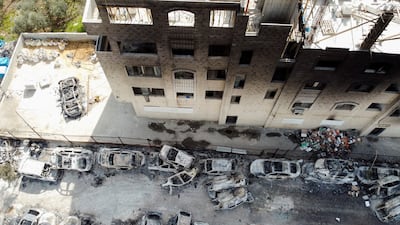
An aerial view shows a building and cars torched in Hawara. Reuters -

A Palestinian man walks past burnt cars in a scrapyard in Hawara. AP -

An Israeli soldiers speak to a Palestinianians near in the West Bank town of Hawara. Reuters -

Israeli soldier holds back a settler during confrontations at the scene of a shooting attack in the West Bank town of Hawara. EPA -

A Palestinian man uses a stick to remove burnt tyres left in in front of his house as Israeli soldiers stand guard. EPA -

Israeli troops patrol as tensions escalate in the West Bank town of Hawara. EPA -

Israeli security forces examine a vehicle riddled with bullet holes following a reported shooting attack near Jericho, in the occupied West Bank. AFP


In many regards, the Mandate system was better in that it offered a theoretical cut-off point. Israel’s government doesn’t. It has tried to suffocate Palestinian nationalism for decades, even habitually banning the Palestinian flag. Yet anyone can plainly see how futile and counterproductive that approach has been.
Israelis may cringe at Israel’s comparison with European colonialism. Yet as the Marxist scholar of Islam Maxime Rodinson, himself a Jew whose family perished in the Holocaust, wrote in a famous essay in Les Temps Modernes in 1967: “Wanting to create a purely Jewish, or predominantly Jewish, state in Arab Palestine in the 20th century could not help but lead to a colonial-type situation and to the development [completely normal, sociologically speaking] of a racist state of mind, and in the final analysis to a military confrontation between the two ethnic groups.”
To Mr Rodinson, the mass immigration of Jews to build a state for the Jews created a political order in Israel’s first decades in which an indigenous population was either expelled or ruled by an elite that had largely originated outside Palestine. Since the 1970s, Israel has proposed many “enlightened” political projects to Palestinians – from autonomy to stunted statehood – all of which fell far short of their desires.
The European colonial model, flexible or not, never really worked in the face of strong local nationalisms. Israeli nationalism may be more potent than European colonial control, but it is not more potent than Palestinian nationalism, which it only reinforces. In the worst-case scenario, where Israel could ethnically cleanse Arab populations in its midst, it would still never achieve the security it craves.

