Sheikh Salem Al Qassimi is the UAE's Minister of Culture
March 21, 2024
UAE Founding Father, the late Sheikh Zayed bin Sultan Al Nahyan, once said: “The book is a container of science, civilisation, culture, knowledge, literature and arts. Nations are not only measured by material wealth but also by their civil authenticity. The book is the basis of this authenticity and a key factor in the confirmation of its civilisation.”
This profound insight underscores our leadership’s philosophy and the belief that our nation’s greatest asset is its people. And to nurture their skills, we must start with the fundamental building block: reading. We are now halfway through National Reading Month 2024 in the UAE, and I am filled with a deep sense of appreciation for the transformative power of reading. I hope that the initiatives and activities planned for this month enable us to actively engage and connect with the community.
The value of reading cannot be overstated. Whether novels, newspapers, journals or magazines, reading provides us with the tools necessary for personal and intellectual growth. It is through reading that we cultivate critical thinking, analytical skills and a nuanced understanding of the world around us. It also opens the door to myriad cultures, fosters empathy, broadens our perspective on any given topic and offers insight to human experiences beyond our immediate surroundings. In fact, so much of what we know about our world has been learnt through reading, rather than via first-hand experience. Perhaps most importantly in an increasingly polarised world, reading helps us understand the lives and experiences of others.
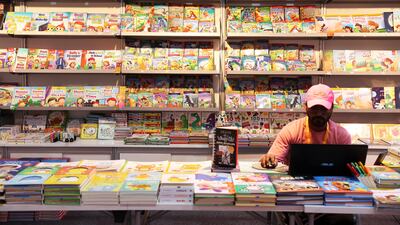
The Sharjah Children’s Reading Festival will run until Sunday at the Sharjah Expo Centre. Photo: Chris Whiteoak / The National
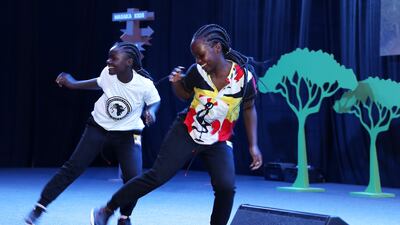
Performers dress up and play music at the festival. Photo: Chris Whiteoak / The National
A live music workshop. Photo: Chris Whiteoak / The National
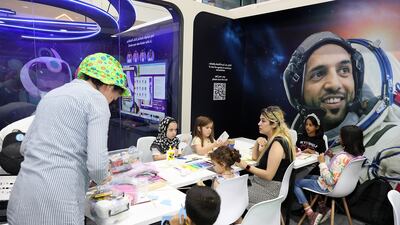
Students from the Victoria English school, Sharjah, draw pictures at a festival workshop. Photo: Chris Whiteoak / The National
There are more than 100 publishers specialising in children's literature at the festival this year. Photo: Chris Whiteoak / The National
Books on display at Sharjah Expo Centre. Photo: Chris Whiteoak / The National
Performer shows off his martial arts skills. Photo: Chris Whiteoak / The National
Author Sudha Murty signs books at the festival. Photo: Chris Whiteoak / The National
Children take part in a dance performance. Photo: Chris Whiteoak / The National
More than 400 guests including authors, artists, illustrators, experts and influencers are involved in talks, demonstrations, activities and workshops for both children and adults. Photo: Pawan Singh / The National
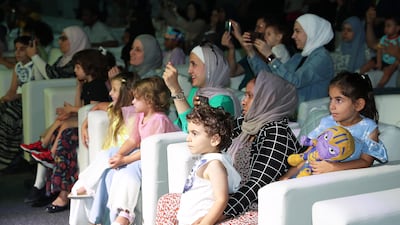
Parents and their children watch a performance at one of the festival's many shows and theatre productions. Photo: Pawan Singh / The National
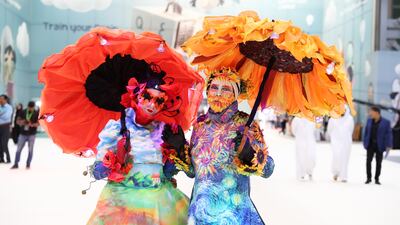
Roaming performers at the Sharjah Children's Reading Festival. Photo: Pawan Singh / The National
Children take part in an art workshop. Photo: Pawan Singh / The National
Look for topics that interest you and read every day to open up endless possibilities of discovery and learning
National Reading Month in the UAE has grown bigger with each edition. This year, too, ministries, government institutions and the private sector are collaborating to present various activities. Among them is an initiative to republish rare books, thereby protecting their legacy from being lost. The Ministry of Culture has partnered with the Emirates Writers Union to bring 12 such books back to life. In addition to this, we will also translate a collection of Emirati literary pieces into different languages. The reading month in the UAE is a community event and this year it coincides with the Holy Month of Ramadan, providing us with an opportunity to bring culture, literature and tradition together.
Books have been an integral part of the UAE’s journey. Every emirate is connected through an extensive network of public libraries, which are home to some of the most valuable and rare books. Built over the years, these treasure troves of knowledge are not just places of reading but also hubs for knowledge sharing and cultural activities.
Take, for example, the Qasr Al Watan Library, which was launched during National Reading Month in 2019. With more than 50,000 titles on science, the arts and other fields, this library spotlights how the UAE’s National Strategy of Reading and National Reading Month have been instrumental in reminding us of the significance of books. The National Library and Archives Abu Dhabi is another great example of how libraries contribute to this legacy and play a central role in building the country’s strong knowledge infrastructure. The National Library and Archives are currently working on digitising books about the UAE, the Gulf and the Arab world to offer an accessible platform and resource to researchers at the local, regional and global levels.
In Dubai, we have the Mohammed bin Rashid Library, which marks its 10th anniversary this year and houses hundreds of thousands of books from all over the world, covering different genres and languages. Al Safa Art and Design Library was revamped and opened to the public during National Reading Month in 2019 and hosts a remarkable collection of books on design, calligraphy, architecture and the arts.
Sharjah has been instrumental in positioning the UAE on the global cultural map since the 1970s, and this is evident through initiatives such as the Dr Sultan Al Qasimi Centre for Gulf Studies, which houses a rich collection of centuries-old maps, manuscripts and books. The House of Wisdom is yet another cultural hub that places books at the forefront of community engagement offering a massive library and space for people to appreciate, critique and discuss books.
National Reading Month 2024 provides us all with a welcome reminder of the value of reading and an opportunity to discover or rediscover it for ourselves. I encourage you to utilise the initiative and activities this month to make reading a habit. Look for topics that interest you and read every day to open up endless possibilities of discovery and learning.
I am sharing some recommendations from my personal library to help you get started: Nuthum Al-Fara’id in the Legacy of Ibn Majid by Sheikh Dr Sultan bin Muhammad Al Qasimi, Ruler of Sharjah; Letters to a Young Muslim, a collection of letters addressing the complexities of being a Muslim in the modern world, by Omar Ghobash; and Celestial Bodiesby Jokha Alharthi, winner of the 2019 International Booker Prize.

Profile
Company: Justmop.com
Date started: December 2015
Founders: Kerem Kuyucu and Cagatay Ozcan
Sector: Technology and home services
Based: Jumeirah Lake Towers, Dubai
Size: 55 employees and 100,000 cleaning requests a month
Funding: The company’s investors include Collective Spark, Faith Capital Holding, Oak Capital, VentureFriends, and 500 Startups.
Eoin Morgan (capt), Moeen Ali, Jofra Archer, Jonny Bairstow, Jos Buttler (wkt), Tom Curran, Liam Dawson, Liam Plunkett, Adil Rashid, Joe Root, Jason Roy, Ben Stokes, James Vince, Chris Woakes, Mark Wood
Predictions
Predicted winners for final round of games before play-offs:
Friday: Delhi v Chennai - Chennai
Saturday: Rajasthan v Bangalore - Bangalore
Saturday: Hyderabad v Kolkata - Hyderabad
Sunday: Delhi v Mumbai - Mumbai
Sunday - Chennai v Punjab - Chennai
Final top-four (who will make play-offs): Chennai, Hyderabad, Mumbai and Bangalore
Dh200 for littering or spitting in the Dubai Metro
Dh500 for throwing cigarette butts or chewing gum on the floor, or littering from a vehicle.
Dh1,000 for littering on a beach, spitting in public places, throwing a cigarette butt from a vehicle
In Sharjah and other emirates
Dh500 for littering - including cigarette butts and chewing gum - in public places and beaches in Sharjah
Dh2,000 for littering in Sharjah deserts
Dh500 for littering from a vehicle in Ras Al Khaimah
Dh1,000 for littering from a car in Abu Dhabi
Dh1,000 to Dh100,000 for dumping waste in residential or public areas in Al Ain
Dh10,000 for littering at Ajman's beaches
Stuck in a job without a pay rise? Here's what to do
Chris Greaves, the managing director of Hays Gulf Region, says those without a pay rise for an extended period must start asking questions – both of themselves and their employer.
“First, are they happy with that or do they want more?” he says. “Job-seeking is a time-consuming, frustrating and long-winded affair so are they prepared to put themselves through that rigmarole? Before they consider that, they must ask their employer what is happening.”
Most employees bring up pay rise queries at their annual performance appraisal and find out what the company has in store for them from a career perspective.
Those with no formal appraisal system, Mr Greaves says, should ask HR or their line manager for an assessment.
“You want to find out how they value your contribution and where your job could go,” he says. “You’ve got to be brave enough to ask some questions and if you don’t like the answers then you have to develop a strategy or change jobs if you are prepared to go through the job-seeking process.”
For those that do reach the salary negotiation with their current employer, Mr Greaves says there is no point in asking for less than 5 per cent.
“However, this can only really have any chance of success if you can identify where you add value to the business (preferably you can put a monetary value on it), or you can point to a sustained contribution above the call of duty or to other achievements you think your employer will value.”
Cecelia Crocker was on board Northwest Airlines Flight 255 in 1987 when it crashed in Detroit, killing 154 people, including her parents and brother. The plane had hit a light pole on take off
George Lamson Jr, from Minnesota, was on a Galaxy Airlines flight that crashed in Reno in 1985, killing 68 people. His entire seat was launched out of the plane
Bahia Bakari, then 12, survived when a Yemenia Airways flight crashed near the Comoros in 2009, killing 152. She was found clinging to wreckage after floating in the ocean for 13 hours.
Jim Polehinke was the co-pilot and sole survivor of a 2006 Comair flight that crashed in Lexington, Kentucky, killing 49.
AI traffic lights to ease congestion at seven points to Sheikh Zayed bin Sultan Street
The seven points are:
Shakhbout bin Sultan Street
Dhafeer Street
Hadbat Al Ghubainah Street (outbound)
Salama bint Butti Street
Al Dhafra Street
Rabdan Street
Umm Yifina Street exit (inbound)
Dubai World Cup nominations
UAE: Thunder Snow/Saeed bin Suroor (trainer), North America/Satish Seemar, Drafted/Doug Watson, New Trails/Ahmad bin Harmash, Capezzano, Gronkowski, Axelrod, all trained by Salem bin Ghadayer
Japan: Matera Sky/Hideyuki Mori, KT Brace/Haruki Sugiyama. Bahrain: Nine Below Zero/Fawzi Nass. Ireland: Tato Key/David Marnane. Hong Kong: Fight Hero/Me Tsui. South Korea: Dolkong/Simon Foster.
The Uefa Awards winners
Uefa Men's Player of the Year: Virgil van Dijk (Liverpool)
Uefa Women's Player of the Year: Lucy Bronze (Lyon)
Best players of the 2018/19 Uefa Champions League
Goalkeeper: Alisson (Liverpool)
Defender: Virgil van Dijk (Liverpool)
Midfielder: Frenkie de Jong (Ajax)
Forward: Lionel Messi (Barcelona)
Uefa President's Award: Eric Cantona
Labour dispute
The insured employee may still file an ILOE claim even if a labour dispute is ongoing post termination, but the insurer may suspend or reject payment, until the courts resolve the dispute, especially if the reason for termination is contested. The outcome of the labour court proceedings can directly affect eligibility.
- Abdullah Ishnaneh, Partner, BSA Law
Mercer, the investment consulting arm of US services company Marsh & McLennan, expects its wealth division to at least double its assets under management (AUM) in the Middle East as wealth in the region continues to grow despite economic headwinds, a company official said.
Mercer Wealth, which globally has $160 billion in AUM, plans to boost its AUM in the region to $2-$3bn in the next 2-3 years from the present $1bn, said Yasir AbuShaban, a Dubai-based principal with Mercer Wealth.
“Within the next two to three years, we are looking at reaching $2 to $3 billion as a conservative estimate and we do see an opportunity to do so,” said Mr AbuShaban.
Mercer does not directly make investments, but allocates clients’ money they have discretion to, to professional asset managers. They also provide advice to clients.
“We have buying power. We can negotiate on their (client’s) behalf with asset managers to provide them lower fees than they otherwise would have to get on their own,” he added.
Mercer Wealth’s clients include sovereign wealth funds, family offices, and insurance companies among others.
From its office in Dubai, Mercer also looks after Africa, India and Turkey, where they also see opportunity for growth.
Wealth creation in Middle East and Africa (MEA) grew 8.5 per cent to $8.1 trillion last year from $7.5tn in 2015, higher than last year’s global average of 6 per cent and the second-highest growth in a region after Asia-Pacific which grew 9.9 per cent, according to consultancy Boston Consulting Group (BCG). In the region, where wealth grew just 1.9 per cent in 2015 compared with 2014, a pickup in oil prices has helped in wealth generation.
BCG is forecasting MEA wealth will rise to $12tn by 2021, growing at an annual average of 8 per cent.
Drivers of wealth generation in the region will be split evenly between new wealth creation and growth of performance of existing assets, according to BCG.
Another general trend in the region is clients’ looking for a comprehensive approach to investing, according to Mr AbuShaban.
“Institutional investors or some of the families are seeing a slowdown in the available capital they have to invest and in that sense they are looking at optimizing the way they manage their portfolios and making sure they are not investing haphazardly and different parts of their investment are working together,” said Mr AbuShaban.
Some clients also have a higher appetite for risk, given the low interest-rate environment that does not provide enough yield for some institutional investors. These clients are keen to invest in illiquid assets, such as private equity and infrastructure.
“What we have seen is a desire for higher returns in what has been a low-return environment specifically in various fixed income or bonds,” he said.
“In this environment, we have seen a de facto increase in the risk that clients are taking in things like illiquid investments, private equity investments, infrastructure and private debt, those kind of investments were higher illiquidity results in incrementally higher returns.”
The Abu Dhabi Investment Authority, one of the largest sovereign wealth funds, said in its 2016 report that has gradually increased its exposure in direct private equity and private credit transactions, mainly in Asian markets and especially in China and India. The authority’s private equity department focused on structured equities owing to “their defensive characteristics.”
Zakat: an Arabic word meaning ‘to cleanse’ or ‘purification’.
Nisab: the minimum amount that a Muslim must have before being obliged to pay zakat. Traditionally, the nisab threshold was 87.48 grams of gold, or 612.36 grams of silver. The monetary value of the nisab therefore varies by current prices and currencies.
Zakat Al Mal: the ‘cleansing’ of wealth, as one of the five pillars of Islam; a spiritual duty for all Muslims meeting the ‘nisab’ wealth criteria in a lunar year, to pay 2.5 per cent of their wealth in alms to the deserving and needy.
Zakat Al Fitr: a donation to charity given during Ramadan, before Eid Al Fitr, in the form of food. Every adult Muslim who possesses food in excess of the needs of themselves and their family must pay two qadahs (an old measure just over 2 kilograms) of flour, wheat, barley or rice from each person in a household, as a minimum.