


For years, Lebanese visitors to Saudi Arabia who have met with senior members of the Saudi government have spoken of Riyadh’s ambivalence towards Lebanese politics, complaining of Iran’s overwhelming dominance of Lebanon’s political landscape.
That may well have been true, as Saudi involvement in Lebanon often seemed to be a thankless task. Despite Saudi investment in the country, and the decision of the late King Abdullah to deposit $1 billion in the Lebanese central bank in 2006 as support for the economy, over the years Iranian power, implemented through Hezbollah, only seemed to grow. However, several things suggest the situation may be changing.
By change, it is far too premature to assume that Saudi Arabia will go back to pouring money into the economy. Rather, there are indications that the kingdom may be more open to reinforcing its political stakes in Lebanese affairs, so that its local allies and those of Tehran can co-exist, balance each other off on certain key issues, and negotiate mutually beneficial compromises.
What may have permitted this, among several developments, is the Saudi-Iranian rapprochement of last March, facilitated by China. As relations between Riyadh and Tehran improve, this will necessarily be reflected in Lebanon, where communal relations have often reflected regional tensions or, on the contrary, reconciliations.
Something else may also help to ease an improvement in Saudi ties with Lebanon. Since the economic collapse in 2019, Hezbollah, the dominant political force in the country, has failed to convince many Lebanese that it has any realistic economic plan for the country’s revival. On the contrary, the party has protected the failed political leadership, and its leading allies have been among those most resistant to reform.
-
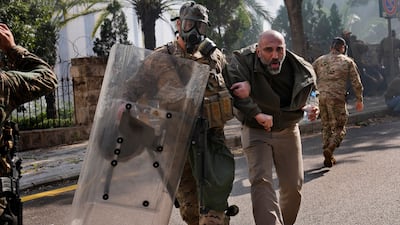
A Lebanese soldier, left, helps a retired comrade who inhaled tear gas during a protest in Beirut to demand better pay. AP -

Lebanese soldiers push back retired comrades trying to reach government buildings in Beirut during a protest to demand better pay. AP -
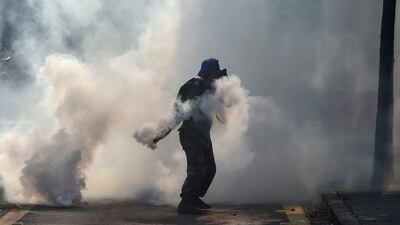
A retired member of the Lebanese security forces returns a tear gas canister towards riot police during a protest in downtown Beirut. EPA -
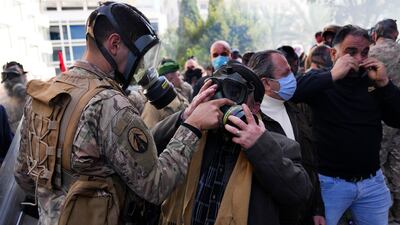
A Lebanese soldier gives a gas mask to a retired comrade who inhaled tear gas during the protest. AP -

A Lebanese soldier fires tear gas during a protest by retired members of Lebanon's security forces outside the government palace in Beirut. EPA -
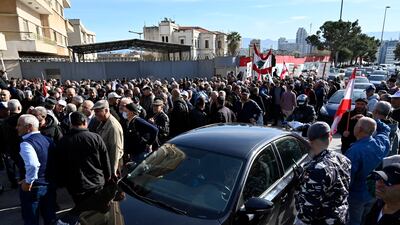
Retired Lebanese security force members block an entrance of the government palace to prevent ministers from attending a cabinet meeting. EPA -
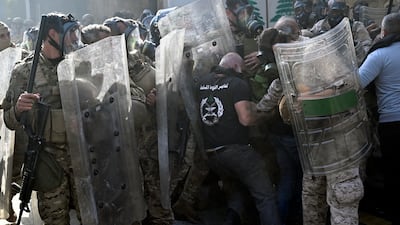
Retired members of the Lebanese security forces clash with soldiers during the protest. EPA -
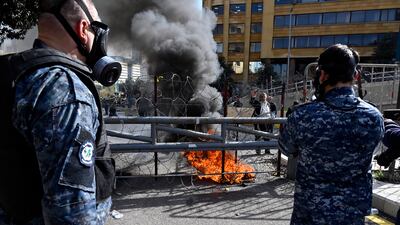
Protesters burn tires during the protest. EPA -
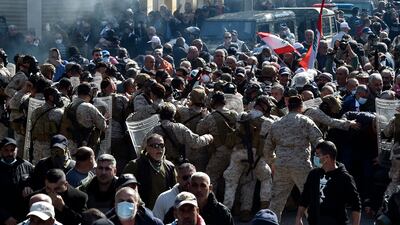
Protesters and soldiers clash outside the government palace in downtown Beirut. EPA -
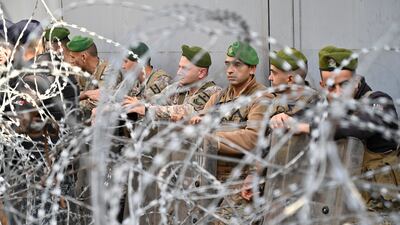
Lebanese soldiers on guard during the protest by retired members of Lebanon's security forces. EPA


In this context, Hezbollah became increasingly contested at home, with many in the Sunni community opposed to its agenda, and many others in the Christian and even the small Druze communities hostile to the party. In this context, there seems to be an interest from Hezbollah’s leadership, and with it Iran, to stabilise the party’s environment by reaching a modus vivendi with other communities, especially those who want or have close ties with Saudi Arabia.
A revealing sign of a subtle shift in Riyadh occurred last September, when the Saudi ambassador, Walid Bukhari, hosted France’s envoy to Lebanon, Jean-Yves Le Drian, along with the country’s Sunni mufti and a large group of Sunni parliamentarians. At the time, Mr Le Drian was trying to resolve the impasse over Lebanon’s presidency. To many Lebanese, the ambassador’s invitation of these communal representatives was a way of showing Mr Le Drian that the kingdom could potentially encourage their support for any deal reached.
Prominent leaders from Lebanon’s Sunni community have historically had strong ties with Riyadh. It is, arguably, the largest sect in the country, not accounting for the Syrian refugees, a majority of whom are also Sunni. In light of this, both Hezbollah and Iran have increasingly sought to maintain good relations with Lebanon’s Sunnis, who could pose a challenge to Hezbollah if they were to mobilise against the party.
Mr Bukhari has been noticeably active in recent weeks. Saudi Arabia is one of five countries in a contact group for Lebanon, along with the US, France, Qatar and Egypt, whose priority is filling the presidential vacuum. In meetings in January, Mr Bukhari hosted all the ambassadors of these states at his home.
While it’s unclear what came out of the meetings, representatives of the five will reportedly be gathering this month, so the meetings could have been a preparation for that. Above all, there was an obvious message that Saudi Arabia is playing a diplomatic role in discussions over the presidency, when in the past year there were indications that the kingdom was not particularly interested in being involved.

Both Hezbollah and its presidential candidate, Suleiman Frangieh, realise that improved ties with Riyadh will be important for Lebanon’s next president. Hezbollah is also aware that no real exit from the Lebanese economic crisis can take place without support from richer Arab states, which is why Saudi support for any solution on the presidency is critical.
This creates an interesting situation for Lebanon. No one expects Iranian influence in the country to wane, but as other states, Saudi Arabia above all, take advantage of their significant reserves of sympathy in the country, this can gradually turn Lebanon into a shared interest, forcing Iran and Hezbollah to compromise and pursue better co-operation with other groups.
In many regards, this would reflect what former US president Barack Obama sought when he told The Atlantic in 2016: “The competition between the Saudis and the Iranians … requires us to say to our friends as well as to the Iranians that they need to find an effective way to share the neighbourhood and institute some sort of cold peace.”
While many countries might recoil at being “shared” by anyone, Lebanon, because of its sectarian divisions, has always been vulnerable to regional rivalries, which have often crippled domestic politics. This is what has enabled Iran to control Lebanon’s commanding heights through Hezbollah. If this can be counterbalanced by the influence of others, however, one can imagine Iranian hegemony being tempered.
One of the meetings Mr Bukhari held in January was with Iran’s ambassador in Beirut, Mojtaba Amani. The meeting, which was described in local media reports as quite friendly, showed that there appears to be a new willingness on both sides to co-operate on the Lebanese front. Still, one cannot assume that all differences will magically disappear.

