US President Joe Biden attends the dignified transfer of the remains of three US service members killed in Jordan, in Dover earlier this month. Reuters


Is Biden getting tough with both Israel and Iran?


  • English
  • Arabic

February 11, 2024

As the Middle East continues to face instability, there is widespread criticism of what appears to be a feeble US stance towards both Israel and Iran. Yet officials in Washington retain a sense of optimism that the Biden administration will leverage is relationship with Israel, which could lead to provisional agreements, ceasefires and consequential settlements involving the two regional powers.

It has taken much too long, but US President Joe Biden adopted a sharper-than-usual tone towards Israel last Thursday, saying that its military operation in Gaza had been over the top. “I’m pushing very hard now to deal with this hostage ceasefire … to lead to a sustained pause in the fighting in … the Gaza Strip,” Mr Biden said.

The White House has also advised against Israel’s planned offensive on Rafah.

While the US has repeatedly called on Israel to limit civilian casualties during its military offensive, these appeals have never escalated to the level of a formal ultimatum. Thursday’s warning, despite the tone, has not been accompanied by concrete actions. In other words, the Biden administration appears not to have made a definitive decision regarding putting tangible pressure on Israel, such as imposing restrictions on its $3.8 billion annual military aid package.

During a recent visit to Israel, US Secretary of State Antony Blinken demonstrated patience even as Israeli Prime Minister Benjamin Netanyahu in a news conference declared his intent to expand the military operations – including towards Rafah, into which about one and a half million displaced Palestinians have been crammed. He made it clear that he accepts nothing but a total victory by eliminating Hamas.

Mr Netanyahu has so far shown little interest in a settlement, or a Palestinian state, or even a demilitarised state with reduced borders.

US Secretary of State Antony Blinken meets Israeli Prime Minister Benjamin Netanyahu in Jerusalem last week. EPA
There is a sense, at least in some parts of the Arab world, that Hamas’s actions have proved costly for the Palestinian people

After the killing of more than 28,000 Palestinians, Hamas has called for a deal that, it says, should pave the way for a permanent ceasefire. However, Israel has categorically rejected its proposal, saying that it will not permit the group to continue running Gaza.

Nonetheless, if certain western media outlets are to be believed, Israel might be willing to facilitate the departure of Hamas’s top leadership from Gaza as part of a ceasefire and settlement. Indeed, these reports suggest that Israel is open to allowing Yahya Sinwar to go into exile in exchange for the release of all hostages and ending the group’s rule in the territory.

Current efforts by the US and key Arab nations are reportedly aimed at providing security assurances to Israel in return for its acceptance of the “two-state solution” and the establishment of a Palestinian state. In addition, a successor to Palestine President Mahmoud Abbas capable of leading both the West Bank and Gaza is being pursued. There is a sense, at least in some parts of the Arab world, that Hamas’s actions have proved costly for the Palestinian people.

Last week, Riyadh clarified its position through a statement from its foreign ministry, affirming that it had communicated its unwavering stance to the US that diplomatic relations with Israel will be established only after its recognition of an independent Palestinian state, an end to Israeli aggression in Gaza, and a complete withdrawal of Israeli forces from the territory.

Be that as it may, the Israeli government’s actions in Gaza and elsewhere continue to threaten an escalation of the current conflict in the region. An operation in Rafah could have dire consequences, and the Lebanon-Israel border remains tense.

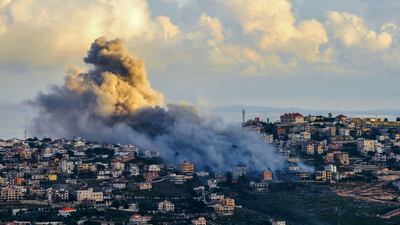
  • The Israeli bombing of Khiam, a village near the southern Lebanese border with Israel. AFP
    The Israeli bombing of Khiam, a village near the southern Lebanese border with Israel. AFP
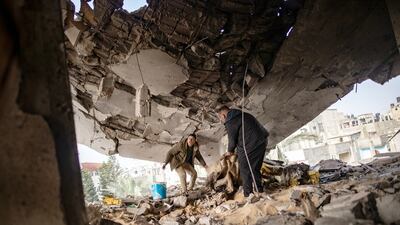
  • Members of the Ghannam family check the damage to their home after an Israeli air strike hit the Rafah refugee camp in the southern Gaza Strip. EPA
    Members of the Ghannam family check the damage to their home after an Israeli air strike hit the Rafah refugee camp in the southern Gaza Strip. EPA
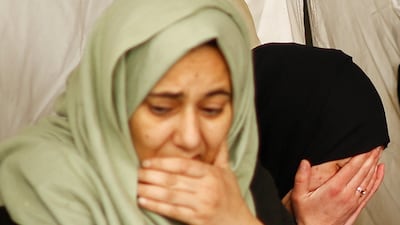
  • Mourners at Abu Yousef Al Najjar Hospital, in Rafah in the southern Gaza Strip. Reuters
    Mourners at Abu Yousef Al Najjar Hospital, in Rafah in the southern Gaza Strip. Reuters
  • A rescuer puts out a fire after a car was hit by an Israeli strike in Rafah in the southern Gaza Strip. Reuters
    A rescuer puts out a fire after a car was hit by an Israeli strike in Rafah in the southern Gaza Strip. Reuters
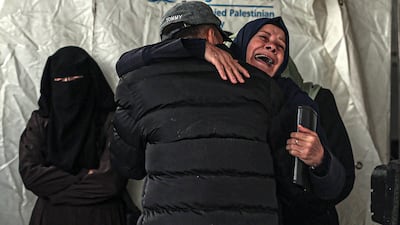
  • At Al Najjar Hospital in Rafah, Palestinians mourn after identifying the bodies of relatives killed in overnight Israeli bombardment on the southern Gaza Strip. AFP
    At Al Najjar Hospital in Rafah, Palestinians mourn after identifying the bodies of relatives killed in overnight Israeli bombardment on the southern Gaza Strip. AFP
  • Palestinian families take refuge at a school affiliated with the UN Relief and Works Agency for Palestine Refugees in the Daraj neighbourhood. Getty Images
    Palestinian families take refuge at a school affiliated with the UN Relief and Works Agency for Palestine Refugees in the Daraj neighbourhood. Getty Images
  • Palestinian-Irish plastic surgeon Ahmed El Mokhallalati checks in on a Palestinian man wounded in an Israeli strike, at the European Hospital, in Khan Younis. Reuters
    Palestinian-Irish plastic surgeon Ahmed El Mokhallalati checks in on a Palestinian man wounded in an Israeli strike, at the European Hospital, in Khan Younis. Reuters
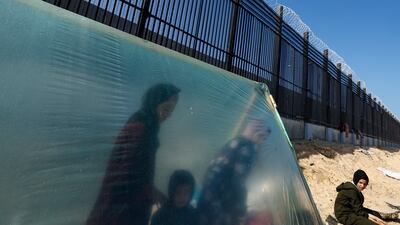
  • A Palestinian man carries a bag of flour, as displaced Palestinians, who fled their houses due to Israeli strikes, take shelter near the border with Egypt in Rafah. Reuters
    A Palestinian man carries a bag of flour, as displaced Palestinians, who fled their houses due to Israeli strikes, take shelter near the border with Egypt in Rafah. Reuters
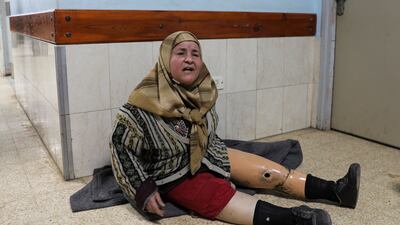
  • Palestinian woman Amal Abu Hashesh, who escaped with her prosthetic leg after her house was hit by an Israeli strike, takes shelter in the European Hospital. Reuters
    Palestinian woman Amal Abu Hashesh, who escaped with her prosthetic leg after her house was hit by an Israeli strike, takes shelter in the European Hospital. Reuters
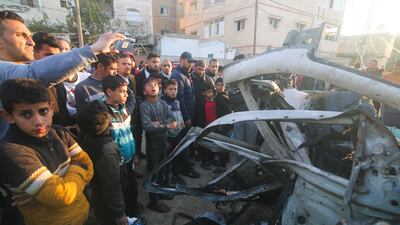
  • Palestinians gather around a Hamas police vehicle after it was struck by an Israeli air strike in Rafah. AP
    Palestinians gather around a Hamas police vehicle after it was struck by an Israeli air strike in Rafah. AP
  • Mother of hostage Amit Esther Buskila holds a poster of her daughter during a press conference in Paris with representatives of families of French hostages held by Hamas. Reuters
    Mother of hostage Amit Esther Buskila holds a poster of her daughter during a press conference in Paris with representatives of families of French hostages held by Hamas. Reuters
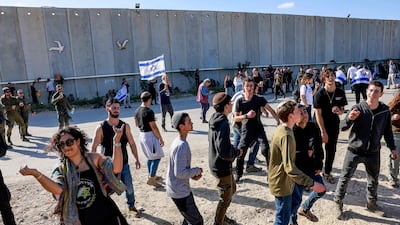
  • People dance as Israeli protesters gather to block the entry of humanitarian aid trucks to the Gaza Strip at the Kerem Shalom border crossing. AFP
    People dance as Israeli protesters gather to block the entry of humanitarian aid trucks to the Gaza Strip at the Kerem Shalom border crossing. AFP
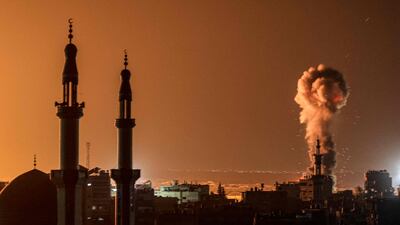
  • Smoke billows during Israeli bombardment in Rafah. AFP
    Smoke billows during Israeli bombardment in Rafah. AFP
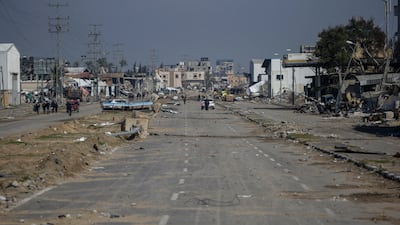
  • Palestinians move along Salah Al Din road after an Israeli air strike on Al Maghazi refugee camp. EPA
    Palestinians move along Salah Al Din road after an Israeli air strike on Al Maghazi refugee camp. EPA
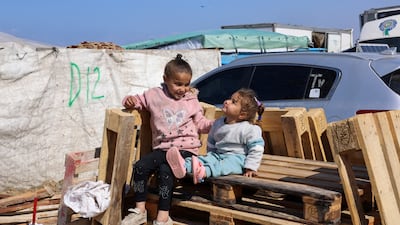
  • Displaced children sit on wooden pallets, as displaced Palestinians take shelter in a tent camp near the border with Egypt in Rafah. Reuters
    Displaced children sit on wooden pallets, as displaced Palestinians take shelter in a tent camp near the border with Egypt in Rafah. Reuters
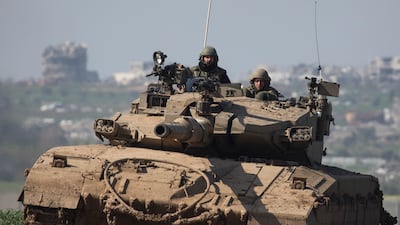
  • An Israeli tank moves along the border with Gaza in southern Israel. Getty Images
    An Israeli tank moves along the border with Gaza in southern Israel. Getty Images
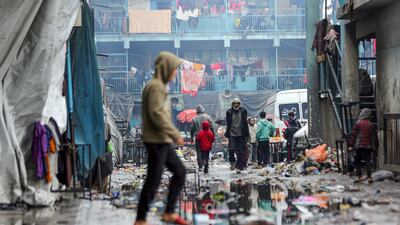
  • Displaced Palestinians near the border with Egypt in Rafah in the southern Gaza Strip. Reuters
    Displaced Palestinians near the border with Egypt in Rafah in the southern Gaza Strip. Reuters
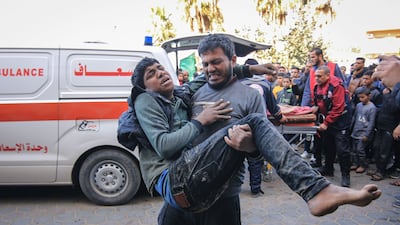
  • A man carried an injured Palestinian man to Al Aqsa Hospital after an Israeli air strike in Deir Al-Balah in southern Gaza. Bloomberg
    A man carried an injured Palestinian man to Al Aqsa Hospital after an Israeli air strike in Deir Al-Balah in southern Gaza. Bloomberg
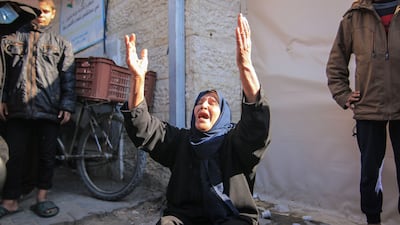
  • A Palestinian woman reacts after an Israeli air strike in Deir Al-Balah. Bloomberg
    A Palestinian woman reacts after an Israeli air strike in Deir Al-Balah. Bloomberg
  • Palestinians search the site of a destroyed residential building hit by an Israeli air strike in Deir Al-Balah. Bloomberg
    Palestinians search the site of a destroyed residential building hit by an Israeli air strike in Deir Al-Balah. Bloomberg
  • A soldier visits the site of the Nova festival, with displayed photos of the people who were killed and kidnapped during the October 7 attack near the site. Reuters
    A soldier visits the site of the Nova festival, with displayed photos of the people who were killed and kidnapped during the October 7 attack near the site. Reuters
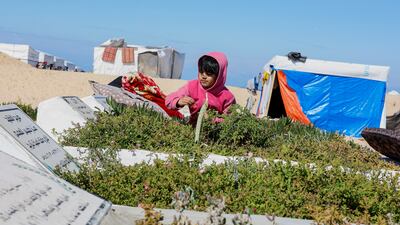
  • A displaced Palestinian girl, who fled her house due to Israeli strikes, arranges plants on a grave in a cemetery where she shelters, amid the ongoing conflict between Israel and Hamas, in Rafah in the southern Gaza Strip. Reuters
    A displaced Palestinian girl, who fled her house due to Israeli strikes, arranges plants on a grave in a cemetery where she shelters, amid the ongoing conflict between Israel and Hamas, in Rafah in the southern Gaza Strip. Reuters

The Biden administration is expected to issue an ultimatum to Israel, starting with a gentle approach but potentially escalating to unprecedented measures if the Netanyahu government continues to defy it. Were that to happen, it could dent the traditional US-Israeli relations.

Meanwhile, neither the Biden administration nor the Iranian regime has so far been drawn into Israel’s provocations. This underscores the significance of US diplomatic efforts, particularly in pacifying the political class in Lebanon. The understandings with Iran are crucial, even as Tehran-backed proxies threaten American interests in the region.

The Biden administration appears to have adopted a strategy reminiscent of the previous Trump administration’s response to provocations by Iranian-backed proxies in both Syria and Iraq, by targeting their leaders. An American drone strike killed two high-ranking militia leaders in Baghdad late on Wednesday.

Tehran is attempting to distance itself from the actions of its proxies. It maintains indirect communication with the Biden administration, which appears to have taken a softer stance on Iranian responsibility for attacks targeting American interests. Both parties are treading cautiously between words and actions, in order to avoid a costly confrontation.

The Iranian regime, from what I understand, would consider a possible – although still-elusive – ceasefire deal in Gaza a positive outcome for the region.

For its part, the Biden administration is convinced that the Netanyahu government will arrive at some form of accommodation with Hamas. The challenge now lies in translating this conviction in Washington into a tangible reality in the ever-shifting sands.


The more serious side of specialty coffee

While the taste of beans and freshness of roast is paramount to the specialty coffee scene, so is sustainability and workers’ rights.

The bulk of genuine specialty coffee companies aim to improve on these elements in every stage of production via direct relationships with farmers. For instance, Mokha 1450 on Al Wasl Road strives to work predominantly with women-owned and -operated coffee organisations, including female farmers in the Sabree mountains of Yemen.

Because, as the boutique’s owner, Garfield Kerr, points out: “women represent over 90 per cent of the coffee value chain, but are woefully underrepresented in less than 10 per cent of ownership and management throughout the global coffee industry.”

One of the UAE’s largest suppliers of green (meaning not-yet-roasted) beans, Raw Coffee, is a founding member of the Partnership of Gender Equity, which aims to empower female coffee farmers and harvesters.

Also, globally, many companies have found the perfect way to recycle old coffee grounds: they create the perfect fertile soil in which to grow mushrooms. 

Real estate tokenisation project

Dubai launched the pilot phase of its real estate tokenisation project last month.

The initiative focuses on converting real estate assets into digital tokens recorded on blockchain technology and helps in streamlining the process of buying, selling and investing, the Dubai Land Department said.

Dubai’s real estate tokenisation market is projected to reach Dh60 billion ($16.33 billion) by 2033, representing 7 per cent of the emirate’s total property transactions, according to the DLD.

How much sugar is in chocolate Easter eggs?
  • The 169g Crunchie egg has 15.9g of sugar per 25g serving, working out at around 107g of sugar per egg
  • The 190g Maltesers Teasers egg contains 58g of sugar per 100g for the egg and 19.6g of sugar in each of the two Teasers bars that come with it
  • The 188g Smarties egg has 113g of sugar per egg and 22.8g in the tube of Smarties it contains
  • The Milky Bar white chocolate Egg Hunt Pack contains eight eggs at 7.7g of sugar per egg
  • The Cadbury Creme Egg contains 26g of sugar per 40g egg
COMPANY%20PROFILE
%3Cp%3E%3Cstrong%3ECompany%20name%3A%3C%2Fstrong%3E%20Revibe%20%0D%3Cbr%3E%3Cstrong%3EStarted%3A%3C%2Fstrong%3E%202022%0D%3Cbr%3E%3Cstrong%3EFounders%3A%3C%2Fstrong%3E%20Hamza%20Iraqui%20and%20Abdessamad%20Ben%20Zakour%20%0D%3Cbr%3E%3Cstrong%3EBased%3A%3C%2Fstrong%3E%20UAE%20%0D%3Cbr%3E%3Cstrong%3EIndustry%3A%3C%2Fstrong%3E%20Refurbished%20electronics%20%0D%3Cbr%3E%3Cstrong%3EFunds%20raised%20so%20far%3A%3C%2Fstrong%3E%20%2410m%20%0D%3Cbr%3E%3Cstrong%3EInvestors%3A%20%3C%2Fstrong%3EFlat6Labs%2C%20Resonance%20and%20various%20others%0D%3C%2Fp%3E%0A

Mercer, the investment consulting arm of US services company Marsh & McLennan, expects its wealth division to at least double its assets under management (AUM) in the Middle East as wealth in the region continues to grow despite economic headwinds, a company official said.

Mercer Wealth, which globally has $160 billion in AUM, plans to boost its AUM in the region to $2-$3bn in the next 2-3 years from the present $1bn, said Yasir AbuShaban, a Dubai-based principal with Mercer Wealth.

Within the next two to three years, we are looking at reaching $2 to $3 billion as a conservative estimate and we do see an opportunity to do so,” said Mr AbuShaban.

Mercer does not directly make investments, but allocates clients’ money they have discretion to, to professional asset managers. They also provide advice to clients.

“We have buying power. We can negotiate on their (client’s) behalf with asset managers to provide them lower fees than they otherwise would have to get on their own,” he added.

Mercer Wealth’s clients include sovereign wealth funds, family offices, and insurance companies among others.

From its office in Dubai, Mercer also looks after Africa, India and Turkey, where they also see opportunity for growth.

Wealth creation in Middle East and Africa (MEA) grew 8.5 per cent to $8.1 trillion last year from $7.5tn in 2015, higher than last year’s global average of 6 per cent and the second-highest growth in a region after Asia-Pacific which grew 9.9 per cent, according to consultancy Boston Consulting Group (BCG). In the region, where wealth grew just 1.9 per cent in 2015 compared with 2014, a pickup in oil prices has helped in wealth generation.

BCG is forecasting MEA wealth will rise to $12tn by 2021, growing at an annual average of 8 per cent.

Drivers of wealth generation in the region will be split evenly between new wealth creation and growth of performance of existing assets, according to BCG.

Another general trend in the region is clients’ looking for a comprehensive approach to investing, according to Mr AbuShaban.

“Institutional investors or some of the families are seeing a slowdown in the available capital they have to invest and in that sense they are looking at optimizing the way they manage their portfolios and making sure they are not investing haphazardly and different parts of their investment are working together,” said Mr AbuShaban.

Some clients also have a higher appetite for risk, given the low interest-rate environment that does not provide enough yield for some institutional investors. These clients are keen to invest in illiquid assets, such as private equity and infrastructure.

“What we have seen is a desire for higher returns in what has been a low-return environment specifically in various fixed income or bonds,” he said.

“In this environment, we have seen a de facto increase in the risk that clients are taking in things like illiquid investments, private equity investments, infrastructure and private debt, those kind of investments were higher illiquidity results in incrementally higher returns.”

The Abu Dhabi Investment Authority, one of the largest sovereign wealth funds, said in its 2016 report that has gradually increased its exposure in direct private equity and private credit transactions, mainly in Asian markets and especially in China and India. The authority’s private equity department focused on structured equities owing to “their defensive characteristics.”

Tell Me Who I Am

Director: Ed Perkins

Stars: Alex and Marcus Lewis

Four stars

Updated: February 11, 2024, 2:00 PM