


The sheer surprise over the exchange of missile and drone strikes by Iran and Pakistan last week has kept much of the international community uncertain about how best to make sense of these unprecedented events.
Both Tehran and Islamabad have shown such eagerness to prevent escalation and move on since then, including deciding to return their respective ambassadors, that it raises the question of just why these states – both of whom were reacting to persistent Baloch insurgencies – found themselves firing such expensive and attention-seeking weapons at each other in the first place.
A widespread line of speculation in local commentary has been that these tensions are closely tied to the instability spiralling outwards from Gaza since the war began on October 7.
In this telling, Jaish Al Adl, an Iran-based Sunni Baloch separatist group that claimed responsibility for an attack on local police last December, had been “activated” by external sponsors in their bid to pressure Tehran into standing down its proxies in the region. One reason for the theory’s popularity is Jaish Al Adl’s seeming lack of high-profile activity in recent years.
These easy assumptions are contradicted by facts visible to those on the ground.

Some experts in Pakistan had picked up on the steadily intensifying drumbeat of propaganda from Jaish Al Adl back in the autumn of 2022 – a full year before Hamas’s attacks – which signalled that the group was gearing up for major attacks. The intersection of Gaza and Balochistan is most likely not the wheels within wheels of someone’s grand masterplan, but instead the unplanned collisions of complex and unstable regions.
Jaish Al Adl is unique enough that it is best understood in its own context. Although the group’s language indicates a worldview built around a supremacist attitude towards sectarian identity, their messaging conveys deep hostility not only towards Iran, but also the Taliban and Pakistan for their willingness to co-operate with Tehran against the group.
Most notably, the Rigi brothers who led Jaish Al Adl’s parent group, Jundallah, were arrested by the Pakistani government in February 2010, and deported to Iran, where they were promptly executed. Similarly, members of Jaish Al Adl and Jundallah have been killed and arrested by Taliban factions that are said to receive funding from Iran. This is despite the fact that these separatist groups, like the Taliban, belong to the Deobandi movement and many within the movement were trained in Deobandi madrasas in Pakistan.
What Jaish Al Adl seems to hope for is co-operation with largely secular, but Sunni-heritage, militant groups, such as the Balochistan Liberation Army and the Baluch People’s Liberation Front that are currently fighting Islamabad. These are the groups that the Pakistani military attempted to strike on Iranian soil in retaliation for Tehran’s own drone and missile strikes against Jaish Al Adl on Pakistani soil.
This brings up the question of why Iran chose to launch a military response to Jaish Al Adl that would embarrass and anger Pakistan. This is where the circumstances of the Israel-Gaza war almost certainly play a major role.
The Iranian state, and in particular the Islamic Revolutionary Guard Corps, have found themselves in a position that is highly ideologically and strategically embarrassing. A significant portion of Iran’s regional power comes from the perception that it will react in a forceful and unexpected manner to any attacks upon it and its proxies. And yet Tehran has stayed out of direct involvement in the fighting with Hamas and Hezbollah under heavy threat from the Biden administration.
-
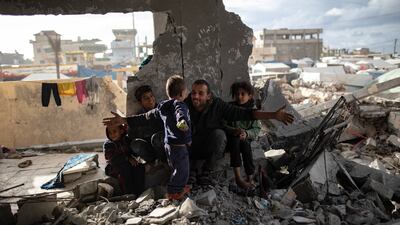
Palestinian Muhammad Al Durra with his children in the ruins of a house in Rafah where they sheltered on January 11, 2024. EPA -
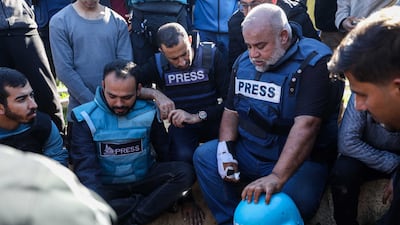
Family and friends at the funerals of journalists Hamza Al Dahdouh and Mustafa Thuraya on January 7, 2024 in Rafah, Gaza. Getty Images -
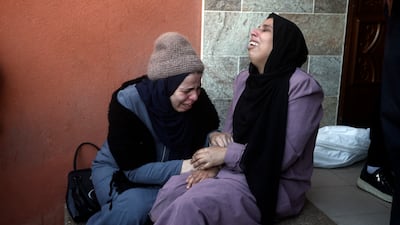
Palestinians mourn relatives killed by Israeli bombardment of the Gaza Strip outside a mortuary in Khan Younis January 4, 2024. AP Photo -
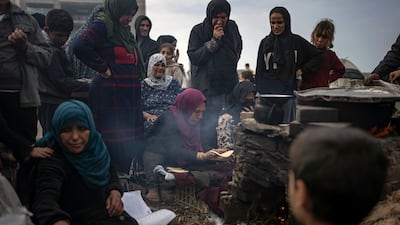
Displaced Palestinians queue to bake bread at a camp in the Muwasi area of Rafah, Gaza Strip, on December 23, 2023. AP Photo -
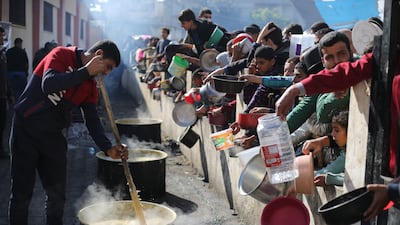
Palestinians queue for food in Rafah, the Gaza Strip, on December 20, 2023. AP Photo -

The ruins of Rafah on December 14, 2023. AFP -
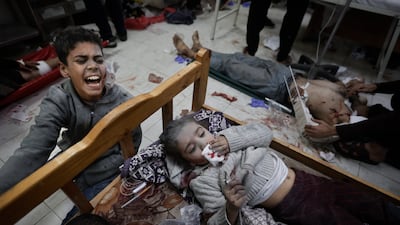
Palestinians wounded in the Israeli bombardment of the Gaza Strip arrive at a hospital in Khan Younis on December 8, 2023. AP Photo -
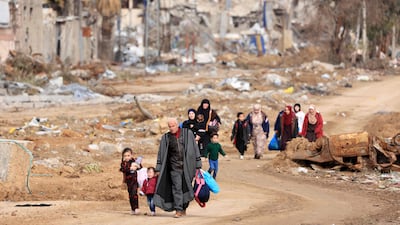
Palestinians flee Israeli bombing along the Salaheddine Road in the Zeitoun district of Gaza city on November 28, 2023. AFP -

A Red Cross vehicle takes Israeli hostages from the Gaza Strip into Egypt in Rafah on November 25, 2023. AP -
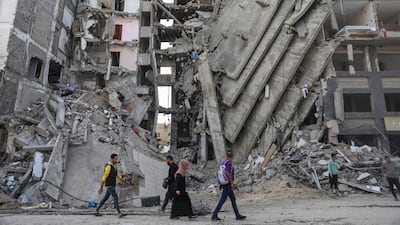
The ruins of buildings in Gaza city on November 24, 2023, as a temporary truce between Israel and Hamas took effect. AP Photo -
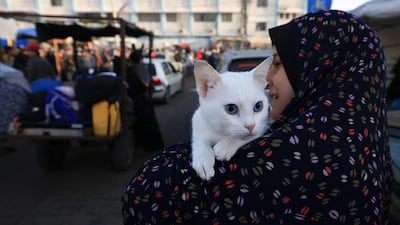
A woman and her cat return home to eastern Khan Younis in the southern Gaza Strip during the first hours of a four-day truce between Israel and Hamas forces on November 24, 2023. AFP -
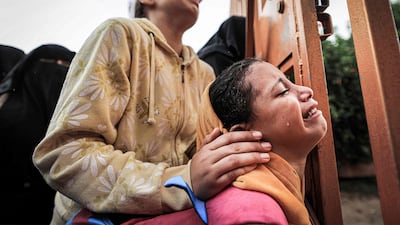
Mourning the dead of Israeli bombardment outside the mortuary at Nasser Hospital in Khan Younis on November 14, 2023. AFP -
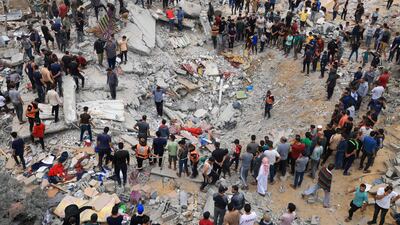
Civilians and rescuers look for survivors in the rubble of a building after Israeli bombing of Khan Younis in the southern Gaza Strip on November 12, 2023. AFP -

November 7, 2023, a month to the day after Hamas attacked Israel, a victim of an Israeli bombardment in Rafah is moved from the rubble. AFP -
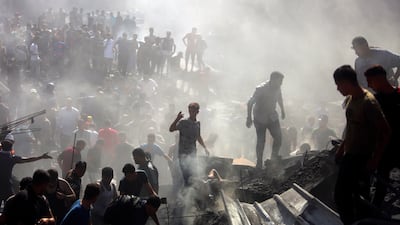
Searching the rubble after Israeli air strikes on the town of Khan Younis, southern Gaza Strip, on October 26, 2023. AP Photo -
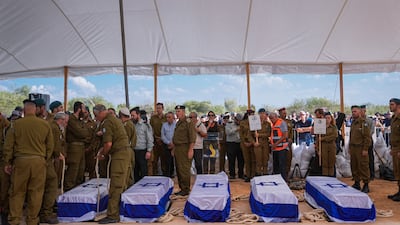
Mourning the Kotz family at their funeral in Gan Yavne, Israel, on October 17, 2023. AP Photo -
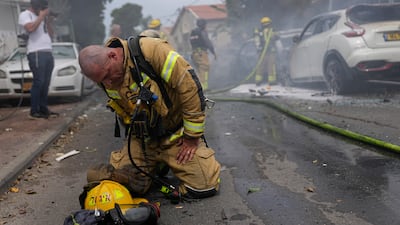
An Israeli firefighter composes himself after he and his colleagues extinguished cars set on fire by a rocket fired from the Gaza Strip in Ashkelon, Israel, on October 9, 2023. AP Photo -
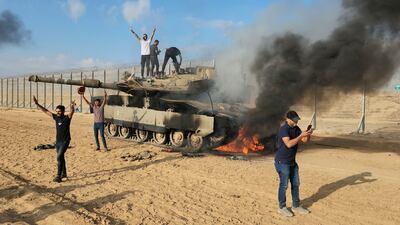
Palestinians with the wreckage of an Israeli tank at the Gaza Strip fence east of the city of Khan Younis on October 7, 2023, the day Hamas forces swept unopposed into Israel. AP Photo -
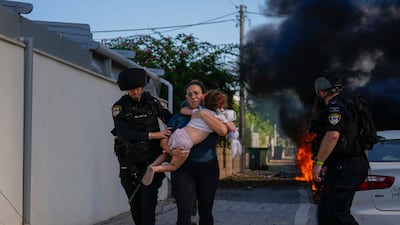
Israeli police officers evacuate a woman and a child from a site hit by a rocket fired from the Gaza Strip, in Ashkelon, southern Israel, on October 7, 2023. AP Photo


Reacting in such a forceful way to Jaish Al Adl’s attack is intended to restore some of the IRGC’s image and its deterrent value. The IRGC was probably also keen to showcase not just its will, but some of its newer capabilities, specifically long-range precision strikes – once the unique preserve of the US – without putting its own people at direct risk. The Pakistan army and air force, for their part, appear to have had almost exactly the same calculus: demonstrate the will to defend their territory, show off new technology and avoid own losses.
Prolonging hostilities could mean actually having to fight each other, which would be far more expensive and unlikely to advance either country’s strategic objectives. Although revolutionary Iran and Pakistan have often found themselves on opposite sides of regional coalitions, both states have taken care to avoid an antagonistic relationship with each other. In fact, since 1992, Pakistan’s embassy in Washington has hosted what is called the Interests Section of Iran, the regime’s de facto consular representation in the US.
Does all of this mean that Iran and Pakistan will now fight Baloch insurgents together? Although that is exactly what happened in the 1970s during the Shah’s era, the prospects for such an alignment today are not high. For one thing, defeating or at least containing the Baloch insurgency is far more important to Pakistan’s security state than it is to Iran’s.
For another, the evolution of the current Middle East crisis is entirely unclear. As events intensify, this Iran-Pakistan episode will soon drop out of the news cycle, becoming little more than a footnote to its course. Tehran is unlikely to want to lose focus on the standoff with Israel, and Islamabad is likely to sound out its allies in the Arabian Peninsula before engaging closely with the IRGC.
But for the people of Balochistan, unhappy with the governments on both sides of the border, this moment will take on much greater significance as an opportunity to tell their story to anyone who is interested enough to listen.

