

New beginnings often inspire hope and signify the presence of upcoming milestones. In that spirit, the start of this new year inspires the UAE, even as the country maintains its established trajectory from previous years.
Recent years have witnessed a new approach to shaping Gulf security through economic and diplomacy gateways. This approach is based on the importance of de-escalation in the entire region and diplomatic – not military – tools to enhance regional stability and focus on economic development.
Events such as the ongoing Israel-Gaza war are a fundamental challenge to the approach of de-escalation and expansion of economic co-operation. However, recognising the need for a political solution between Palestinians and Israelis based on the two-state solution is unlikely to disrupt the expansion of economic co-operation. This has become evident in the response to the war in Gaza among regional actors and beyond.
There are, of course, difficulties, challenges and even a certain fragility that sometimes come with this approach, especially when conflicts, wars and divisions erupt. Such developments are always expected, especially in our region. The UAE has a realistic perspective on the enormous difficulties surrounding the Middle East – one that is opposed to regression or any halting of the wheel of development. It continues to prepare for the future while these difficulties are being resolved.
The visit by President Sheikh Mohamed to India on January 9 clearly reflects that approach. The visit came a day after Sheikh Mohamed’s meeting with US Secretary of State Antony Blinken in Abu Dhabi to discuss the fallout of the war in Gaza.

On January 7, the UAE announced its participation in Nasa’s Lunar Gateway Station alongside the US, Japan, Canada and the EU. It is one of the most important international space projects of the 21st century. As part of the project, the UAE will send the first Emirati and Arab astronaut to the Moon after the station’s completion in 2030.
This is undoubtedly a unique step towards accessing valuable and accurate scientific and engineering data that will be appropriately employed to enhance the UAE’s knowledge in this field and boost its status and ability to prepare for the future. The first elements of this project are expected to be launched by 2025, while the Emirates Airlock is scheduled to be launched by 2030.
In the early days of the new year, the UAE announced a limited cabinet reshuffle in the federal government. The objective was to infuse more expertise and youthful energy into decision making, reinforcing the core pillars of prosperity, security and innovation. Recently, during the official visit of Sheikh Mohamed to Baku, the UAE signed several memorandums of co-operation with Azerbaijan. These agreements cover strategic collaboration, investments and financing, marking a significant step in bilateral relations.
Through such engagements, the UAE focuses on two strategic fronts. First, it fosters co-operation to address conflicts, crises, wars and unresolved issues to generate just and sustainable solutions. Second, it demonstrates a clear commitment to enhancing stability through prosperity, economic and participatory diplomacy, expanding opportunities and building bridges.
With the UAE concluding 10 comprehensive economic partnership agreements and negotiating with several other countries, 2024 is poised to be a pivotal milestone in diversifying partnerships and forging global connections. The President’s recent visit to India focused on critical areas, including investment co-operation in developing food parks, renewable energy and innovative health care, and establishing sustainable, green and efficient ports.
-
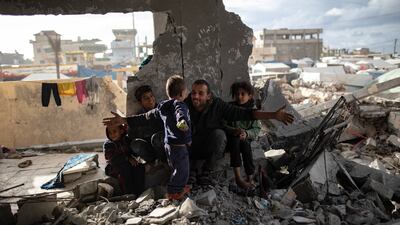
Palestinian Muhammad Al Durra with his children in the ruins of a house in Rafah where they sheltered on January 11, 2024. EPA -
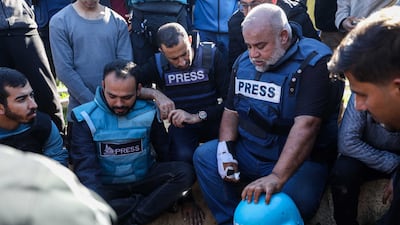
Family and friends at the funerals of journalists Hamza Al Dahdouh and Mustafa Thuraya on January 7, 2024 in Rafah, Gaza. Getty Images -
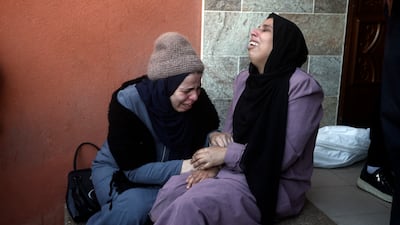
Palestinians mourn relatives killed by Israeli bombardment of the Gaza Strip outside a mortuary in Khan Younis January 4, 2024. AP Photo -
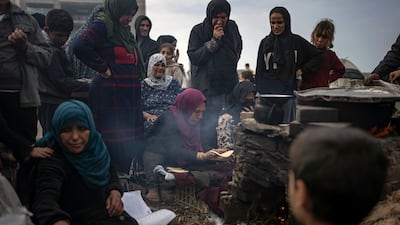
Displaced Palestinians queue to bake bread at a camp in the Muwasi area of Rafah, Gaza Strip, on December 23, 2023. AP Photo -
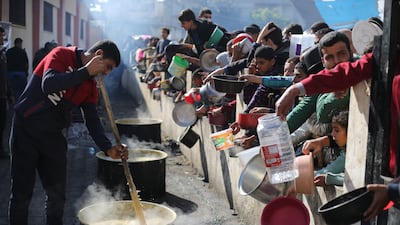
Palestinians queue for food in Rafah, the Gaza Strip, on December 20, 2023. AP Photo -

The ruins of Rafah on December 14, 2023. AFP -
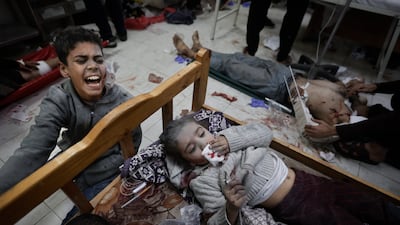
Palestinians wounded in the Israeli bombardment of the Gaza Strip arrive at a hospital in Khan Younis on December 8, 2023. AP Photo -
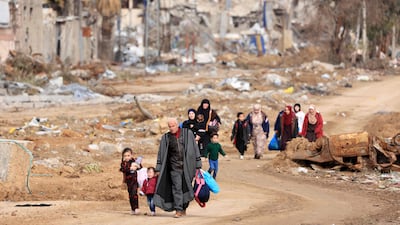
Palestinians flee Israeli bombing along the Salaheddine Road in the Zeitoun district of Gaza city on November 28, 2023. AFP -

A Red Cross vehicle takes Israeli hostages from the Gaza Strip into Egypt in Rafah on November 25, 2023. AP -
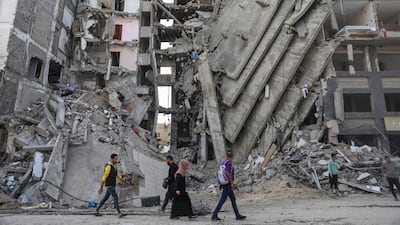
The ruins of buildings in Gaza city on November 24, 2023, as a temporary truce between Israel and Hamas took effect. AP Photo -
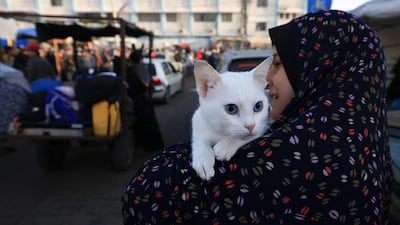
A woman and her cat return home to eastern Khan Younis in the southern Gaza Strip during the first hours of a four-day truce between Israel and Hamas forces on November 24, 2023. AFP -
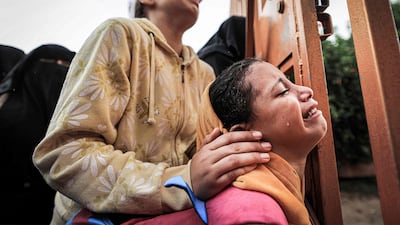
Mourning the dead of Israeli bombardment outside the mortuary at Nasser Hospital in Khan Younis on November 14, 2023. AFP -
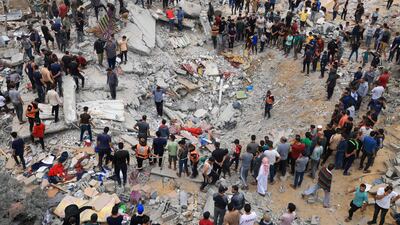
Civilians and rescuers look for survivors in the rubble of a building after Israeli bombing of Khan Younis in the southern Gaza Strip on November 12, 2023. AFP -

November 7, 2023, a month to the day after Hamas attacked Israel, a victim of an Israeli bombardment in Rafah is moved from the rubble. AFP -
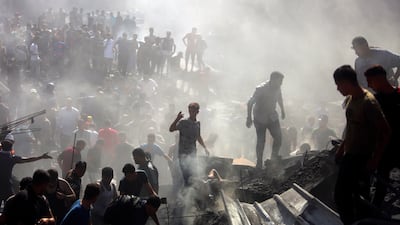
Searching the rubble after Israeli air strikes on the town of Khan Younis, southern Gaza Strip, on October 26, 2023. AP Photo -
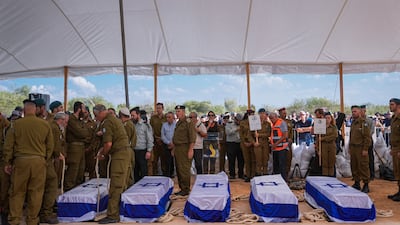
Mourning the Kotz family at their funeral in Gan Yavne, Israel, on October 17, 2023. AP Photo -
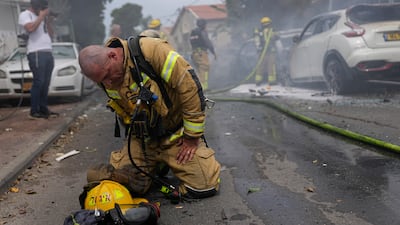
An Israeli firefighter composes himself after he and his colleagues extinguished cars set on fire by a rocket fired from the Gaza Strip in Ashkelon, Israel, on October 9, 2023. AP Photo -
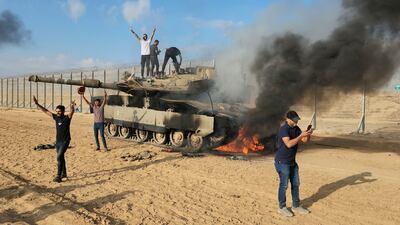
Palestinians with the wreckage of an Israeli tank at the Gaza Strip fence east of the city of Khan Younis on October 7, 2023, the day Hamas forces swept unopposed into Israel. AP Photo -
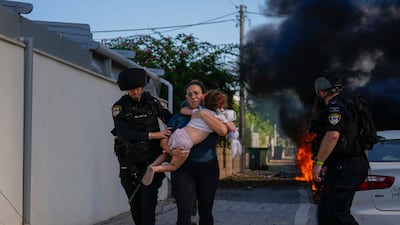
Israeli police officers evacuate a woman and a child from a site hit by a rocket fired from the Gaza Strip, in Ashkelon, southern Israel, on October 7, 2023. AP Photo


Thani Al Zeyoudi, the Minister of State for Foreign Trade, has said the Comprehensive Economic Partnership Agreement programme is expected to boost the UAE’s exports by 33 per cent and contribute over Dh153 billion ($41.7 billion) to the national gross domestic product by 2031. The programme’s impact is already evident.
These efforts align with the UAE’s persistent call for de-escalation and a ceasefire in Gaza, coupled with pursuing a political horizon leading to a just and comprehensive solution.
The proposed solution is rooted in the two-state paradigm, emphasising the importance of avoiding procrastination and not relying solely on power balance. Simultaneously, there’s a concurrent call for regional and international efforts to mitigate conflicts and promote regional stability, encompassing countries such as Sudan, Syria, Yemen and others.
Explaining this approach, Dr Anwar Gargash, diplomatic adviser to the President, has asserted that the Israeli war on Gaza underscores the need for the UAE and other regional actors to collaborate in ensuring regional stability. “National plans, such as enhancing development and expanding the economy and trade,” he said, “must move forward. I don’t believe national plans should pause, as there will always be major regional issues that will surprise us.”
The year 2024 has undoubtedly already necessitated a UAE policy that weaves caution with perseverance, but the year is off to a promising start all the same.

