


Just after sunset on the second day of 2024, a missile shattered the calm of a south Beirut evening, ripping into a residential building and killing Hamas deputy leader Saleh Al Arouri and six other militants. The strike, allegedly carried out by Israel, marked the deadliest attack outside Gaza since Hamas’s horrifying October 7 assault and possibly the start of a more dynamic third phase of the war.
First came a huge bombing campaign intended to destroy Hamas infrastructure and drive out civilians, then Israeli forces moved into Gaza and entered the group’s warren of tunnels. Now, with Hamas beleaguered in Gaza, Israel seems to think it’s time to expand the playing field.
Many fear the Beirut strike could kick off a tit-for-tat escalation that engulfs the Middle East. Former Nato chief James Stavridis argues that the chance of a regional war just doubled, to “30 per cent”. “This is a conflict that could easily metastasise,” US Secretary of State Antony Blinken said on the weekend.
I hate to break it to you, Antony, but we’re already there.
Regular attacks in the Red Sea, Iraq, Syria and Lebanon, along with Gaza, mean that this has been a five-front war for more than a month. And this excludes the West Bank, where attacks by Israeli forces, such as the deadly Israeli strike on Sunday, have killed hundreds of Palestinians, and Iran, where a terror attack last week killed more than 100 people.
ISIS soon claimed that bombing, and it followed up by calling for lone wolf attacks across the West in support of Palestinians. An attack on US troops in Syria last week brought the tally of Iran-backed assaults on US positions in Iraq and Syria to 120. This time the US responded, taking out a commander of the Iran-backed Popular Mobilisation Forces, Abu Taqwa, with a strike on Baghdad.
Hezbollah promptly responded to that by sending its Iraq commander back to Baghdad to co-ordinate further strikes on US targets. Persistent attacks by Iran-backed Houthis in the Red Sea have dented the global maritime economy, and the US has also responded there – persuading 20 allies to join its coalition to enable continued Red Sea shipping. Iran, too, has taken a stand, sending its lone warship to the Red Sea to support the Houthis.

In the coming days, expected US strikes on Houthi bases in Yemen may add yet another front to this conflict. And that’s not all. Hamas has vowed to avenge Al Arouri’s death, while Hezbollah chief Hassan Nasrallah said a response was inevitable. True to his word, on Saturday the group fired more than 60 missiles into northern Israel. On Monday, Israel hit back with a series of strikes on Hezbollah targets in southern Lebanon.
However you slice it, this is already a regional war, maybe even a global one – and the worst is yet to come.
US officials’ defence of Israel’s Beirut assassination seemed to suggest Israel is free to go after its enemies wherever it wants. David Barnea, head of the Israeli spy agency Mossad, compared the situation to Israel’s quest to kill Palestinian militants for the murder of Israeli athletes at the 1972 Munich Olympics. Over many years, Israeli agents assassinated Palestinians in Rome, Paris, Nicosia, Lebanon and beyond.
So, where next? Targeting Hamas operatives in Qatar seems unlikely, not in the least because Doha is overseeing hostage talks. Hamas has command centres in Turkey, and it’s not much of a stretch to envision Israel plotting a covert attack on Turkish soil. No surprise, then, that on the same day of the Beirut strike, Turkish authorities arrested nearly three dozen people across Turkey and charged them with spying for Mossad.
After the October 7 assault, I predicted in these pages that the US and Israel would pressure Ankara to cut ties with Hamas and hand over its leaders. Now, with the war expanding its footprint, that pressure is building.
In comments aired last month on Israeli TV, Ronen Bar, head of Israeli security agency Shin Bet, said Israel was determined to kill Hamas leaders “in every location, in Gaza, in the West Bank, in Lebanon, in Turkey, in Qatar”. Turkish President Recep Tayyip Erdogan warned Israel against such a step. “They will be doomed to pay a price they cannot recover from,” he said.
Mr Blinken visited Istanbul on the weekend and met Mr Erdogan and Foreign Minister Hakan Fidan, aiming to calm Gaza tensions and ensure Ankara’s approval for Sweden’s Nato membership. Just as Mr Blinken’s plane touched down, the State Department announced a $10 million reward for information leading to the capture of Hamas’s financiers, several of whom are thought to be in Turkey.
-
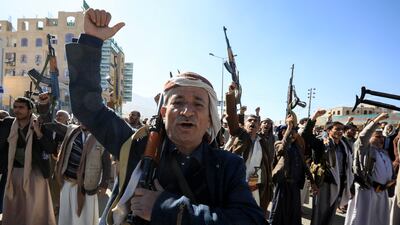
Houthi fighters shout gather in Sanaa. The rebels have launched attacks in the Red Sea in response to the Gaza war. EPA -

From left, Israeli Foreign Ministry adviser Tal Becker, lawyer Malcolm Shaw and Gilad Noam, deputy attorney general for international affairs, at the International Court of Justice in The Hague. AFP -
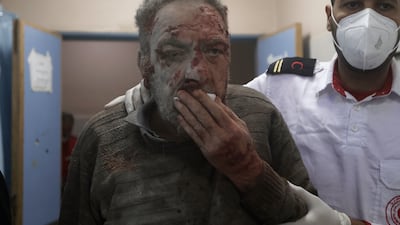
A Palestinian man injured in an Israeli strike receives treatment in Khan Younis, southern Gaza. AP -

Palestinian medics mourn after members of the Palestinian Red Crescent were killed in an Israeli strike in Deir Al Balah. Reuters -
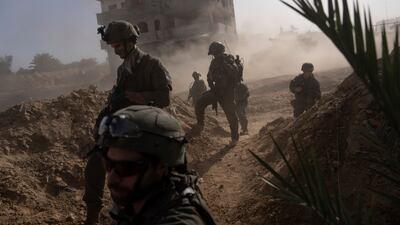
Israeli soldiers take up positions during a ground operation in Khan Younis. AP -
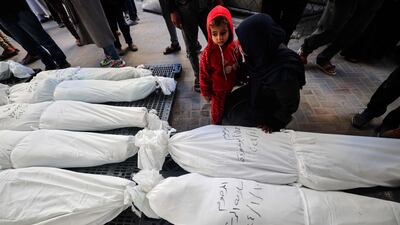
Mourners gather at Al Najar hospital in Rafah, after several relatives of a member of the Hamas general military council were killed in a strike. AFP -
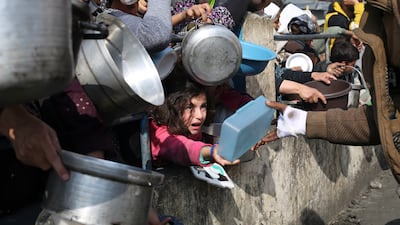
Palestinians wait to receive food aid in Rafah. AP -

A mass grave in Rafah. More than 23,000 people have been killed in Gaza since October 7. AFP -

Palestinians search the rubble of destroyed buildings after an Israeli attack on Rafah. AFP -
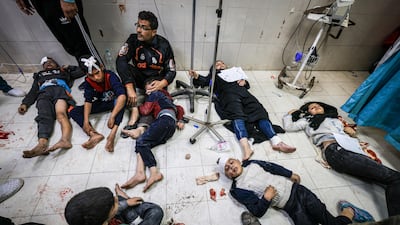
Injured Palestinians receive treatment at Nasser hospital in Khan Younis. AFP -
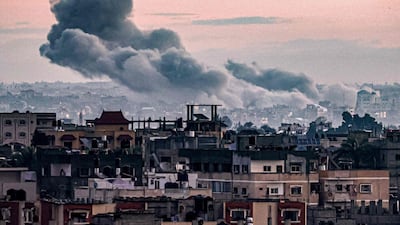
Smoke rises over Khan Younis in the southern Gaza Strip, as seen from Rafah, during sustained Israeli air strikes. AFP -
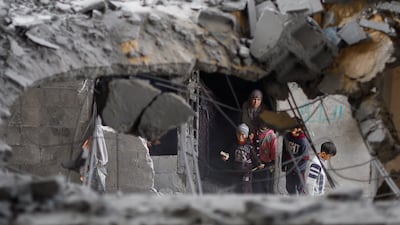
The destruction has spread throughout the Gaza Strip, from the north to Rafah in the south. Reuters -
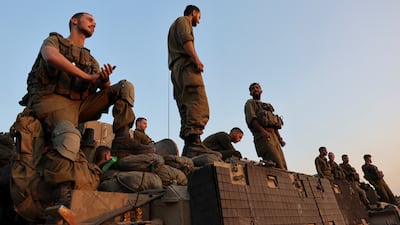
Israeli soldiers stand on an armoured personnel carrier near the Israel-Gaza border, in southern Israel. Reuters -
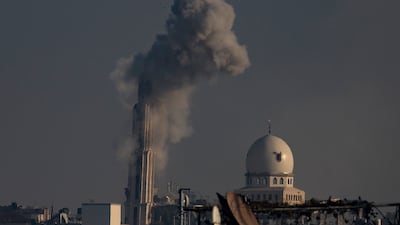
Smoke rises following Israeli air strikes in Khan Younis, the southern Gaza Strip. EPA -
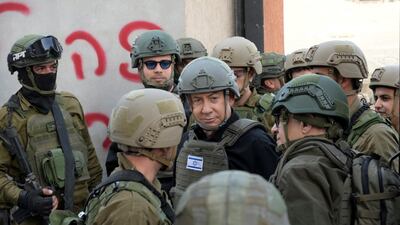
Israeli Prime Minister Benjamin Netanyahu receives a security briefing with commanders and soldiers in the northern Gaza Strip. AP -
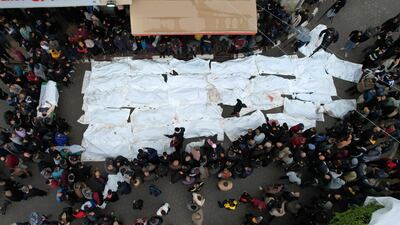
Palestinians mourn their relatives killed in an Israeli strike on the Al Maghazi refugee camp. AFP -
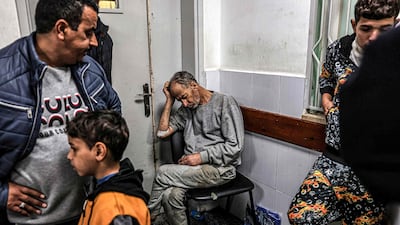
A Palestinian man detained by the Israeli military awaits treatment for his injuries in Rafah. AFP


Washington seems to think a carrot, in this case, will be more effective than the stick of possible sanctions. Yet it may be that as long as Turkey pays no price, it will continue to stretch the distance between itself and its western allies. Mr Erdogan has repeatedly defended Hamas and denounced Israel’s assault on Gaza, which has now killed 23,000 Palestinians.
This may be mainly for voter consumption in the lead-up to local elections in March. The majority of Turks are pro-Palestinian, which explains the wave of boycotts and rallies. Meanwhile, Turkish-Israeli trade increased more than a third in December, with some government-linked businesses benefiting from the bump. This seems a fitting way to enter 2024, which marks 75 years since Turkey become the first Muslim-majority state to recognise the state of Israel.
Ankara surely wants to avoid imperilling its budding economic recovery, thus the threat of US sanctions and Israel cutting trade ties could be rather persuasive. Even so, Turkey may lack adequate leverage on Hamas to persuade it to change its ways, particularly as the group’s credibility and influence have surged in recent weeks, according to US intelligence.
Despite being labelled a terrorist outfit by most western countries, and even after the horrors of October 7, Hamas has positioned itself across some of the Arab and Muslim world, and beyond, as a defender of the Palestinian cause.
In mid-December, top Hamas officials reportedly gathered in Turkey – chosen because it had been deemed safe – for a meeting attended remotely by Al Arouri and former Hamas chief Khaled Mashaal. Should the group organise another such meeting in the coming weeks, one wonders how many of the attendees will be able to walk away unscathed – and just how far this war will escalate before cooler heads prevail.

