


One day last week, The New York Times printed two separate articles describing Israeli and Palestinian reactions to the ongoing war that, together, paint a disturbing portrait of where we are three months after October 7.
The piece about Israelis was headlined “Oct 7 Is Forcing Israelis to Rethink Their Identity”, with the subhead “Attack has Shaken Belief in a Sanctuary, but Also Unified a Divided People”. The Palestinian article, datelined “Jenin Camp”, was titled “Facing Israeli Troops and Destruction, Yet Vowing to Survive” and featured a pull-out quote, “The killing, the invasion, the raids – it will all fuel even more resistance.”
Much of the Israeli article focuses on a few data points about ultra-orthodox Jews now expressing interest in serving in the military – something they have always resisted – and Palestinian citizens of Israel saying that, despite their feelings of fraternity with their people in Gaza, they would prefer to live under Israeli rule than to be governed by Hamas. None of this should be surprising, as it resembles the initial unity experienced by Americans after 9/11. But it is important to recall that emotional responses only temporarily bridge fault lines that if unaddressed will re-emerge in the future.
As the article makes clear, the fault lines remain. While the idea of Israel as a sanctuary that can protect Jews has been shaken, the sense of unity and identity now shared by most Israeli Jews is in their Jewishness and their feeling of distrust for Palestinians and any peaceful solution to the Palestinian-Israeli conflict. They may still dislike their prime minister, but many remain supportive of the killing in Gaza and silent about the ongoing violence perpetrated by police raids and settlers in the West Bank.
If the Israelis thought that their government’s assault on Gaza and the intensified repression in the West Bank would succeed in subduing Palestinians, the other NYT article and a poll of Palestinian attitudes covered a week earlier establish that the opposite has happened. Seventy per cent of Palestinians support the attack launched by Hamas on October 7. And opinion in the West Bank and Gaza now favours Hamas’s leadership over that of the Palestinian Authority.
-
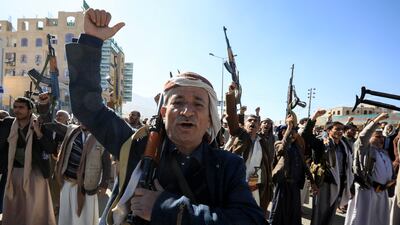
Houthi fighters shout gather in Sanaa. The rebels have launched attacks in the Red Sea in response to the Gaza war. EPA -

From left, Israeli Foreign Ministry adviser Tal Becker, lawyer Malcolm Shaw and Gilad Noam, deputy attorney general for international affairs, at the International Court of Justice in The Hague. AFP -
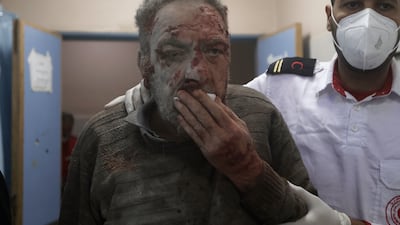
A Palestinian man injured in an Israeli strike receives treatment in Khan Younis, southern Gaza. AP -

Palestinian medics mourn after members of the Palestinian Red Crescent were killed in an Israeli strike in Deir Al Balah. Reuters -
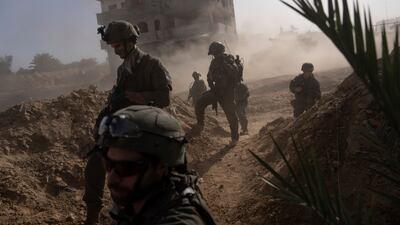
Israeli soldiers take up positions during a ground operation in Khan Younis. AP -
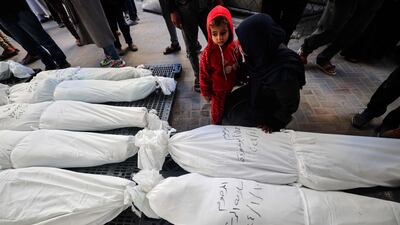
Mourners gather at Al Najar hospital in Rafah, after several relatives of a member of the Hamas general military council were killed in a strike. AFP -
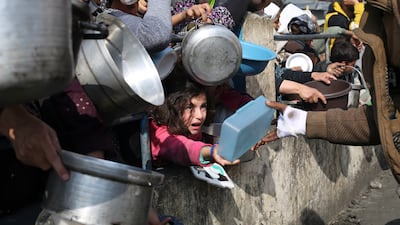
Palestinians wait to receive food aid in Rafah. AP -

A mass grave in Rafah. More than 23,000 people have been killed in Gaza since October 7. AFP -

Palestinians search the rubble of destroyed buildings after an Israeli attack on Rafah. AFP -
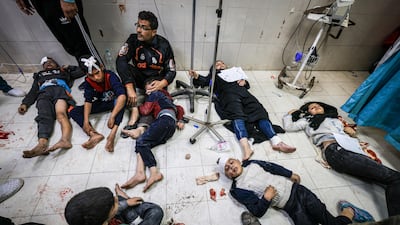
Injured Palestinians receive treatment at Nasser hospital in Khan Younis. AFP -
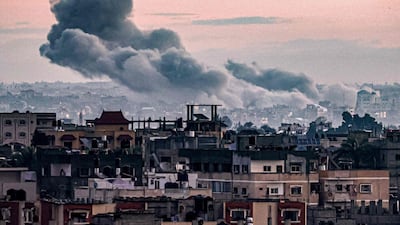
Smoke rises over Khan Younis in the southern Gaza Strip, as seen from Rafah, during sustained Israeli air strikes. AFP -
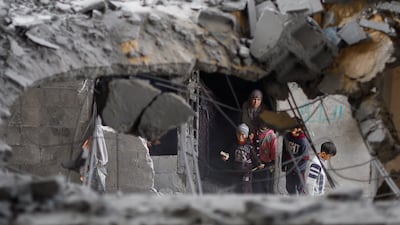
The destruction has spread throughout the Gaza Strip, from the north to Rafah in the south. Reuters -
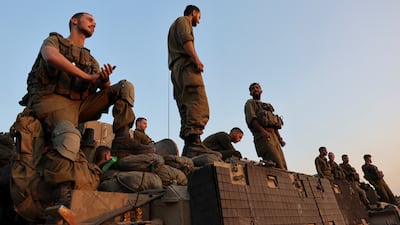
Israeli soldiers stand on an armoured personnel carrier near the Israel-Gaza border, in southern Israel. Reuters -
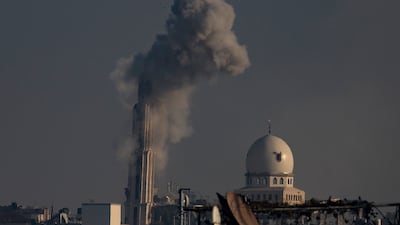
Smoke rises following Israeli air strikes in Khan Younis, the southern Gaza Strip. EPA -
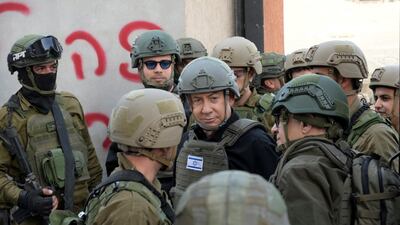
Israeli Prime Minister Benjamin Netanyahu receives a security briefing with commanders and soldiers in the northern Gaza Strip. AP -
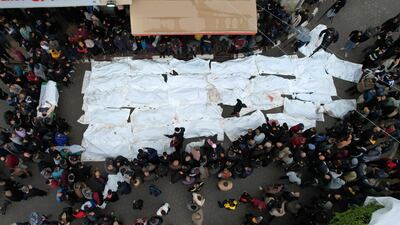
Palestinians mourn their relatives killed in an Israeli strike on the Al Maghazi refugee camp. AFP -
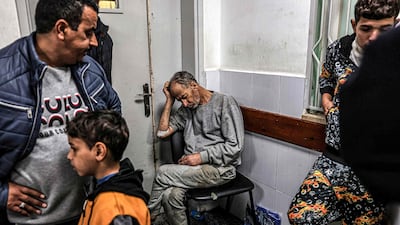
A Palestinian man detained by the Israeli military awaits treatment for his injuries in Rafah. AFP


While the numbers of dead and wounded in Gaza have been publicised – more than 21,000 killed, over 55,000 wounded – the impact of the Israeli raids across the West Bank are less well known.
In the Jenin camp, the Israelis have subjected its residents to a Gaza-like assault. Here’s the NYT description of the situation: “Electricity lines have been damaged, water tanks punctured, and paved roads turned into little more than pebbles and dirt. The stench of sewage hangs thick in the air. Over the past two months around 80 per cent of the roughly 17,000 have temporarily moved … .” And during that short span, 330 Jenin residents have been arrested and 67 have been killed.
In the face of this, one resident is quoted saying: “What the Israelis are trying to do with all this destruction is create a state of despair and drive a wedge between the people in the camp and the resistance – so people blame the resistance. What they don’t realise is that our biggest strength is our unity.”
Three months ago, when this horrific conflict was just beginning, I wrote an article lamenting that neither Israelis nor Palestinians had learnt the lessons of the past – namely that just as violence will not end the occupation, neither will violence end resistance to the occupation. I noted that because we‘ve been down this path before, we should know that when it’s over we will find ourselves right back where we started, except that there will be more dead, more anger, and more extremism on both sides.
The problem, of course, is that while this dance of death between Israelis and Palestinians continues to unfold, the US has demonstrated that it, too, hasn’t learnt any lessons.
After warning Israel against making the mistakes it made in Afghanistan, the US stood by silently as Israel did just that. The US cautioned it not to target civilians and then shipped it the bombs that continue to take a huge toll in civilian life. And the US has blocked all international calls for a ceasefire.

It’s not as if Israel hid its intentions. Prime Minister Netanyahu three times noted that the fate of the Palestinians would be that of the Amalek, Old Testament victims of a genocide. Defence Minister Yoav Gallant said Gaza should be flattened and called Palestinians “animals” saying they would be treated as such. And now leading members of his party are calling for Israel to reoccupy Gaza after driving out a significant number of its residents into Egypt or to other countries that would accept them. The US response has been feeble.
In addition to merely stating “no” to re-occupation and “no” to forced relocation, the US has proposed a “plan” for moving forward that can only politely be described as adding insult to injury.
The idea that the Palestinian Authority would be able to govern Gaza in the wake of the Israeli assault is delusional. As is the notion that this or any future Israeli coalition would be ready to move towards a negotiated two-state solution. The reasonable question one might ask is: “Negotiate what?”
With Gaza devastated; with Israeli settlements gobbling up territory making a contiguous Palestinian state impossible; with settlers and the Israeli military rampaging and removing Palestinians from their homes and properties in the West Bank and Jerusalem; with no possible Israeli coalition government ready to accept an independent Palestinian state; with the PA weakened and Hamas crippled; and with the US refusing to rein in Israeli abuses and excesses – what would be negotiated and with whom would either side be able to negotiate?
If we’ve learnt anything from the past three months, it is that bad behaviour left unchecked will grow and fester. The US enabled this situation to become what it is. Until it finds the political courage to demand a ceasefire and pull the plug on future political and military assistance, the cycle of violence and repression will continue. It all begins with the US learning lessons from its past and present failures and then changing course.
By itself, this won’t end the conflict, but it will create an environment in which Israelis will be forced to confront the costs involved in the path their leaders have chosen and Palestinians can feel hope that their plight is understood. This could mark the beginning of a long process of transformation that could lead the way to peace.

