


In an age defined by unprecedented global challenges, governments worldwide find themselves grappling with multifaceted issues such as war, post-pandemic recovery, climate change, and the relentless advance of artificial intelligence. This turbulent era has led many nations to reassess their economic strategies, with some leaning towards protectionism and intervention as safeguards for their economies.
Not long ago, the concept of globalisation promised a new world order. However, recent years have seen a shift in the global landscape. The 2008 recession raised doubts about the advantages of globalisation, and events such as Brexit signalled a move towards devolution.
World trade, relative to global gross domestic product, witnessed a 5-percentage-point decline between 2008 and 2019. Further, long-term cross-border investments plummeted by half between 2016 and 2019. And this was before Covid-19 struck global trade. These trends indicate a departure from the assumption of a rules-based global order that benefits all participants, as individual players now seek to reshape the system in their favour.
Looking ahead, the Economist Intelligence Unit noted that its researchers excepted restrained global growth but no recession. Global economic growth is forecast to decelerate to 2.2 per cent in 2024, from an estimated 2.3 per cent in 2023. Further ahead, global growth is forecast to strengthen to 2.7 per cent a year on average in 2025-28, aided by monetary easing and investment in technology and clean energy.
The World Bank echoes this sentiment, painting a less optimistic picture of global growth for the years ahead. As the economic pie worldwide begins to shrink, competition among countries is set to intensify.
-
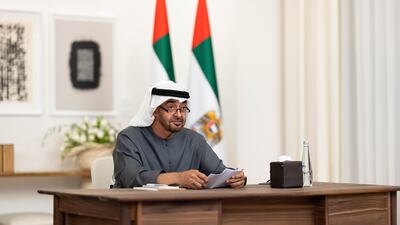
President Sheikh Mohamed delivers a speech remotely, to mark the signing of the Comprehensive Economic Partnership Agreement between the UAE and Turkey. Photo: Ryan Carter / UAE Presidential Court -
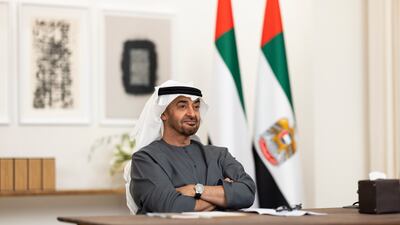
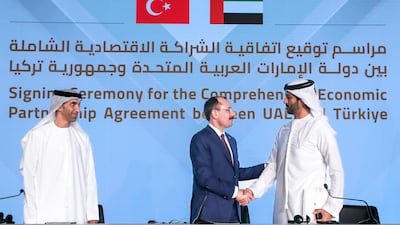
Sheikh Mohamed follows proceedings during the signing of the agreement. Photo: Ryan Carter / UAE Presidential Court -
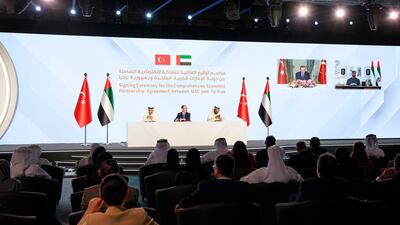
Sheikh Mohamed and President Recep Tayyip Erdogan of Turkey virtually attend the ceremony as Abdulla Bin Touq, UAE Minister of the Economy, right, Mehmet Muş, Minister of Trade of Turkey, centre, and Dr Thani Al Zeyoudi, UAE Minister of State for Foreign Trade complete formalities. Photo: Hamad Al Kaabi / UAE Presidential Court -
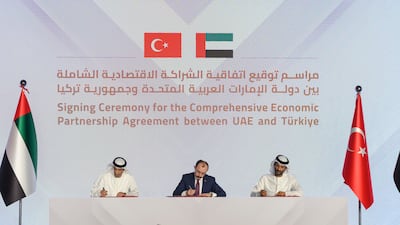
The signing ceremony was held on Yas Island. Photo: Hamad Al Kaabi / UAE Presidential Court -

Mr Bin Touq, Mr Mus and Dr Al Zeyoudi, Saeed Thani Hareb Al Dhaheri, the UAE's ambassador to Turkey, and other dignitaries during the signing ceremony. Photo: Hamad Al Kaabi / UAE Presidential Court -
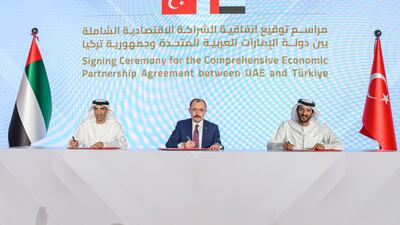
The agreement is aimed at boosting trade between the two nations. Photo: Hamad Al Kaabi / UAE Presidential Court -
Dr Al Zeyoudi told journalists in Abu Dhabi that the agreement was a also milestone for the region. Victor Besa / The National -
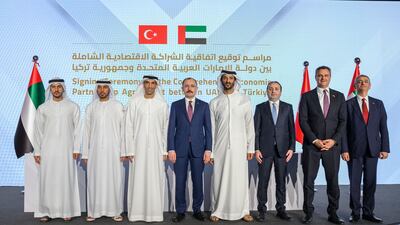
Mr Bin Touq, Mr Mus and Dr Al Zeyoudi, Saeed Thani Hareb Al Dhaheri, the UAE's ambassador to Turkey, and other dignitaries during the signing ceremony. Photo: Hamad Al Kaabi / UAE Presidential Court -
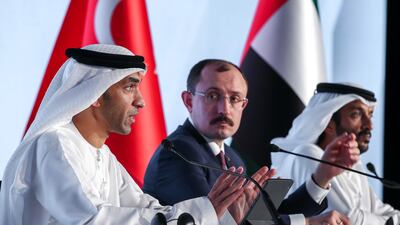
Mr Bin Touq, Mr Mus and Dr Al Zeyoudi, during the signing ceremony. Victor Besa / The National


In light of these changes, countries must prepare for a new reality marked by fragmentation rather than a unified system. This evolving landscape will probably entail mutually beneficial bilateral, trilateral, or quadrilateral agreements, adaptable to the evolving needs.
In this fiercely competitive environment, the UAE has strategically positioned itself to secure a substantial share of the global economic landscape. Its approach is characterised by innovation and agility, exemplified by its recent introduction of the “10 Economic Principles for the Future”.
These principles outline a forward-thinking roadmap for the UAE’s economic landscape over the next decade. In an era of shifting paradigms, these principles underscore its commitment not only to adapt but also to thrive amid evolving global dynamics.
The foundation of the UAE’s economic strategy is its commitment to an open economy without boundaries. This principle positions the nation as a global economic hub, welcoming international and regional economic exchange without limitations. It entices investment and trade by offering an attractive environment with competitive incentives.
Moreover, the UAE’s emphasis on diversifying trade partners and exploring new economic horizons reinforces its role as a central player in the global free-market economy. Indeed, in February 2024, the UAE will chair and host the World Trade Organisation’s 13th Ministerial Conference, and it will aim to underline this focus on global growth and openness.
An essential component of the UAE’s economic vision is the attraction of the world’s most skilled individuals, innovators and creative minds. This principle recognises the UAE as an economic environment where local and global talent converges.
Another pivotal element of the UAE’s economic vision is its dedication to becoming a global digital economy hub. By continually developing its digital infrastructure and related regulations, the nation positions itself as an international platform for digital transactions. This commitment to embracing AI revolution technologies fosters a competitive digital economy that shapes the future.

Sustainability takes centre stage in the UAE’s economic vision. This principle underscores the nation’s focus on ensuring the sustainability of its economy through advanced legislation and policies. In a year in which the UAE will welcome and chair the Cop28, it aims to guarantee the sustainability of resources and environmentally friendly energy sources.
The UAE’s recent record-breaking numbers in international trade exemplify its potential to thrive in this increasingly competitive environment. With an economy deeply integrated into global trade networks, the nation is well-positioned to seize opportunities arising from a more interconnected world.
The future is a domain reserved for nations that possess the vision to transcend prevailing economic paradigms and the courage to make bold decisions aimed at pioneering novel avenues for growth, all while maintaining adaptability in the face of evolving global dynamics.
We stand on the cusp of megatrends that are reshaping our world. These seismic shifts include the transition of economic power from the established G7 stalwarts to the burgeoning economies of the East, collectively referred to as the “E7”. This group encompasses economic giants such as China, India, Indonesia, the Philippines, Thailand, Vietnam and Bangladesh.
Simultaneously, we bear witness to the ascent of Africa on the global stage, accompanied by intense international competition for its resources, talents and burgeoning consumer markets.
The advent of a new global paradigm in AI further underscores the transformative potential that promises to permeate nearly every aspect of our lives. This transformative promise is poised to accelerate with the introduction of quantum computing, heralding an era of unparalleled advancement.
In this new world order, survival and prosperity will not hinge solely on the size of a nation’s economy or the might of its military forces. Instead, it will be claimed by those nations that exhibit unparalleled connectivity, agility and innovation. This represents not the conclusion of globalisation but the genesis of a fresh epoch, one characterized by “reglobalisation”, governed by an entirely novel set of rules.
The rules of the game may be shifting, but for those with the vision and agility to navigate this new terrain, the opportunities are boundless.
Yasar Jarrar is managing partner at International Advisory Group

