


According to Israel’s official sources, its military campaign in Gaza has now entered phase two, with a configuration of air, ground and special forces engaged in the Palestinian enclave. This is part of a long war, with Israel’s stated objective being to eradicate Hamas’s military and political capabilities. The focus is first on northern Gaza, but it expects to expand its operations to central and southern Gaza as well.
Hamas and other Palestinian groups claim to have repulsed Israeli ground and special forces, while Israel reports having killed Hamas leaders in Gaza and incarcerated others in the West Bank. A handful of hostages held by Hamas have returned, but militarily very little can be objectively verified. Therefore, the only conclusion to be drawn, as the conflict reaches its one-month mark, is that the battles will continue.
From a societal perspective, the enclave’s evident devastation is widespread, with more than 25 per cent of Gaza City razed to rubble. Thousands upon thousands of Palestinians have been killed and tens of thousands maimed or injured, including from the recent air raids on the Jabalia refugee camp. More than a million Palestinians have been displaced across the Strip, which only provides partial safety from intermittent air raids. Israel is pursuing collective punishment and targeting health facilities in violation of international law.
Along with many of its western allies, it has rejected calls for a ceasefire and refused to accept even a humanitarian pause. Israel has essentially deprived the sick and wounded of basic health services, with hospitals being rendered dysfunctional by the high number of patients and the lack of resources.
-
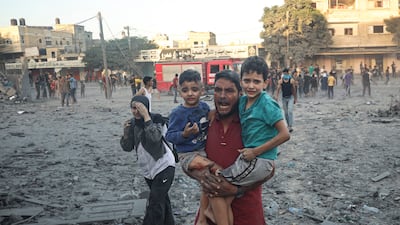
Palestinians cry as they walk away after an area hit by Israeli missiles in Rafah, the Gaza Strip. AP -
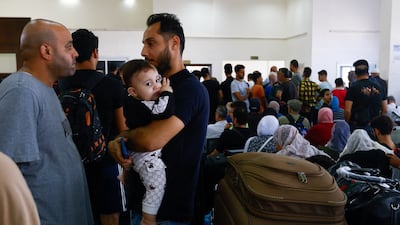
Palestinians with foreign passports wait for permission to leave Gaza at the Rafah border crossing with Egypt. Reuters -
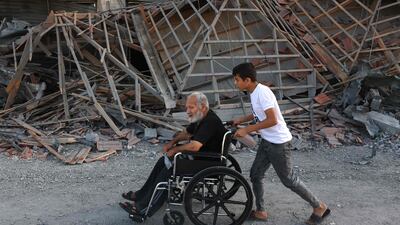
A Palestinian boy pushes a man on a wheelchair past debris in Rafah. AFP -

A paramedic holds an injured bird as he searches through buildings destroyed during Israeli air raids in Khan Younis, in the southern Gaza Strip. Getty Images -

Israeli soldiers take part in ground operations at a location given as Gaza. Reuters -
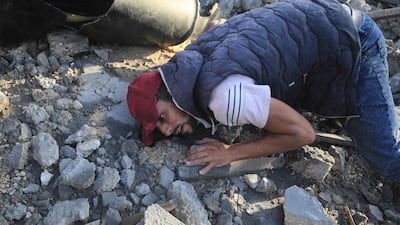
A man listens for any potential sounds of life following an Israeli air strike on the Maghazi refugee camp in Gaza. AFP -
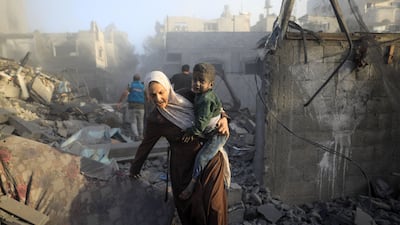
People flee after Israeli air strikes on the Maghazi refugee camp. AFP -

An Israeli soldier arranges artillery shells near the border with the Gaza Strip. AFP -

Relatives and friends of those kidnapped during the October 7 Hamas attack hold photos of their loved ones during a protest calling for their return outside Israel's parliament. AP -
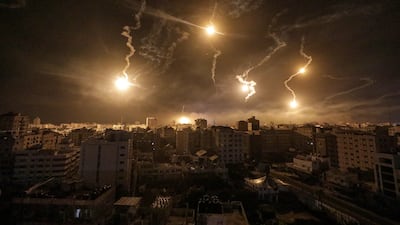
Israeli flares illuminate the sky over west Gaza in the northern Gaza Strip. EPA -
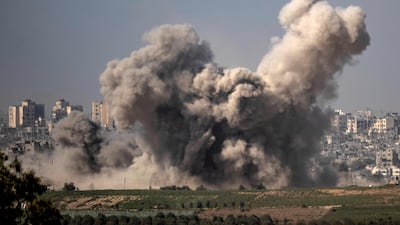
Smoke rises from northern Gaza after Israeli pounded the besieged enclave. AFP -

Ambulances queue at the Rafah border as they wait to cross into Gaza to transport the injured back to Egypt for treatment. Getty Images -

Women cry as one of them holds an injured toddler outside Shuhada Al Aqsa hospital after an Israeli bombardment of Deir Balah, in the central Gaza Strip. AFP -
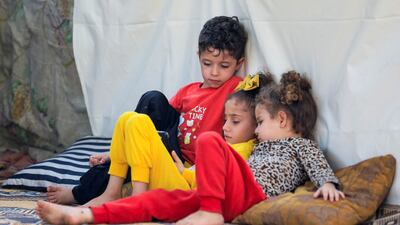
Displaced Palestinian children sit in a makeshift shelter at Al Shifa hospital, amid the Israel-Gaza war. Reuters -
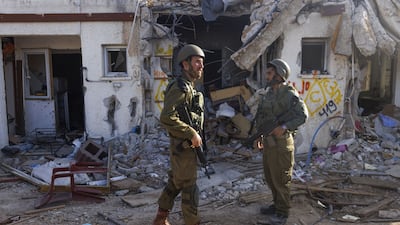
Israeli soldiers patrol outside a house destroyed during fighting with Hamas militants, in the kibbutz of Kfar Aza. Bloomberg -

Palestinians from Bureij refugee camp use Salah Al Din street as they flee the southern Gaza Strip. AP -
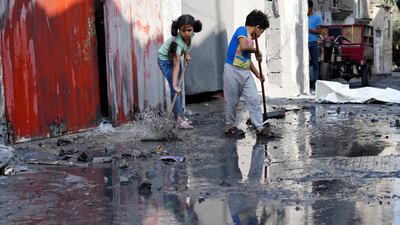
Palestinian children clean up outside their home after Israel struck Maghazi refugee camp in the Gaza Strip. AP -
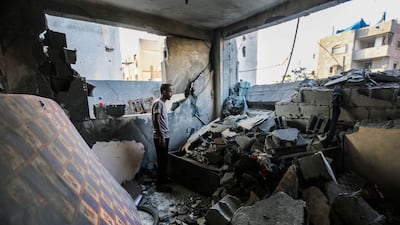
Khan Younis residents search through buildings destroyed during Israeli air raids. Getty Images -
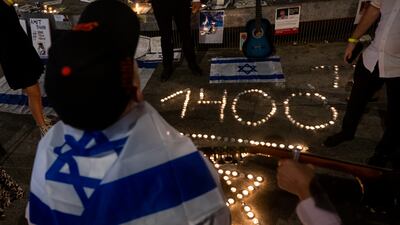
People take part in a candlelight vigil in Dizengoff Square, in Tel Aviv. Getty Images -
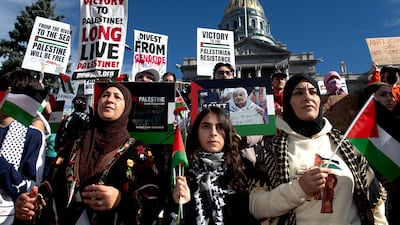
Demonstrators rally in support of Palestinians in Denver, Colorado. AFP -

Galya David, the mother of hostage Evyatar David, takes part in the 'Bring them home' event organised by the Greek Israeli Community in Athens. EPA -

Lebanese parademics show the blood-stained high-vis jackets of four of their colleagues wounded after their ambulances were hit in a strike on the Lebanese town of Tayr Harfa. AFP -
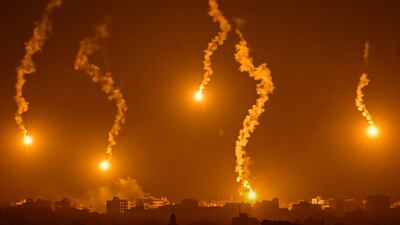
Flares are dropped by Israeli forces above Gaza, as seen from Sderot, near the border with the Palestinian enclave. AFP -

Israeli forces at a position along the the border with Gaza. AFP -

Palestinians search for bodies and survivors at Magazi refugee camp in Gaza after an Israeli air strike. Reuters -

Leaflets are dropped by the Israeli army over Gaza city asking people to evacuate towards the south of the Palestinian enclave. AFP -
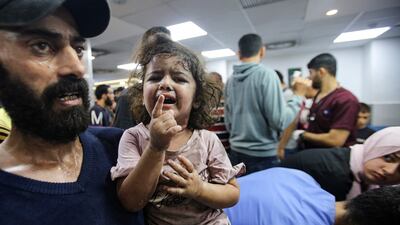
An injured toddler awaits treatment at the emergency ward of Al-Shifa Hospital following an Israeli strike, in Gaza city. AFP -

A Palestinian man wails amid a search for casualties after an Israeli strike on houses, at Magazi refugee camp, Gaza. Reuters -
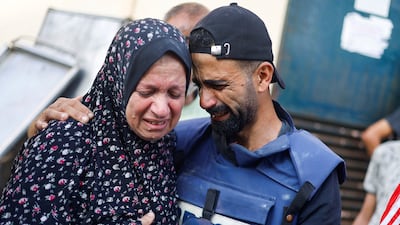
Anadolu news agency cameraman Mohammed El Aloul pictured after several of his children and siblings were killed in Israeli strikes. Reuters -

Israeli soldiers walk past debris and damaged buildings at a location given as Gaza by Israel's military. Reuters -

Protesters rally outside the White House in support of Palestinians in Gaza, Washington. Reuters -
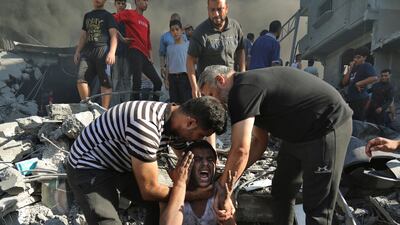
A man mourns after losing relatives following an Israeli air strike in Gaza city. AP -
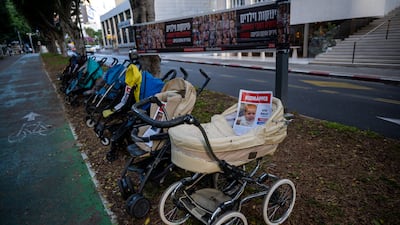
An art installation of prams with the faces of kidnapped children on display in Tel Aviv. Getty Images -

An Israeli woman calls for a ceasefire in the Gaza Strip. AP -

A Palestinian man stands on a collapsed building following a strike by the Israeli military on Khan Yunis in the southern Gaza Strip. AFP -
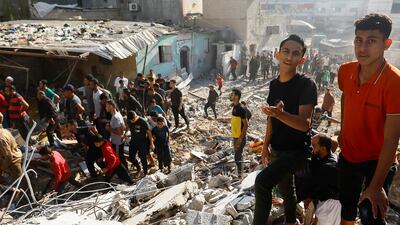
Palestinians gather at the site of Israeli strikes on a residential building in Khan Younis. Reuters -
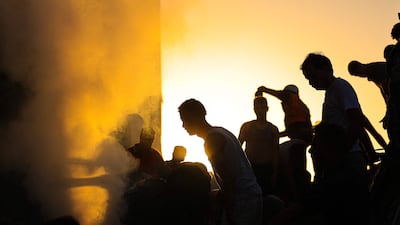
Thousands of civilians, both Palestinians and Israelis, have died since October 7, 2023. AFP -

A Palestinian woman sits in the rubble as rescuers look for her relatives following the Israeli bombardment of Khan Younis. AFP -
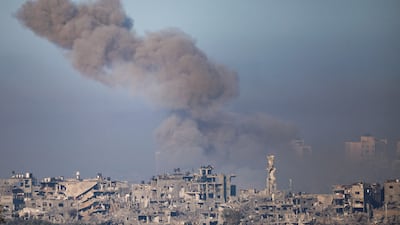
Smoke rises from Gaza as the conflict between Israel and Palestinian group Hamas continues. Reuters -

Mourners at the funeral of Druze Israeli Lt Col Salman Habaka in the village of Yanuh Jat, northern Israel. AP -
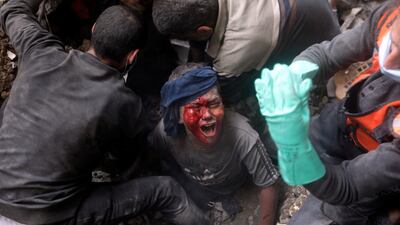
A Palestinian boy pulled from the rubble of a building following an Israeli air attack on Bureij refugee camp, in the Gaza Strip. AP -

A survivor calls from Nasser Hospital in Khan Younis following Israeli air attacks. EPA -
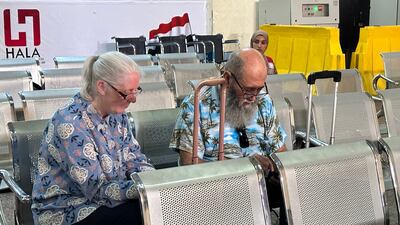
People wait on the Egyptian side of the border after passing the Rafah border crossing between the Gaza Strip and Egypt. EPA -
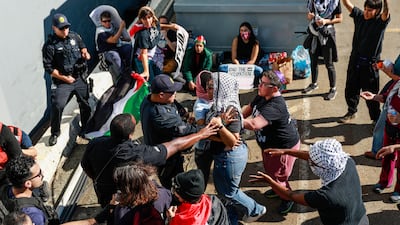
Pro-Palestinian supporters during a demonstration near a US military transport vessel at the Port of Oakland in California. AP


The situation has become so dire that several US and UN officials have resigned in protest. Numerous demonstrations have been witnessed in several western countries, countering their own governments’ positions and calling for a ceasefire in Gaza. Bolivia, Chile, Colombia and Jordan have either cut relations with or reduced the level of representation in Israel. Other countries could follow.
Regrettably, however, I foresee more pain and suffering of non-combatants before this page is turned. The only question is how many more lives will be lost and civilians injured.
The political consequences of the events of the past month are also quite significant.
It was hardly surprising that the US and most of the western world were inclined to support Israel. However, US President Joe Biden’s meeting with Israel’s recently assembled war cabinet was particularly inappropriate, and alarming, as he effectively green lighted the subsequent Israeli operations. It was not surprising, therefore, that the leaders of Egypt, Jordan and Palestine then decided to cancel their meetings with Mr Biden.
The subsequent refusal of the US and several western governments to support calls for a ceasefire, and their insistence that Israel had the right to self-defence, further affirmed the belief of a wide-ranging majority of public opinion that the West was biased and applying double standards. This was evident at the Cairo Peace Summit held shortly after hostilities broke out. This forced some Arab countries to distance themselves from their western friends.
Arab and international efforts have been made at the UN Security Council and General Assembly to generate wider public support for a ceasefire and humanitarian pause. Several western countries joined in these efforts, but the US remained in opposition. While this obvious bias will not immediately change Arab positions towards the West, there will be incremental consequences as public opinion heats up if Israel continues its relentless use of force, especially at the expense of civilians.
As the war is prolonged as projected by Israel, and the number of civilian casualties continues to mount, we are seeing an erosion of support for Israel in global public opinion, including in the western world. The traditional contemporary narrative that Israel is a small country facing existential threats from aggressive neighbours has already lost some ground and will continue to do so.

Most importantly, public opinion in the Arab world, including among those who do not support Hamas, is increasingly aggrieved by the ruthlessness of the Israeli military campaign, which justifies Palestinian deaths as acceptable collateral damage. The feelings of dismay and anger are bound to increase as the death toll keeps going up, as will growing perceptions that all this is part of a preconceived plan to evacuate Palestinians by transferring them from Gaza to the Sinai Peninsula in Egypt and subsequently from the West Bank to Jordan. Public opinion will carefully monitor Israeli actions and Arab reactions in the weeks to come, with the expectation that concrete measures will be taken at the Arab League summit in Riyadh on November 11.
There are concerns that the Gaza crisis will spill over into a wider regional conflict. There have been several cross-border incidents involving Israel, Egypt, Hezbollah and even reports of missile activity in the Red Sea, with the US targeting some Iranian sites in Syria. For now, all these appear to be contained and controlled actions rather than precursors to a regional conflict, but one should never underestimate the potential threats and risks embodied in the fog of a war that can quickly get out of hand.
Looking forward, one can only conclude that without a paradigm shift, things will only worsen as risks of spill overs increase. In essence, the status quo is politically untenable and morally unacceptable. Palestinian lives are not collateral damage, especially non-combatants. In the absence of a ceasefire or humanitarian pause, Palestinian losses will only fuel more anger against Israel and possibly even generate a greater need for personal revenge and retribution.
US Secretary of State Antony Blinken returned to the region on Friday, with behind-the-scenes diplomacy ongoing, albeit mostly regarding hostage exchange and the provision of humanitarian support. The humanitarian issues there need to be dealt with expeditiously. I therefore expect renewed efforts in the UN to deal with them more cogently in the next few days.
These issues alone, however, do not address the root causes of the Palestinian-Israeli conflict that, in essence, are existential choices of whether these two peoples will live together peacefully moving forward. Crisis management efforts need to be complemented by conflict resolution efforts on the core issue of ending Israeli occupation of Palestinian territory and the creation of a Palestinian state as part of a two-state solution. That is what will provide peace and security for all, including Israel.

