


As climate change intensifies and biodiversity deteriorates, the time for action is now. The upcoming Cop28 presents a unique opportunity to mobilise the significant private sector financial resources required to tackle these dual crises of climate change and biodiversity loss.
The past decade was the warmest on record, leading to more frequent and intense storms, droughts and heatwaves. At the same time, species loss is occurring at an unprecedented rate, with one million species at risk of extinction within the coming decades.
Biodiversity loss affects climate change through a feedback loop: as ecosystems degrade, they lose their ability to act as carbon sinks. Climate change is also affecting critical ecosystems such as coral reefs, wetlands and forests that provide natural resilience against climate impacts. Preserving these ecosystems is not just crucial for biodiversity; it is also essential for climate mitigation and adaptation.
This is not only a crisis of nature but also a crisis for people and livelihoods, as communities worldwide grapple with the effects of erratic weather and diminished natural resources. Safeguarding these ecosystems becomes imperative for humanity, biodiversity and climate stability alike.
It is our collective responsibility to address these twin challenges urgently.
Climate action requires considerable financial investments from both governments and businesses – at an estimated four to $5 trillion every year by 2030. At the same time, we know that there is a significant funding gap in biodiversity conservation, ranging from $598 billion to $824 billion every year by 2030.
-
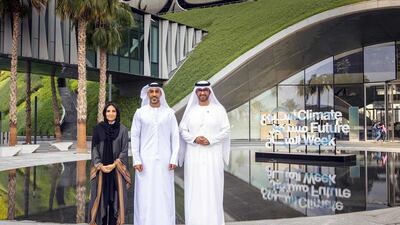
Dr Sultan Al Jaber, Cop28 President-designate, with Razan Al Mubarak, UN Climate Change High-Level Champion for Cop28, and Khalfan Belhoul, chief executive Dubai Future Foundation, at the Climate Future Week at the Museum of the Future in Dubai. Photo: Cop28 UAE -
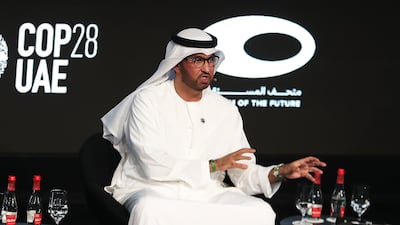
Dr Sultan Al Jaber, Cop28 President-designate and UAE Special Envoy for Climate Change, calls on all nations to come together to take decisive action to address climate change. Pawan Singh / The National -

Razan Al Mubarak, UN Climate Change High-Level Champion for Cop28, says the world must pay heed to the voices of the vulnerable who bear the brunt of climate change. Pawan Singh / The National -
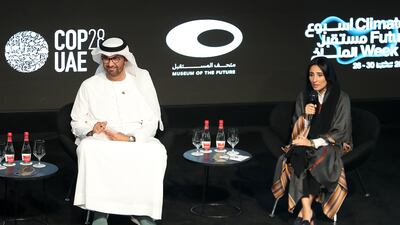
Dr Sultan Al Jaber, Cop28 President-designate and UAE Special Envoy for Climate Change, shares the stage with Razan Al Mubarak, UN Climate Change High-Level Champion for Cop28, at a conference in Dubai in the lead-up to the summit. Pawan Singh / The National -

Delegates listen in during the final day of Climate Future Week held at Museum of the Future in Dubai. Pawan Singh / The National


Private sector finance is becoming increasingly vital in this context, to complement public funds in meeting the growing need for climate finance. Not only can the private sector fill this gap, but it can also contribute valuable expertise, innovation and efficiency.
Bridging the gap between national governments and non-state actors such as the private sector can help to amplify and catalyse even greater impact.
That is exactly what I have been advocating as the UN Climate Change High-Level Champion for Cop28 – to connect the work of governments with the many voluntary and collaborative actions taken by cities, Indigenous peoples, women, businesses and investors.
There are several innovative financial mechanisms that can mobilise private sector finance for climate action and biodiversity conservation. The key examples that I will highlight include philanthropy, blended finance, green bonds and public-private partnerships.
Philanthropy can play a crucial role by seeding innovative projects and can directly make an impact on communities that bear the brunt of climate change and biodiversity loss. Vulnerable populations often face immediate and tangible consequences, such as displacement, due to rising sea levels, loss of livelihoods due to disrupted ecosystems, and increased health risks due to heatwaves and pollution.
Philanthropic organisations and individual donors become pivotal in supporting initiatives that safeguard these communities, providing financial aid, supporting the development of sustainable livelihoods, and enhancing adaptive capacities to navigate through climatic challenges.
Unlike traditional investors, philanthropic entities can channel funds into high-risk or long-term projects, directly aiding people by establishing resilient infrastructures, fostering sustainable development, and supporting community-based conservation and adaptation practices.
Unlike traditional investors, philanthropic funding is less driven by expectations of financial returns, allowing it to support high-risk or long-term projects that may not be immediately profitable. The funding can serve as a catalyst, leveraging additional investments from public and private sectors.
Green bonds are another key example that can mobilise private sector finance for climate and biodiversity goals. Investors can purchase these bonds with the understanding that the funds will support a range of projects, from habitat restoration to renewable energy infrastructure. This tool allows organisations to secure necessary financing while offering investors a reliable return on investment.
Blended finance, which combines public and private funding sources, can also help to unlock private capital. This approach amplifies the impact of limited public resources by reducing investment risks or offering incentive, making the projects more attractive to private investors.
And finally, another important piece of the financing puzzle is public-private partnerships, wherein governments and private entities collaborate to develop, finance and operate projects or services. The public sector typically provides regulatory support and may subsidise the project, while the private sector brings in capital, technology and operational expertise. This collaborative approach can speed up the implementation of critical projects, ranging from renewable energy facilities to nature-based coastal protection measures such as mangrove restoration.
Recognising that finance is a critical enabler of action, the Cop28 presidency has continually called for climate finance that is available, accessible and affordable, especially for the Global South. We must accelerate efforts and bring in the private sector to meaningfully deliver transformative change.
Only by enlisting the resources, innovation and agility of the private sector can we hope to close the funding gap and set the stage for a more resilient, sustainable world.
Let’s transform commitments into capital and action – starting here, starting now.

