US President Joe Biden confers with National Security Adviser Jake Sullivan on Wednesday. Reuters


The Middle East crisis Joe Biden hoped he would avoid


  • English
  • Arabic

October 12, 2023

In the tumultuous arena of Middle Eastern geopolitics, US President Joe Biden's entire approach to the region has been brutally upended, with critics claiming his policies helped precipitate the unfolding Israel-Gaza war.

The murderous rampage by Hamas in Israel and the ongoing Israeli military strikes on and siege of Gaza are the antithesis of the image of steady progress that until recently the administration had been depicting.

In fateful comments just a fortnight ago, National Security Adviser Jake Sullivan touted the apparent successes of the Biden administration's measured approach to the Middle East.

“Iranian attacks on US forces have stopped. Our presence in Iraq for now is stable,” Mr Sullivan said. “The Middle East region is quieter today than it has been for two decades.”

Now, Mr Biden is dealing with a geopolitical crisis that risks spreading beyond Israel's and Palestine’s borders.

His administration's prior focus for the region, pushing a normalisation deal between Saudi Arabia and Israel, has seemingly been put on the back-burner while it rushes military aid to Israel for its expected invasion of the Gaza Strip.

“All of our attention … has been focused squarely on this conflict, on this heinous brutal attack and on helping Israel be able to defend itself,” Mr Sullivan said on Tuesday.

It's a huge mess for the Biden administration, which had steered its foreign policy towards countering China, helping Ukraine to fight Russia's invasion, and nudging Iran back into some sort of deal to slow its progress towards potentially obtaining a nuclear bomb.

The plight of Palestinians and the extent to which they should be factored into a Saudi-Israeli deal received little attention under the Biden administration, arguably a significant flaw in the whole endeavour. Now, a little more than a year before he is up for re-election, Mr Biden has a Middle East crisis squarely on his lap.

For the moment, the US Congress is united in its support for Israel. But Republicans are already trying to capitalise on the crisis, and Democrats are voicing concerns about the toll on Palestinian civilians as Israel attacks the Gaza Strip.

Former president Donald Trump, who in all likelihood will run against Mr Biden, said the Hamas attacks were the result of the US being “weak and ineffective” and claimed there would somehow have been “zero chance” of the assault happening if he were in the White House.

“When we get back in, I will immediately reimpose the Trump Travel Ban on entry from terrorist countries,” Mr Trump said at a rally on Wednesday, referring to what became known as his 2017 “Muslim ban” and appealing to his xenophobic base. Of course, any sort of travel ban in the US would have done nothing to protect Israelis from this attack.

Will Wechsler, the senior director of the Rafik Hariri Centre and Middle East Programmes at the Atlantic Council, said that whatever happens next, it probably won't factor into the November 2024 elections.

“It's always painful for international audiences to realise exactly how little foreign policy matters in most presidential elections in the United States,” Mr Wechsler told The National.

When pollsters ask voters their top concerns, “you usually have to scroll very far down the list before you get to foreign policy issues”.

Mr Biden has often professed his “love” for Israel. Over the decades, the 80-year-old president has visited the country more than 10 times, including as a young senator in 1973, when he met then-prime minister Golda Meir. The visit came shortly before the October war, the last time Israel mobilised on a scale similar to now.

“I do not think that what is motivating President Biden is the domestic political environment. I think he made his decisions about Israel many decades ago,” Mr Wechsler said, referring to Mr Biden's affinity and support for Israel.

The Democrat has had disagreements over the rightward political direction Israel has taken, most recently this year when he refused to grant Prime Minister Benjamin Netanyahu an audience at the White House and met him on the sidelines of the UN instead.

In the immediate aftermath of the Hamas attacks, Mr Biden put any political differences aside and repeatedly pledged unflinching support for Israel without referencing the civilian deaths in Gaza, where more than 1,000 people have been killed in Israeli strikes.

On Wednesday, though, he signalled his support had some limitations, saying Israel should follow “the rules of war”. Israel has already flattened large parts of Gaza and has cut off food and water to the territory's 2.3 million people.

Have Mr Biden's policies actually contributed to this crisis?

Richard Goldberg, a senior adviser at the Foundation for Defence of Democracies, said the Biden administration's Middle East policy has been a “strategic failure”, with too much emphasis on trying to reach a new nuclear deal with Iran even as the latter has funded Hamas and other anti-Israeli militant groups such as Hezbollah in Lebanon.

He was particularly critical of the recent prisoner swap with Tehran that saw five Americans walk free while Iran was to be given access to $6 billion in previously frozen funds – although the Biden administration has repeatedly stressed that the money can only be used for humanitarian purposes.

“Israeli officials are on edge, believing, based on their own intelligence, that Iran is trying to get Hezbollah into the fight,” Mr Goldberg said.

The Israel-Gaza war is a conflict Mr Biden wanted to avoid. Whatever happens next could define his legacy.

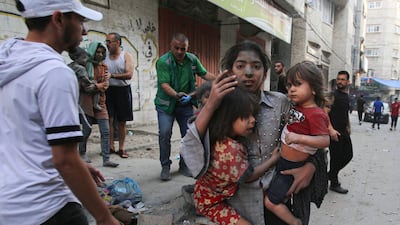
  • A Palestinian girl holds two children as she stands on a street in Gaza city as Israel continues to launch air strikes. AFP
    A Palestinian girl holds two children as she stands on a street in Gaza city as Israel continues to launch air strikes. AFP
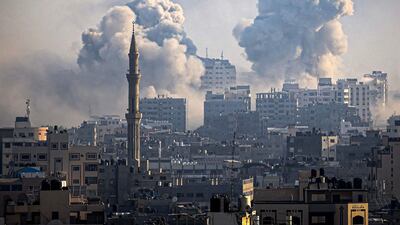
  • Smoke plumes billow during Israeli air strikes on Gaza city. AFP
    Smoke plumes billow during Israeli air strikes on Gaza city. AFP
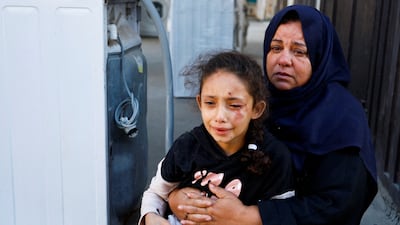
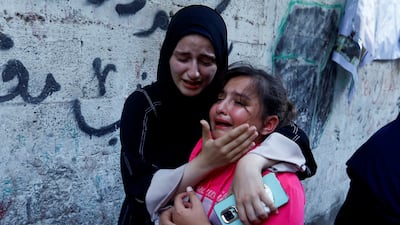
  • A Palestinian girl following an Israeli air strike in Khan Younis. Reuters
    A Palestinian girl following an Israeli air strike in Khan Younis. Reuters
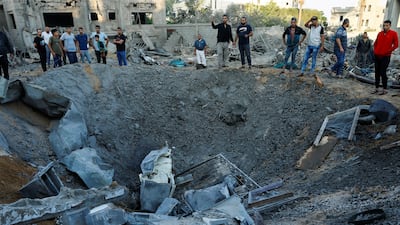
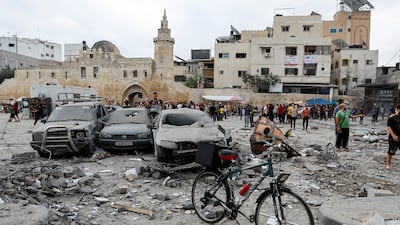
  • Palestinians survey the rubble of a house destroyed in Israeli strikes in Khan Younis, in the southern Gaza Strip. Reuters
    Palestinians survey the rubble of a house destroyed in Israeli strikes in Khan Younis, in the southern Gaza Strip. Reuters
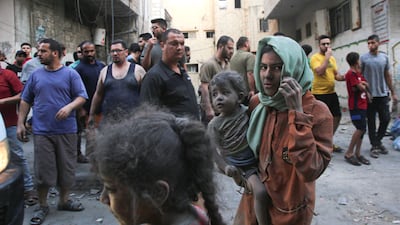
  • A Palestinian woman, covered in dust, carries a child in Gaza city. AFP
    A Palestinian woman, covered in dust, carries a child in Gaza city. AFP
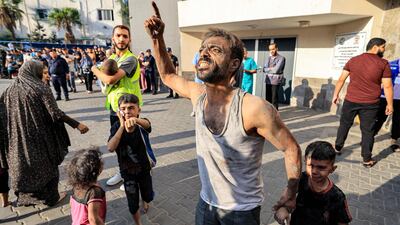
  • A Palestinian man with a child outside al-Shifa hospital in Gaza city. AFP
    A Palestinian man with a child outside al-Shifa hospital in Gaza city. AFP
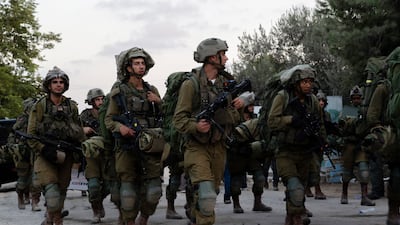
  • Israeli soldiers walk through Kibbutz Be'eri. Days earlier Hamas militants killed more than a hundred civilians near the border with Gaza. Getty Images
    Israeli soldiers walk through Kibbutz Be'eri. Days earlier Hamas militants killed more than a hundred civilians near the border with Gaza. Getty Images
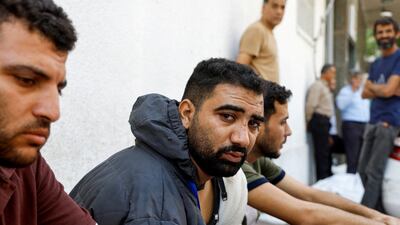
  • A wounded Palestinian man Ala Al-Kafarneh, who survived Israeli strikes, attends a hospital in Gaza city. Mr Al-Kafarneh lost his pregnant wife and several members of his family in air strikes after they fled Beit Hanoun. Reuters
    A wounded Palestinian man Ala Al-Kafarneh, who survived Israeli strikes, attends a hospital in Gaza city. Mr Al-Kafarneh lost his pregnant wife and several members of his family in air strikes after they fled Beit Hanoun. Reuters
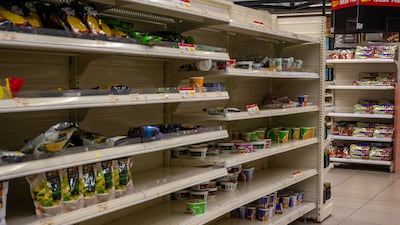
  • Supermarket shelves containing dry goods are left depleted in Tel Aviv. Getty Images
    Supermarket shelves containing dry goods are left depleted in Tel Aviv. Getty Images
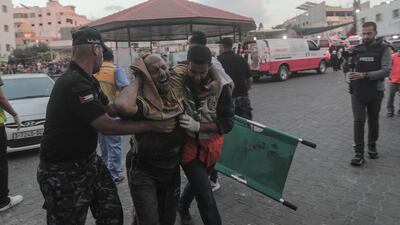
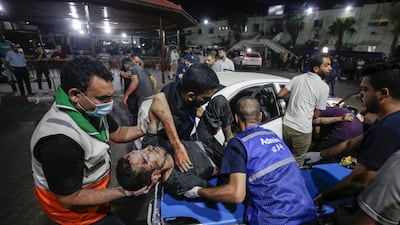
  • An injured Palestinian man arrives at Al-Shefa hospital in Gaza city. EPA
    An injured Palestinian man arrives at Al-Shefa hospital in Gaza city. EPA
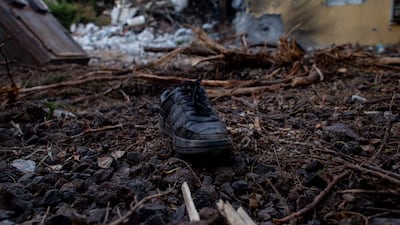
  • A boot lies on the ground outside a damaged house in Be'eri, Israel. EPA
    A boot lies on the ground outside a damaged house in Be'eri, Israel. EPA
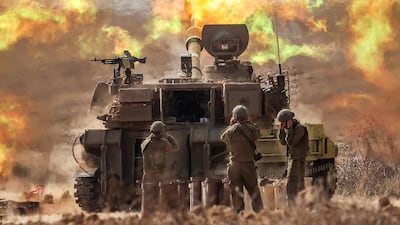
  • An Israeli army self-propelled howitzer near the border with Gaza in southern Israel. AFP
    An Israeli army self-propelled howitzer near the border with Gaza in southern Israel. AFP
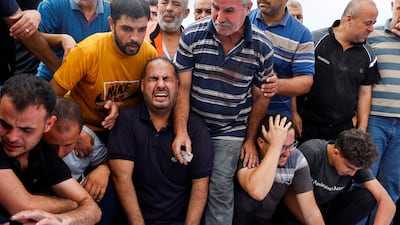
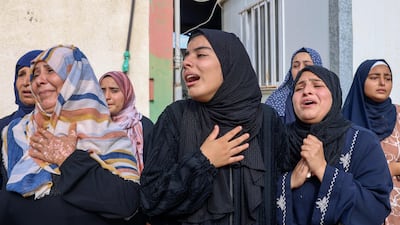
  • Palestinian mourners during the funerals of Al-Agha family members killed in Israeli strikes in Khan Younis in the southern Gaza Strip. Reuters
    Palestinian mourners during the funerals of Al-Agha family members killed in Israeli strikes in Khan Younis in the southern Gaza Strip. Reuters
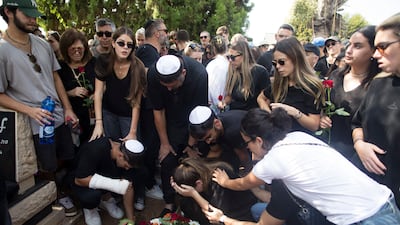
  • Family and friends of May Naim, 24, who was killed by Palestinians militants at a party near the Israeli border with the Gaza Strip, during her funeral in Gan Haim, Israel. Getty Images
    Family and friends of May Naim, 24, who was killed by Palestinians militants at a party near the Israeli border with the Gaza Strip, during her funeral in Gan Haim, Israel. Getty Images
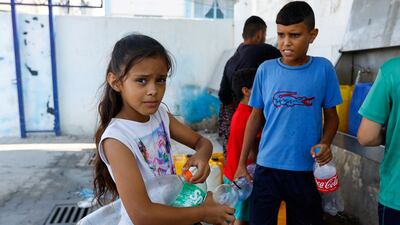
  • Palestinian children in Khan Younis fill bottles with water from public taps during the conflict with Israel. Reuters
    Palestinian children in Khan Younis fill bottles with water from public taps during the conflict with Israel. Reuters
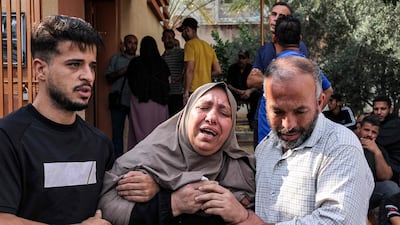
  • Men outside a morgue in Khan Yunis console a woman mourning loved ones killed in an Israeli air strike. AFP
    Men outside a morgue in Khan Yunis console a woman mourning loved ones killed in an Israeli air strike. AFP
  • A Palestinian girl injured in Israeli strikes is taken to hospital in Gaza City. Reuters
    A Palestinian girl injured in Israeli strikes is taken to hospital in Gaza City. Reuters
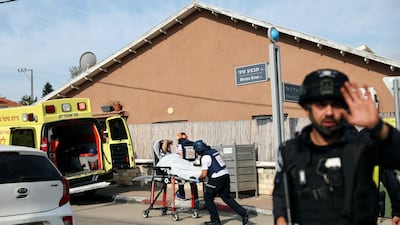
  • An Israeli woman is evacuated by paramedics following a rocket attack launched from the Gaza Strip into Israel, in Sderot. Reuters
    An Israeli woman is evacuated by paramedics following a rocket attack launched from the Gaza Strip into Israel, in Sderot. Reuters
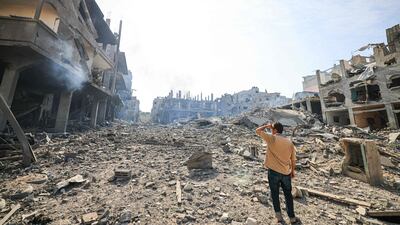
  • A man looks at the destruction in the ravaged Jabalia refugee camp, following overnight Israeli air strikes. AFP
    A man looks at the destruction in the ravaged Jabalia refugee camp, following overnight Israeli air strikes. AFP
  • The daughter of Zakaria Abu Maamar, a member of Hamas's political office, at her father's funeral, after he was killed in an air strike in Khan Younis. Reuters
    The daughter of Zakaria Abu Maamar, a member of Hamas's political office, at her father's funeral, after he was killed in an air strike in Khan Younis. Reuters
  • A collapsed building after an Israeli bombardment in Gaza City. AFP
    A collapsed building after an Israeli bombardment in Gaza City. AFP
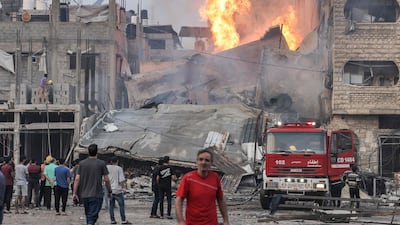
  • Firefighters attend a burning building after an Israeli bombardment in Gaza City. AFP
    Firefighters attend a burning building after an Israeli bombardment in Gaza City. AFP
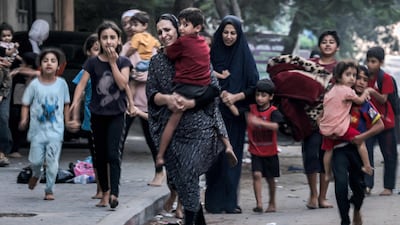
  • Women and children in Gaza City. AFP
    Women and children in Gaza City. AFP
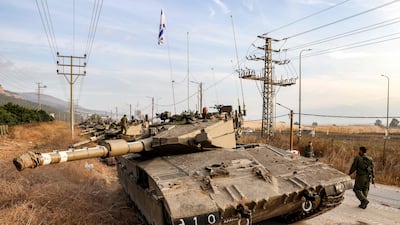
  • An Israeli army soldier passes a Merkava battle tank in northern Israel near the border with Lebanon. AFP
    An Israeli army soldier passes a Merkava battle tank in northern Israel near the border with Lebanon. AFP
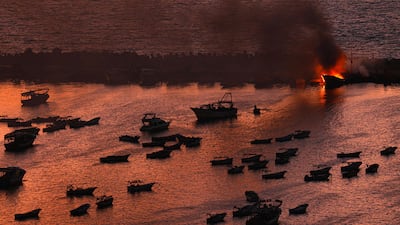
  • An Israeli strike on the port of Gaza City. AFP
    An Israeli strike on the port of Gaza City. AFP
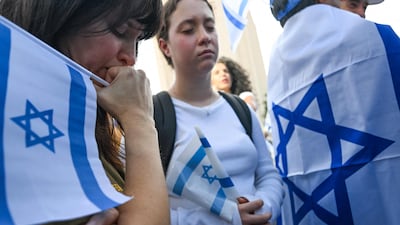
  • Demonstrators outside the West Los Angeles Federal Building in California during a rally in support of Israel. AFP
    Demonstrators outside the West Los Angeles Federal Building in California during a rally in support of Israel. AFP
  • Mourners at the funeral of Palestinians killed in overnight Israeli shelling in Khan Younis in Gaza. AFP
    Mourners at the funeral of Palestinians killed in overnight Israeli shelling in Khan Younis in Gaza. AFP
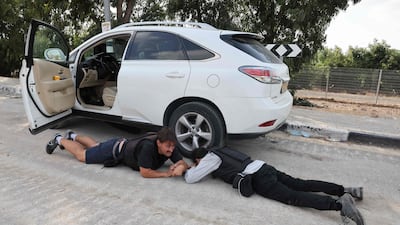
  • Israeli journalists take cover during a rocket attack from Gaza in the southern Israeli kibbutz of Kfar Aza near the border. AFP
    Israeli journalists take cover during a rocket attack from Gaza in the southern Israeli kibbutz of Kfar Aza near the border. AFP
  • Palestinians rescue a young girl from the rubble of a destroyed residential building following an Israeli air strike. AP
    Palestinians rescue a young girl from the rubble of a destroyed residential building following an Israeli air strike. AP
  • Mourners at the graveside of Eden Guez, who was killed as she attended a festival that was attacked by Hamas gunmen from Gaza. Reuters
    Mourners at the graveside of Eden Guez, who was killed as she attended a festival that was attacked by Hamas gunmen from Gaza. Reuters
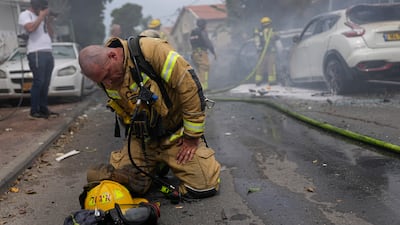
  • An Israeli fireman recovers after extinguishing cars set on fire by a rocket fired from Gaza. AP
    An Israeli fireman recovers after extinguishing cars set on fire by a rocket fired from Gaza. AP
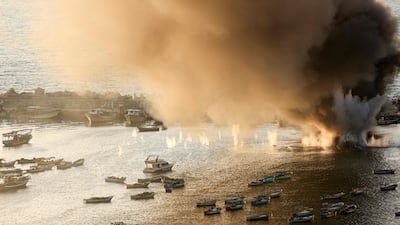
  • Smoke billows from a boat after a strike by Israel on the port of Gaza City. AFP
    Smoke billows from a boat after a strike by Israel on the port of Gaza City. AFP
  • Destroyed residential buildings in Gaza City. AP
    Destroyed residential buildings in Gaza City. AP
  • Rockets from Gaza launched towards Israel. Reuters
    Rockets from Gaza launched towards Israel. Reuters
  • A Palestinian woman sits among the rubble in the destroyed Al-Ramal neighborhood following an Israeli air strike in Gaza City. EPA
    A Palestinian woman sits among the rubble in the destroyed Al-Ramal neighborhood following an Israeli air strike in Gaza City. EPA
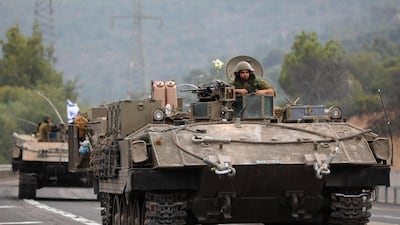
  • Israeli soldiers in armoured vehicles near the northern town of Kiryat Shmona close to the border with Lebanon. AFP
    Israeli soldiers in armoured vehicles near the northern town of Kiryat Shmona close to the border with Lebanon. AFP
  • Buildings destroyed by Israeli strikes in Gaza city. Reuters
    Buildings destroyed by Israeli strikes in Gaza city. Reuters
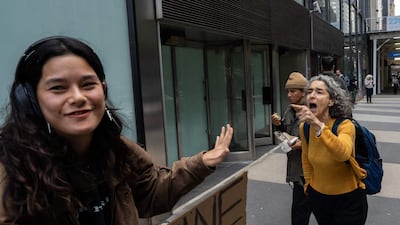
  • Nicole Izsak, right, confronts a Palestinian supporter near the Israeli consulate in New York, claiming her cousin is being held hostage in Gaza. AFP
    Nicole Izsak, right, confronts a Palestinian supporter near the Israeli consulate in New York, claiming her cousin is being held hostage in Gaza. AFP
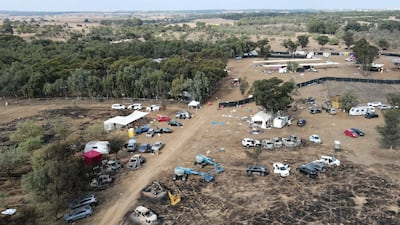
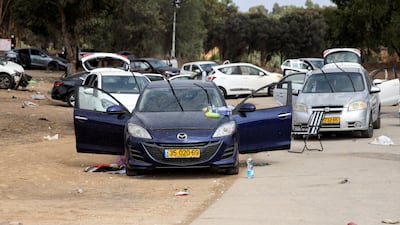
  • The abandoned site of the Supernova music festival, besieged by Hamas militants in southern Israel. AFP
    The abandoned site of the Supernova music festival, besieged by Hamas militants in southern Israel. AFP
  • An attack on the site by Hamas gunmen from Gaza left at least 260 people dead. Reuters
    An attack on the site by Hamas gunmen from Gaza left at least 260 people dead. Reuters
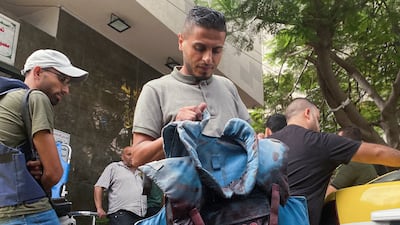
  • A man carries a blood-stained flak jacket belonging to a Palestinian journalist, who was killed with two colleagues when an Israeli missile hit a hospital building while they were outside reporting, in Gaza city. Reuters
    A man carries a blood-stained flak jacket belonging to a Palestinian journalist, who was killed with two colleagues when an Israeli missile hit a hospital building while they were outside reporting, in Gaza city. Reuters
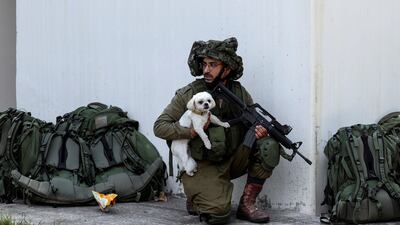
  • An Israeli soldier holds a rescued dog as he takes position near a bomb shelter in Kibbutz Kfar Aza, southern Israel. Reuters
    An Israeli soldier holds a rescued dog as he takes position near a bomb shelter in Kibbutz Kfar Aza, southern Israel. Reuters
  • Protesters chant and wave the Palestinian flag at a rally in Melbourne, Australia. Getty Images
    Protesters chant and wave the Palestinian flag at a rally in Melbourne, Australia. Getty Images
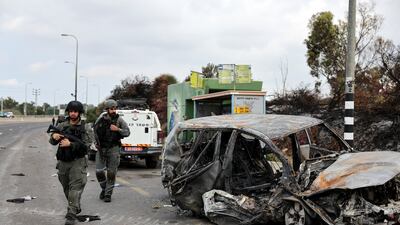
  • Israeli border police walk past a burnt-out car as rockets are launched from the Gaza Strip towards Israel, in Ashkelon, southern Israel. Reuters
    Israeli border police walk past a burnt-out car as rockets are launched from the Gaza Strip towards Israel, in Ashkelon, southern Israel. Reuters
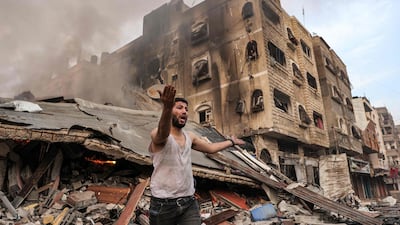
  • Palestinians amid the rubble following Israeli air strikes that razed a neighbourhood in Gaza city. AP
    Palestinians amid the rubble following Israeli air strikes that razed a neighbourhood in Gaza city. AP
  • Palestinians carry a wounded man at Al Shifa Hospital in Gaza city. EPA
    Palestinians carry a wounded man at Al Shifa Hospital in Gaza city. EPA
  • Palestinians inspect damage in the aftermath of Israeli strikes in Khan Younis, southern Gaza Strip. Reuters
    Palestinians inspect damage in the aftermath of Israeli strikes in Khan Younis, southern Gaza Strip. Reuters

Mercer, the investment consulting arm of US services company Marsh & McLennan, expects its wealth division to at least double its assets under management (AUM) in the Middle East as wealth in the region continues to grow despite economic headwinds, a company official said.

Mercer Wealth, which globally has $160 billion in AUM, plans to boost its AUM in the region to $2-$3bn in the next 2-3 years from the present $1bn, said Yasir AbuShaban, a Dubai-based principal with Mercer Wealth.

Within the next two to three years, we are looking at reaching $2 to $3 billion as a conservative estimate and we do see an opportunity to do so,” said Mr AbuShaban.

Mercer does not directly make investments, but allocates clients’ money they have discretion to, to professional asset managers. They also provide advice to clients.

“We have buying power. We can negotiate on their (client’s) behalf with asset managers to provide them lower fees than they otherwise would have to get on their own,” he added.

Mercer Wealth’s clients include sovereign wealth funds, family offices, and insurance companies among others.

From its office in Dubai, Mercer also looks after Africa, India and Turkey, where they also see opportunity for growth.

Wealth creation in Middle East and Africa (MEA) grew 8.5 per cent to $8.1 trillion last year from $7.5tn in 2015, higher than last year’s global average of 6 per cent and the second-highest growth in a region after Asia-Pacific which grew 9.9 per cent, according to consultancy Boston Consulting Group (BCG). In the region, where wealth grew just 1.9 per cent in 2015 compared with 2014, a pickup in oil prices has helped in wealth generation.

BCG is forecasting MEA wealth will rise to $12tn by 2021, growing at an annual average of 8 per cent.

Drivers of wealth generation in the region will be split evenly between new wealth creation and growth of performance of existing assets, according to BCG.

Another general trend in the region is clients’ looking for a comprehensive approach to investing, according to Mr AbuShaban.

“Institutional investors or some of the families are seeing a slowdown in the available capital they have to invest and in that sense they are looking at optimizing the way they manage their portfolios and making sure they are not investing haphazardly and different parts of their investment are working together,” said Mr AbuShaban.

Some clients also have a higher appetite for risk, given the low interest-rate environment that does not provide enough yield for some institutional investors. These clients are keen to invest in illiquid assets, such as private equity and infrastructure.

“What we have seen is a desire for higher returns in what has been a low-return environment specifically in various fixed income or bonds,” he said.

“In this environment, we have seen a de facto increase in the risk that clients are taking in things like illiquid investments, private equity investments, infrastructure and private debt, those kind of investments were higher illiquidity results in incrementally higher returns.”

The Abu Dhabi Investment Authority, one of the largest sovereign wealth funds, said in its 2016 report that has gradually increased its exposure in direct private equity and private credit transactions, mainly in Asian markets and especially in China and India. The authority’s private equity department focused on structured equities owing to “their defensive characteristics.”

The specs

Engine: 4.0-litre V8 twin-turbocharged and three electric motors

Power: Combined output 920hp

Torque: 730Nm at 4,000-7,000rpm

Transmission: 8-speed dual-clutch automatic

Fuel consumption: 11.2L/100km

On sale: Now, deliveries expected later in 2025

Price: expected to start at Dh1,432,000

GAC GS8 Specs

Engine: 2.0-litre 4cyl turbo

Power: 248hp at 5,200rpm

Torque: 400Nm at 1,750-4,000rpm

Transmission: 8-speed auto

Fuel consumption: 9.1L/100km

On sale: Now

Price: From Dh149,900

Global state-owned investor ranking by size

1.

United States

2.

China

3.

UAE

4.

Japan

5

Norway

6.

Canada

7.

Singapore

8.

Australia

9.

Saudi Arabia

10.

South Korea

Email sent to Uber team from chief executive Dara Khosrowshahi

From: Dara

To: Team@

Date: March 25, 2019 at 11:45pm PT

Subj: Accelerating in the Middle East

Five years ago, Uber launched in the Middle East. It was the start of an incredible journey, with millions of riders and drivers finding new ways to move and work in a dynamic region that’s become so important to Uber. Now Pakistan is one of our fastest-growing markets in the world, women are driving with Uber across Saudi Arabia, and we chose Cairo to launch our first Uber Bus product late last year.

Today we are taking the next step in this journey—well, it’s more like a leap, and a big one: in a few minutes, we’ll announce that we’ve agreed to acquire Careem. Importantly, we intend to operate Careem independently, under the leadership of co-founder and current CEO Mudassir Sheikha. I’ve gotten to know both co-founders, Mudassir and Magnus Olsson, and what they have built is truly extraordinary. They are first-class entrepreneurs who share our platform vision and, like us, have launched a wide range of products—from digital payments to food delivery—to serve consumers.

I expect many of you will ask how we arrived at this structure, meaning allowing Careem to maintain an independent brand and operate separately. After careful consideration, we decided that this framework has the advantage of letting us build new products and try new ideas across not one, but two, strong brands, with strong operators within each. Over time, by integrating parts of our networks, we can operate more efficiently, achieve even lower wait times, expand new products like high-capacity vehicles and payments, and quicken the already remarkable pace of innovation in the region.

This acquisition is subject to regulatory approval in various countries, which we don’t expect before Q1 2020. Until then, nothing changes. And since both companies will continue to largely operate separately after the acquisition, very little will change in either teams’ day-to-day operations post-close. Today’s news is a testament to the incredible business our team has worked so hard to build.

It’s a great day for the Middle East, for the region’s thriving tech sector, for Careem, and for Uber.

Uber on,

Dara

The specs

Engine: 6.2-litre V8

Transmission: ten-speed

Power: 420bhp

Torque: 624Nm

Price: Dh325,125

On sale: Now

Know your Camel lingo

The bairaq is a competition for the best herd of 50 camels, named for the banner its winner takes home

Namoos - a word of congratulations reserved for falconry competitions, camel races and camel pageants. It best translates as 'the pride of victory' - and for competitors, it is priceless

Asayel camels - sleek, short-haired hound-like racers

Majahim - chocolate-brown camels that can grow to weigh two tonnes. They were only valued for milk until camel pageantry took off in the 1990s

Millions Street - the thoroughfare where camels are led and where white 4x4s throng throughout the festival

PROFILE OF SWVL

Started: April 2017

Founders: Mostafa Kandil, Ahmed Sabbah and Mahmoud Nouh

Based: Cairo, Egypt

Sector: transport

Size: 450 employees

Investment: approximately $80 million

Investors include: Dubai’s Beco Capital, US’s Endeavor Catalyst, China’s MSA, Egypt’s Sawari Ventures, Sweden’s Vostok New Ventures, Property Finder CEO Michael Lahyani

The%20specs%20
%3Cp%3E%3Cstrong%3EEngine%3A%20%3C%2Fstrong%3E2.0-litre%204cyl%20turbo%0D%3Cbr%3E%3Cstrong%3EPower%3A%20%3C%2Fstrong%3E261hp%20at%205%2C500rpm%0D%3Cbr%3E%3Cstrong%3ETorque%3A%20%3C%2Fstrong%3E400Nm%20at%201%2C750-4%2C000rpm%0D%3Cbr%3E%3Cstrong%3ETransmission%3A%20%3C%2Fstrong%3E7-speed%20dual-clutch%20auto%0D%3Cbr%3E%3Cstrong%3EFuel%20consumption%3A%20%3C%2Fstrong%3E10.5L%2F100km%0D%3Cbr%3E%3Cstrong%3EOn%20sale%3A%20%3C%2Fstrong%3ENow%0D%3Cbr%3E%3Cstrong%3EPrice%3A%20%3C%2Fstrong%3EFrom%20Dh129%2C999%20(VX%20Luxury)%3B%20from%20Dh149%2C999%20(VX%20Black%20Gold)%3C%2Fp%3E%0A
COMPANY%20PROFILE
%3Cp%3EFounder%3A%20Hani%20Abu%20Ghazaleh%3Cbr%3EBased%3A%20Abu%20Dhabi%2C%20with%20an%20office%20in%20Montreal%3Cbr%3EFounded%3A%202018%3Cbr%3ESector%3A%20Virtual%20Reality%3Cbr%3EInvestment%20raised%3A%20%241.2%20million%2C%20and%20nearing%20close%20of%20%245%20million%20new%20funding%20round%3Cbr%3ENumber%20of%20employees%3A%2012%3C%2Fp%3E%0A
TO%20CATCH%20A%20KILLER
%3Cp%3E%3Cstrong%3EDirector%3A%20%3C%2Fstrong%3EDamian%20Szifron%3C%2Fp%3E%0A%3Cp%3E%3Cstrong%3EStars%3A%3C%2Fstrong%3E%20Shailene%20Woodley%2C%20Ben%20Mendelsohn%2C%20Ralph%20Ineson%3C%2Fp%3E%0A%3Cp%3E%3Cstrong%3ERating%3A%3C%2Fstrong%3E%202%2F5%3C%2Fp%3E%0A
Key developments

All times UTC 4

The National Archives, Abu Dhabi

Founded over 50 years ago, the National Archives collects valuable historical material relating to the UAE, and is the oldest and richest archive relating to the Arabian Gulf.

Much of the material can be viewed on line at the Arabian Gulf Digital Archive - https://www.agda.ae/en

2025 Fifa Club World Cup groups

Group A: Palmeiras, Porto, Al Ahly, Inter Miami.

Group B: Paris Saint-Germain, Atletico Madrid, Botafogo, Seattle.

Group C: Bayern Munich, Auckland City, Boca Juniors, Benfica.

Group D: Flamengo, ES Tunis, Chelsea, Leon.

Group E: River Plate, Urawa, Monterrey, Inter Milan.

Group F: Fluminense, Borussia Dortmund, Ulsan, Mamelodi Sundowns.

Group G: Manchester City, Wydad, Al Ain, Juventus.

Group H: Real Madrid, Al Hilal, Pachuca, Salzburg.

What can victims do?

Always use only regulated platforms

Stop all transactions and communication on suspicion

Save all evidence (screenshots, chat logs, transaction IDs)

Report to local authorities

Warn others to prevent further harm

Courtesy: Crystal Intelligence

Updated: November 05, 2023, 11:10 PM