


Imagine, if you can, what it must be like to be a young Russian soldier somewhere on the frontline in occupied Ukraine.
You hear from your officers or from Ukrainian propaganda broadcasts that your supposed allies in the Wagner group are not at their posts.
They are not preparing for the next Ukrainian assault. They are instead heading in an armed column to Moscow amid (inevitably unconfirmed) rumours about a coup against Vladimir Putin, the only leader of Russia that you remember.
You may not much like the military leadership and you almost certainly are wary of the Wagner mercenaries, but you know that their disappearance from the zone of conflict means your defences against a Ukrainian advance are now substantially weaker.
What would you do? Would you fight on? (Why?) Flee? (To where?) Surrender and admit defeat? (Possibly.)
Now imagine, if you can, what it must be like to be on the other side of those same frontlines.
You are a Ukrainian soldier. You hear a version of the same (unreliable) news. You also hear rumours and unconfirmed stories that Mr Putin has left the Kremlin and fled from Moscow and that leading members of his regime are fleeing Russia itself.
On social media you hear (also unconfirmed) reports that flights from Russia to Tbilisi in Georgia are fully booked by Russians trying to escape the turmoil ahead.
What would you as a Ukrainian soldier think in this fog of war? Would you prepare for the mass surrender of Russian conscripts? (Possibly.)
Would you hope that your officers order an attack immediately in the hope that the Russian frontline might collapse? (Also possibly.)
Would you – dare you – think that perhaps – just perhaps – this horrible war might be over; that you might survive and go home to be with your family?
-
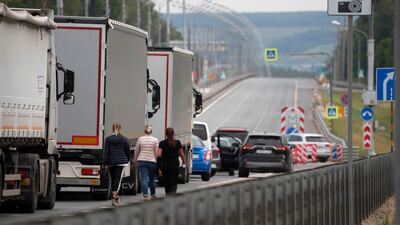
Traffic on the M-4 road in the Moscow region is brought to a halt. EPA -
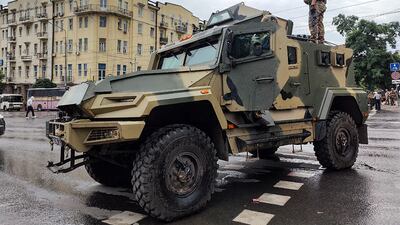
An armoured vehicle of the Wagner group outside the headquarters of the Southern Military District of the Russian armed forces in Rostov-on-Don, Russia. AP -
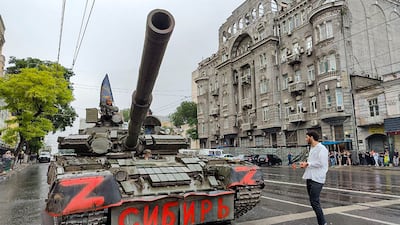
In Rostov, servicemen sit on a tank with a flag of the Wagner group. The letters on the tank's hull appear to spell Siberia. AP -
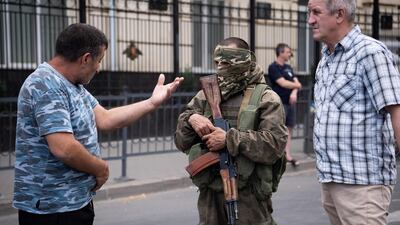
Rostov-on-Don residents speak with a Wagner fighter. AFP -
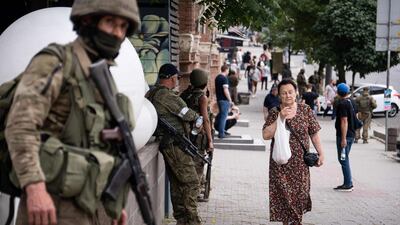
Life in Rostov-on-Don appears to go on after Wagner forces arrived in their city. AFP -
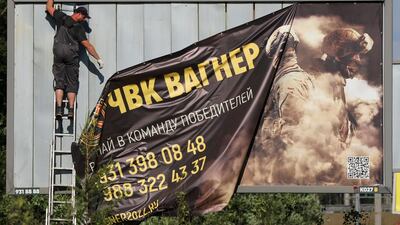
On the outskirts of Saint Petersburg, a banner promoting the Wagner private mercenary group is taken down from view. Reuters -
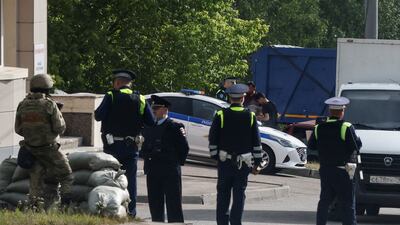
Security personnel watch traffic at a checkpoint in Moscow. Reuters


My guess is that as a Ukrainian soldier, you would think all of the above and nevertheless stay at your post, making sure your finger was still on the trigger.
In the words of then US president Ronald Reagan during the Cold War, with Russia you need to “trust, but verify”.
And so, amid this blizzard of information, disinformation and propaganda, what we do know is this.
For the people of Russia’s capital city, the war that once seemed a long way from their front door has most definitely come home.
Debilitating long-time political rivalries have for years set three powerful forces against each other in Moscow. First, the Wagner mercenaries.
Their leaders publicly deplore Russia’s military commanders.
Russia’s military commanders, in turn, are themselves hugely suspicious of Wagner.
The third group are those in the Russian intelligence and security apparatus, notably the FSB. They are paid to be suspicious of everyone.
If Mr Putin really was on his way out, the real power struggle would emerge between these three forces.
It comes amid reports of a state of emergency in Moscow with the internet and mobile phones switched off. But then suddenly – astonishingly – Wagner group leader Yevgeny Prigozhin announced that about 200 kilometres from Moscow, his forces had stopped his so-called “March for Justice”.
So, what is going on?
Well, the wisdom of Winston Churchill might help. The former British prime minister once said that a sudden change in events at wartime did not mean “the beginning of the end” but perhaps merely “the end of the beginning”.
A second insight from Mr Churchill came when he was perplexed by Russia working with Nazi Germany in 1939 to dismantle Poland.
Russia, Mr Churchill said, was “a riddle, wrapped in a mystery, inside an enigma". Then he wisely added: “But perhaps there is a key. That key is Russian national interest.”
So, what is the Russian national interest now? And what is the West’s? I would optimistically suggest Russia’s interest is to end the Ukraine war and re-engage with the rest of Europe and the world.
The more immediate questions for Nato diplomats, national security experts and political leaders however are these.
Who is in charge in the Kremlin (if anyone)? How safe are the weapons of mass destruction? And what can Russia’s neighbours do to push for stability and peace without humiliating the Russian people?
A very senior former British security adviser recently said to me that the problem for someone like Mr Putin is that he rarely hears honest advice. Officials are too scared to tell the leader that his plans are flawed.
And so, even as Mr Putin has survived this challenge, he will presumably be hugely chastened by the military failures in Ukraine leading to political failure at home and in the Kremlin.
The outcome of Saturday’s developments is still unclear but change in Russia seems more likely today.
Europe wants a peaceful neighbour offering a better and more prosperous future to its people and to the rest of the world.
That means those of us mere spectators at this extraordinarily dangerous political and military drama need to consider how in the future we might extend to Russia the hand of friendship, not the fist of humiliation. Europe wants a good neighbour.
Nobody wants a wounded and resentful Russian bear.

