Rahul Gandhi has completed his long march across India, but where has it led him?


  • English
  • Arabic

January 31, 2023

On Monday evening, Rahul Gandhi and his followers completed a nearly 4,000-kilometre march across the length of India. The de facto leader of the beleaguered Congress party began his Unite India Rally last September from the country’s southern-most tip of Kanyakumari, before reaching its northern-most territory of Jammu-Kashmir about 150 days later.

The purported reason to organise such a rally, as its name implies, was to begin the process of uniting a country that has, as Congress and several other opposition parties claim, been divided along a number of axes, including on religious and socioeconomic lines. But it was evidently also a part of Mr Gandhi’s mission to resuscitate his political career and revive the fortunes of a once dominant party that has been languishing in the opposition for almost a decade.

Walking 25 to 30 kilometres nearly every day for almost five months across the world’s seventh-largest country is undoubtedly an astonishing accomplishment. It is a glowing testament to the travellers’ physical and mental stamina, even if the journey was punctuated with a few breaks, and to the planning and organisation that went into it.

But the question being asked, and rightly so, is whether the rally can be characterised as a political success. With a little more than a year left before the next general election, it remains to be seen if it can help Congress defeat the governing Bharatiya Janata Party and return to power in New Delhi – its ultimate objective.

The BJP is a highly disciplined organisation that won the 2014 and 2019 general elections, and a number of state elections in between, on the back of the popularity of its leader, Prime Minister Narendra Modi, as well as its Hindutva ideology and a bouquet of populist policies.

  • Rahul Gandhi, centre, a leader in India's Congress party, takes part in the Bharat Jodo Yatra, or Unite India March, on the outskirts of Hyderabad on November 1 last year. The march is a five-month, 3,570km trek through 12 states. AFP
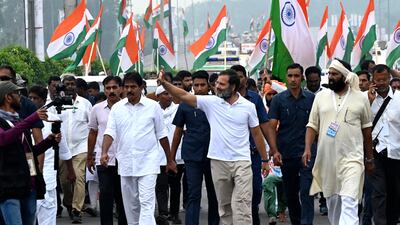
    Rahul Gandhi, centre, a leader in India's Congress party, takes part in the Bharat Jodo Yatra, or Unite India March, on the outskirts of Hyderabad on November 1 last year. The march is a five-month, 3,570km trek through 12 states. AFP
  • Rahul Gandhi marches on the outskirts of Hyderabad in 2022. AFP
    Rahul Gandhi marches on the outskirts of Hyderabad in 2022. AFP
  • Rahul Gandhi, centre, during the march. AFP
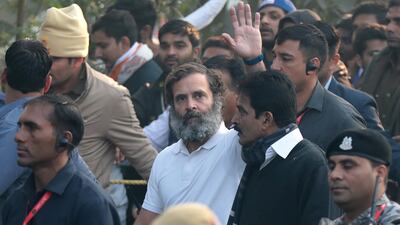
    Rahul Gandhi, centre, during the march. AFP
  • Rahul Gandhi throws flower petals towards press photographers during a march in New Delhi on December 24 last year. AP
    Rahul Gandhi throws flower petals towards press photographers during a march in New Delhi on December 24 last year. AP
  • Rahul Gandhi and his supporters march in New Delhi. Reuters
    Rahul Gandhi and his supporters march in New Delhi. Reuters
  • People wait for the Unite India March, led by senior Congress party figure Rahul Gandhi, in New Delhi on December 24. Reuters
    People wait for the Unite India March, led by senior Congress party figure Rahul Gandhi, in New Delhi on December 24. Reuters
  • Rahul Gandhi began the Unite India March, aimed at regaining political relevance, in Kanyakumari in the Tamil Nadu state on 7 September last year. EPA
    Rahul Gandhi began the Unite India March, aimed at regaining political relevance, in Kanyakumari in the Tamil Nadu state on 7 September last year. EPA
  • Opposition Congress leaders and supporters march in New Delhi on December 24. AP
    Opposition Congress leaders and supporters march in New Delhi on December 24. AP
  • Rahul Gandhi addresses the crowd at the Red Fort during the Unite India March in Delhi. Reuters
    Rahul Gandhi addresses the crowd at the Red Fort during the Unite India March in Delhi. Reuters
Questions remain on Congress’s ability to appeal to the broader electorate

It also played up the idea that there is no alternative to Mr Modi, positioning him as peerless, in part by painting Mr Gandhi as the entitled scion of the Nehru-Gandhi dynasty with little political acumen, experience or even the desire necessary to govern a country as large and complex as India. Mr Gandhi has indeed proved no match to Mr Modi, whose humble beginnings and the experience of governing the state of Gujarat for 12 years before becoming prime minister continue to burnish his larger-than-life persona.

Last week, the India Today-C Voter Mood of the Nation survey put the Modi government’s approval rating at 67 per cent. Mr Modi’s own approval rating stands at 72 per cent. If a general election were to be held today, the BJP would return to power for a third consecutive term.

In which case, does the rally even matter? To be sure, much can still change in the next 12-15 months. India’s economy may be growing, but unemployment, inflation and tensions with China along their 3,500-kilometre-long border are problematic. And while Mr Modi remains popular, growing restiveness over the economy could hurt the BJP’s chances of securing a parliamentary majority on its own next year. In such situations, a multiparty coalition with a resurgent Congress at its core might still be able to form a government.

Congress has taken a furtive step in this direction. Given the attention the rally garnered – drawing in tens of thousands of people from various sections of society – it has undoubtedly helped recast Mr Gandhi’s image as a serious politician who is unafraid of the derision and criticism he has been subjected to since he entered politics almost two decades ago.

More crucially perhaps, he has returned Congress to its ideological roots by articulating the values of secularism and civic nationalism – values that underpin the Indian Constitution. This is important.

Since the rise of the BJP in the 1990s, Hindutva – which emphasises India’s Hindu cultural prominence, distinct from its secular and civic nationalist ethos – has gradually become the nation’s dominant ideology. Such is its potency that most political parties, including Congress, have over the years attempted to rebrand themselves as Hindutva-lite. In an effort to court the Hindu vote, which accounts for more than 80 per cent of the electorate, the best of them have been careful not to be seen as placating religious minorities, particularly Muslims. But this strategy has found little purchase among right-leaning voters, with many preferring the real thing – the BJP – to its cheaper imitations.

Indian Prime Minister Narendra Modi is felicitated at the BJP headquarters in New Delhi last March. AFP

Mr Gandhi has seemingly scrapped this experiment. In various speeches during the march, he was seen to be standing up for the ideals upon which modern India was founded, regardless of the lure of Hindutva. He did this while not entirely relinquishing his own Hindu-ness, most notably by visiting temples but also other places of worship during the journey. This strategy may not necessarily win his party elections in the short term. But by focusing much of his criticism on the Rashtriya Swayamsevak Sangh, the ideological fountainhead of the BJP, he has repositioned Congress, ideologically, in stark opposition to Mr Modi’s party, thereby offering voters a clear alternative at the ballot box over the long term.

However, much as this is being hailed by many liberals and leftists across India, questions remain on Congress’s ability to appeal to the broader electorate. A majority of voters still don’t have an idea of the India Mr Gandhi wants to build, beyond simply returning it to its ideological roots. Few know how he will address issues such as poverty, unemployment and inflation, or how he will deal with China and the fallout from the Ukraine war. Can he convince voters that he, more than Mr Modi, has the solutions to all the big problems – and the ability to implement them?

That only a handful of likeminded parties joined Mr Gandhi during the course of the rally shows that, for now, not everyone in India’s diverse political class is convinced that Congress – despite being the only pan-India party other than the BJP – is worthy of leading a coalition necessary to defeat Mr Modi in 2024.

Another worry for Mr Gandhi is his inability to rein in the infighting within his party. In at least four states, two of which Congress runs, factionalism is rife. One-upmanship may be a feature more than it is a bug in politics, but it takes a strong, vote-catching leader at the top to keep colleagues and cadre alike disciplined and motivated.

Does Mr Gandhi have it in him to bring together fellow party members, as well as leaders from other parties, to forge a united front? It will all depend on whether he can build on the momentum the rally has provided in key state elections this year. If Congress can add to its tally of six states, where it is in power on its own or with coalition partners, the situation will change.

India’s grand old party has surely taken a step forward towards its revival with the rally, but equally there is no doubt that the road to New Delhi remains a long way away.


Specs

Engine: 3.0L twin-turbo V6
Gearbox: 10-speed automatic
Power: 405hp at 5,500rpm
Torque: 562Nm at 3,000rpm
Fuel economy, combined: 11.2L/100km
Price: From Dh292,845 (Reserve); from Dh320,145 (Presidential)
On sale: Now

Visit Abu Dhabi culinary team's top Emirati restaurants in Abu Dhabi

Yadoo’s House Restaurant & Cafe

For the karak and Yoodo's house platter with includes eggs, balaleet, khamir and chebab bread.

Golden Dallah

For the cappuccino, luqaimat and aseeda.

Al Mrzab Restaurant

For the shrimp murabian and Kuwaiti options including Kuwaiti machboos with kebab and spicy sauce.

Al Derwaza

For the fish hubul, regag bread, biryani and special seafood soup. 

Real estate tokenisation project

Dubai launched the pilot phase of its real estate tokenisation project last month.

The initiative focuses on converting real estate assets into digital tokens recorded on blockchain technology and helps in streamlining the process of buying, selling and investing, the Dubai Land Department said.

Dubai’s real estate tokenisation market is projected to reach Dh60 billion ($16.33 billion) by 2033, representing 7 per cent of the emirate’s total property transactions, according to the DLD.

UAE currency: the story behind the money in your pockets
Stage 3 results

1 Adam Yates (GBR) Mitchelton-Scott 4:42:33

2 Tadej Pocagar (SLO) UAE Team Emirates 0:01:03

3 Alexey Lutsenko (KAZ) Astana 0:01:30

4 David Gaudu (FRA) Groupama-FDJ

5 Rafal Majka (POL) Bora-Hansgrohe         

6 Diego Ulissi (ITA) UAE Team Emirates  0:01:56

General Classification after Stage 3:

1 Adam Yates (GBR) Mitchelton-Scott 12:30:02

2 Tadej Pocagar (SLO) UAE Team Emirates 0:01:07

3  Alexey Lutsenko (KAZ) Astana 0:01:35

4 David Gaudu (FRA) Groupama-FDJ 0:01:40

5  Rafal Majka (POL) Bora-Hansgrohe

6 Wilco Kelderman (NED) Team Sunweb)  0:02:06

ASHES FIXTURES

1st Test: Brisbane, Nov 23-27 
2nd Test: Adelaide, Dec 2-6
3rd Test: Perth, Dec 14-18
4th Test: Melbourne, Dec 26-30
5th Test: Sydney, Jan 4-8

The Energy Research Centre

Founded 50 years ago as a nuclear research institute, scientists at the centre believed nuclear would be the “solution for everything”.
Although they still do, they discovered in 1955 that the Netherlands had a lot of natural gas. “We still had the idea that, by 2000, it would all be nuclear,” said Harm Jeeninga, director of business and programme development at the centre.
"In the 1990s, we found out about global warming so we focused on energy savings and tackling the greenhouse gas effect.”
The energy centre’s research focuses on biomass, energy efficiency, the environment, wind and solar, as well as energy engineering and socio-economic research.

Tuesday's fixtures
Group A
Kyrgyzstan v Qatar, 5.45pm
Iran v Uzbekistan, 8pm
N Korea v UAE, 10.15pm
Ms Yang's top tips for parents new to the UAE
  1. Join parent networks
  2. Look beyond school fees
  3. Keep an open mind

The Outsider

Stephen King, Penguin

Banned items
Dubai Police has also issued a list of banned items at the ground on Sunday. These include:
  • Drones
  • Animals
  • Fireworks/ flares
  • Radios or power banks
  • Laser pointers
  • Glass
  • Selfie sticks/ umbrellas
  • Sharp objects
  • Political flags or banners
  • Bikes, skateboards or scooters
CABINET%20OF%20CURIOSITIES%20EPISODE%201%3A%20LOT%2036
%3Cp%3E%3Cstrong%3EDirector%3A%20%3C%2Fstrong%3EGuillermo%20del%20Toro%3Cbr%3E%3Cstrong%3EStars%3A%3C%2Fstrong%3E%20Tim%20Blake%20Nelson%2C%20Sebastian%20Roche%2C%20Elpidia%20Carrillo%3Cbr%3ERating%3A%204%2F5%3C%2Fp%3E%0A
Skoda Superb Specs

Engine: 2-litre TSI petrol

Power: 190hp

Torque: 320Nm

Price: From Dh147,000

Available: Now

Suggested picnic spots

Abu Dhabi
Umm Al Emarat Park
Yas Gateway Park
Delma Park
Al Bateen beach
Saadiyaat beach
The Corniche
Zayed Sports City
 
Dubai
Kite Beach
Zabeel Park
Al Nahda Pond Park
Mushrif Park
Safa Park
Al Mamzar Beach Park
Al Qudrah Lakes 

Who was Alfred Nobel?

The Nobel Prize was created by wealthy Swedish chemist and entrepreneur Alfred Nobel.

  • In his will he dictated that the bulk of his estate should be used to fund "prizes to those who, during the preceding year, have conferred the greatest benefit to humankind".
  • Nobel is best known as the inventor of dynamite, but also wrote poetry and drama and could speak Russian, French, English and German by the age of 17. The five original prize categories reflect the interests closest to his heart.
  • Nobel died in 1896 but it took until 1901, following a legal battle over his will, before the first prizes were awarded.
War 2

Director: Ayan Mukerji

Stars: Hrithik Roshan, NTR, Kiara Advani, Ashutosh Rana

Rating: 2/5

Tamkeen's offering
  • Option 1: 70% in year 1, 50% in year 2, 30% in year 3
  • Option 2: 50% across three years
  • Option 3: 30% across five years 

Director: Laxman Utekar

Cast: Vicky Kaushal, Akshaye Khanna, Diana Penty, Vineet Kumar Singh, Rashmika Mandanna

Rating: 1/5

Jetour T1 specs

Engine: 2-litre turbocharged

Power: 254hp

Torque: 390Nm

Price: From Dh126,000

Available: Now

Mercer, the investment consulting arm of US services company Marsh & McLennan, expects its wealth division to at least double its assets under management (AUM) in the Middle East as wealth in the region continues to grow despite economic headwinds, a company official said.

Mercer Wealth, which globally has $160 billion in AUM, plans to boost its AUM in the region to $2-$3bn in the next 2-3 years from the present $1bn, said Yasir AbuShaban, a Dubai-based principal with Mercer Wealth.

Within the next two to three years, we are looking at reaching $2 to $3 billion as a conservative estimate and we do see an opportunity to do so,” said Mr AbuShaban.

Mercer does not directly make investments, but allocates clients’ money they have discretion to, to professional asset managers. They also provide advice to clients.

“We have buying power. We can negotiate on their (client’s) behalf with asset managers to provide them lower fees than they otherwise would have to get on their own,” he added.

Mercer Wealth’s clients include sovereign wealth funds, family offices, and insurance companies among others.

From its office in Dubai, Mercer also looks after Africa, India and Turkey, where they also see opportunity for growth.

Wealth creation in Middle East and Africa (MEA) grew 8.5 per cent to $8.1 trillion last year from $7.5tn in 2015, higher than last year’s global average of 6 per cent and the second-highest growth in a region after Asia-Pacific which grew 9.9 per cent, according to consultancy Boston Consulting Group (BCG). In the region, where wealth grew just 1.9 per cent in 2015 compared with 2014, a pickup in oil prices has helped in wealth generation.

BCG is forecasting MEA wealth will rise to $12tn by 2021, growing at an annual average of 8 per cent.

Drivers of wealth generation in the region will be split evenly between new wealth creation and growth of performance of existing assets, according to BCG.

Another general trend in the region is clients’ looking for a comprehensive approach to investing, according to Mr AbuShaban.

“Institutional investors or some of the families are seeing a slowdown in the available capital they have to invest and in that sense they are looking at optimizing the way they manage their portfolios and making sure they are not investing haphazardly and different parts of their investment are working together,” said Mr AbuShaban.

Some clients also have a higher appetite for risk, given the low interest-rate environment that does not provide enough yield for some institutional investors. These clients are keen to invest in illiquid assets, such as private equity and infrastructure.

“What we have seen is a desire for higher returns in what has been a low-return environment specifically in various fixed income or bonds,” he said.

“In this environment, we have seen a de facto increase in the risk that clients are taking in things like illiquid investments, private equity investments, infrastructure and private debt, those kind of investments were higher illiquidity results in incrementally higher returns.”

The Abu Dhabi Investment Authority, one of the largest sovereign wealth funds, said in its 2016 report that has gradually increased its exposure in direct private equity and private credit transactions, mainly in Asian markets and especially in China and India. The authority’s private equity department focused on structured equities owing to “their defensive characteristics.”

What is hepatitis?

Hepatitis is an inflammation of the liver, which can lead to fibrosis (scarring), cirrhosis or liver cancer.

There are 5 main hepatitis viruses, referred to as types A, B, C, D and E.

Hepatitis C is mostly transmitted through exposure to infective blood. This can occur through blood transfusions, contaminated injections during medical procedures, and through injecting drugs. Sexual transmission is also possible, but is much less common.

People infected with hepatitis C experience few or no symptoms, meaning they can live with the virus for years without being diagnosed. This delay in treatment can increase the risk of significant liver damage.

There are an estimated 170 million carriers of Hepatitis C around the world.

The virus causes approximately 399,000 fatalities each year worldwide, according to WHO.


MATCH INFO

Syria v Australia
2018 World Cup qualifying: Asia fourth round play-off first leg
Venue: Hang Jebat Stadium (Malacca, Malayisa)
Kick-off: Thursday, 4.30pm (UAE)
Watch: beIN Sports HD

* Second leg in Australia scheduled for October 10

Updated: February 01, 2023, 10:56 AM