With the 2024 parliamentary election firmly in their sights, key opposition parties across India are appearing to make plans on how to defeat Prime Minister Narendra Modi and his ruling Bharatiya Janata Party (BJP). The operative phrase here is “appearing to”.
With three years left before the election, no political party or leader is under any illusion that things will remain static between now and then. It is simply too early to be making actual plans.
Additionally, no effort to build a coalition against the BJP in 2024 will be considered serious enough as long as one particular party – the Indian National Congress (INC) – is not involved in these discussions.
The buzz among some of the involved parties, however, is understandable.
India's economy is doing relatively poorly, in large part due to the Covid-19 pandemic, but also as an outcome of some ill-advised policymaking over seven years. GDP growth, around seven to eight per cent in 2014, was down to 3.1 per cent by the first quarter of 2020. Unemployment climbed to a 45-year high of 6.1 per cent in early 2018 – well before the pandemic – and has barely recovered since.
Business reportedly continues to be hit hard by a demonetisation drive in 2016 that wiped out 86 per cent of Indian currency, followed shortly by a hasty rollout of the otherwise much-needed pan-Indian Goods and Services Tax.
But it is the handling of the pandemic in much of the country, particularly the problematic procurement and distribution of vaccines, that has done the most damage to the administration's credibility and popularity to many citizens. India also experienced a devastating second wave of the pandemic that has claimed close to 400,000 lives; unofficial figures range anywhere between two and five times that number.
In the face of such great tragedy, some opposition parties are sensing an opening.
Sharad Pawar has consistently been in the news over the past fortnight. The veteran leader of the Nationalist Congress Party has held two meetings with Prashant Kishor, the country’s most celebrated non-partisan election strategist. Mr Pawar’s inner circle revealed little about the contents of their conversations and cautioned against drawing any conclusions from them.
Prime Minister Narendra Modi remains India's most popular leader, but his ratings have dropped in recent times. AFP
Just yesterday, however, Mr Pawar met leaders from eight parties – most of them regional outfits – in New Delhi. Prominent among them was Yashwant Sinha, once a towering figure in Mr Modi's BJP and one of India's most reform-minded finance ministers in the nineties and noughties. Mr Sinha is now a member of the All India Trinamool Congress. While his exit from the BJP was a foregone conclusion years ago, given his persistent criticism of the current government, it is significant that he has joined forces with a leader many seem to think will be the most formidable challenger for Mr Modi in 2024: West Bengal Chief Minister Mamata Banerjee.
Last month, Trinamool Congress routed the BJP in the West Bengal state election, handing Ms Banerjee a third successive term. That her victory was so emphatic – even though she was a two-term incumbent facing a national party with far more resources and the compelling Modi brand at its disposal – has led many experts to believe that her star has risen in national politics.
The BJP and its allies, meanwhile, have suffered setbacks in several state elections over the past two years, to the extent that India’s largest and most well-funded political party now runs states whose populations collectively constitute less than 50 per cent of the country.
West Bengal Chief Minister Mamata Banerjee won a secured successive term last month. AFP
Mamata Banerjee's support in West Bengal remains intact, but can she broaden her appeal across the country? Reuters
Curiously, though, Mr Pawar’s recent parleys have led some observers to speculate that a so-called Third Front could be in the works. This coalition will purportedly accommodate all interested parties that are neither allied with the BJP nor with the INC; the latter is India’s grand old party of the Nehru-Gandhi fame that ruled independent India for close to six decades but currently languishes in the opposition.
The rumoured proposal for a Third Front seems to emanate from the many troubles the INC is facing right now.
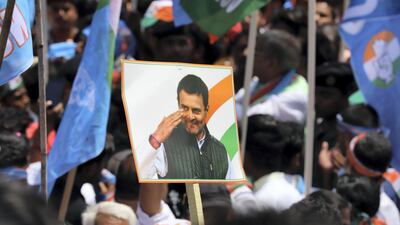
Its de facto head is Rahul Gandhi, whose father, grandmother and great-grandfather were all prime ministers, but who himself seems to be a reluctant leader. His apparent reticence, despite appearing to be a decent human being with a desire to reform Indian politics from the ground up, has paled in comparison to Mr Modi's powerful and purposeful persona. Mr Gandhi seems unable to hold together his party, in charge in just three states, or control the periodic defections at state and national levels.
Gandhi's reticence has paled in comparison to Modi's powerful and purposeful persona
In such a scenario, seasoned politicians and proven administrators such as Ms Banerjee, 66, and Mr Pawar, 80, must surely fancy themselves as worthier challengers to Mr Modi’s crown and who should, therefore, lead this ragtag opposition against the BJP in three years’ time. But there are many problems in assuming a Third Front will succeed.
For one, the numbers don’t add up.
As DK Singh of The Print explains, there are 19 states and five union territories – which account for 204 of the 543 seats in Parliament’s Lower House – in which the INC is either the ruling party or the principal opposition. The Third Front has no chances of winning these seats. This leaves it with 339 seats across the rest of the country, where its constituents will be competitive – provided Mr Pawar and Ms Banerjee can convince every major regional party to join their rumoured coalition. Even if it were to win 50 per cent of the seats, it would still be 100 seats short of forming a government (the magic number is 272). It must then bank on either the BJP or the INC to support it, making the coalition unwieldy and perhaps, in the long run, even untenable. Past experiments show that in India such tail-wagging-the-dog-type coalitions don't last beyond a few months.
The second problem is chemistry. Can the myriad regional parties with competing ideologies and vote banks come together to ensure that their votes get transferred to their respective allies? That remains to be seen.
Nationalist Congress Party president Sharad Pawar is gathering together disparate members within India's opposition. Reuters
Mahathir Mohamad returned as Malaysia's prime minister in 2018 at the ripe old age of 92. AFP
Also, who will lead the coalition? Could it be Mr Pawar, who, at his age, might fancy his chances, given Mahathir Mohamad returned as Malaysia's prime minister at the age of 92? Would Ms Banerjee's voters be put off were she not to be the chosen one? There are several other worthy contenders – all regional satraps – with plenty of experience and heft to lead the Third Front. Will they all get wholly behind whoever they pick? Again, one can only speculate.
It’s difficult to imagine either Mr Pawar or Ms Banerjee would even push for a Third Front, given their own affiliation to the INC. They were both party members whose ambitions grew too big to be accommodated by the Nehru-Gandhi dynasty. But even after they left in the 1990s to form their own outfits, they have remained allies of the INC – partly because, as tall as they are as leaders, their parties are limited to a few pockets in the country. They know that, if the INC – which still commands about 20 per cent of the national vote – wins key state elections between now and 2024, talks of an INC-led coalition will reemerge.
Mr Pawar himself spoke on the record to deny that yesterday’s meeting was concerned with building a Third Front. One doesn’t have to take his word for it, but it would be foolhardy to read too much into the chatter around such exchanges beyond the need for the likes of Mr Pawar to stay relevant and in the news as a means to keep the vote bases of the various opposition parties excited.
Expect more such meetings and speculations up until 2024.
Chitrabhanu Kadalayil is an assistant comment editor at The National

Mercer, the investment consulting arm of US services company Marsh & McLennan, expects its wealth division to at least double its assets under management (AUM) in the Middle East as wealth in the region continues to grow despite economic headwinds, a company official said.
Mercer Wealth, which globally has $160 billion in AUM, plans to boost its AUM in the region to $2-$3bn in the next 2-3 years from the present $1bn, said Yasir AbuShaban, a Dubai-based principal with Mercer Wealth.
“Within the next two to three years, we are looking at reaching $2 to $3 billion as a conservative estimate and we do see an opportunity to do so,” said Mr AbuShaban.
Mercer does not directly make investments, but allocates clients’ money they have discretion to, to professional asset managers. They also provide advice to clients.
“We have buying power. We can negotiate on their (client’s) behalf with asset managers to provide them lower fees than they otherwise would have to get on their own,” he added.
Mercer Wealth’s clients include sovereign wealth funds, family offices, and insurance companies among others.
From its office in Dubai, Mercer also looks after Africa, India and Turkey, where they also see opportunity for growth.
Wealth creation in Middle East and Africa (MEA) grew 8.5 per cent to $8.1 trillion last year from $7.5tn in 2015, higher than last year’s global average of 6 per cent and the second-highest growth in a region after Asia-Pacific which grew 9.9 per cent, according to consultancy Boston Consulting Group (BCG). In the region, where wealth grew just 1.9 per cent in 2015 compared with 2014, a pickup in oil prices has helped in wealth generation.
BCG is forecasting MEA wealth will rise to $12tn by 2021, growing at an annual average of 8 per cent.
Drivers of wealth generation in the region will be split evenly between new wealth creation and growth of performance of existing assets, according to BCG.
Another general trend in the region is clients’ looking for a comprehensive approach to investing, according to Mr AbuShaban.
“Institutional investors or some of the families are seeing a slowdown in the available capital they have to invest and in that sense they are looking at optimizing the way they manage their portfolios and making sure they are not investing haphazardly and different parts of their investment are working together,” said Mr AbuShaban.
Some clients also have a higher appetite for risk, given the low interest-rate environment that does not provide enough yield for some institutional investors. These clients are keen to invest in illiquid assets, such as private equity and infrastructure.
“What we have seen is a desire for higher returns in what has been a low-return environment specifically in various fixed income or bonds,” he said.
“In this environment, we have seen a de facto increase in the risk that clients are taking in things like illiquid investments, private equity investments, infrastructure and private debt, those kind of investments were higher illiquidity results in incrementally higher returns.”
The Abu Dhabi Investment Authority, one of the largest sovereign wealth funds, said in its 2016 report that has gradually increased its exposure in direct private equity and private credit transactions, mainly in Asian markets and especially in China and India. The authority’s private equity department focused on structured equities owing to “their defensive characteristics.”
Frankenstein in Baghdad
Ahmed Saadawi
Penguin Press
The Federal Tax Authority will track shisha imports with electronic markers to protect customers and ensure levies have been paid.
Khalid Ali Al Bustani, director of the tax authority, on Sunday said the move is to "prevent tax evasion and support the authority’s tax collection efforts".
The scheme’s first phase, which came into effect on 1st January, 2019, covers all types of imported and domestically produced and distributed cigarettes. As of May 1, importing any type of cigarettes without the digital marks will be prohibited.
He said the latest phase will see imported and locally produced shisha tobacco tracked by the final quarter of this year.
"The FTA also maintains ongoing communication with concerned companies, to help them adapt their systems to meet our requirements and coordinate between all parties involved," he said.
Future plan: Looking to raise fresh capital and expand in Saudi Arabia
Total Clients: Over 50
UPI facts
More than 2.2 million Indian tourists arrived in UAE in 2023 More than 3.5 million Indians reside in UAE Indian tourists can make purchases in UAE using rupee accounts in India through QR-code-based UPI real-time payment systems Indian residents in UAE can use their non-resident NRO and NRE accounts held in Indian banks linked to a UAE mobile number for UPI transactions
Ministry of Interior Ministry of Defence General Intelligence Directorate Air Force Intelligence Agency Political Security Directorate Syrian National Security Bureau Military Intelligence Directorate Army Supply Bureau General Organisation of Radio and TV Al Watan newspaper Cham Press TV Sama TV
1. Domestic VAT refund amendments: request your refund within five years
If a business does not apply for the refund on time, they lose their credit.
2. E-invoicing in the UAE
Businesses should continue preparing for the implementation of e-invoicing in the UAE, with 2026 a preparation and transition period ahead of phased mandatory adoption.
3. More tax audits
Tax authorities are increasingly using data already available across multiple filings to identify audit risks.
4. More beneficial VAT and excise tax penalty regime
Tax disputes are expected to become more frequent and more structured, with clearer administrative objection and appeal processes. The UAE has adopted a new penalty regime for VAT and excise disputes, which now mirrors the penalty regime for corporate tax.
5. Greater emphasis on statutory audit
There is a greater need for the accuracy of financial statements. The International Financial Reporting Standards standards need to be strictly adhered to and, as a result, the quality of the audits will need to increase.
6. Further transfer pricing enforcement
Transfer pricing enforcement, which refers to the practice of establishing prices for internal transactions between related entities, is expected to broaden in scope. The UAE will shortly open the possibility to negotiate advance pricing agreements, or essentially rulings for transfer pricing purposes.
7. Limited time periods for audits
Recent amendments also introduce a default five-year limitation period for tax audits and assessments, subject to specific statutory exceptions. While the standard audit and assessment period is five years, this may be extended to up to 15 years in cases involving fraud or tax evasion.
8. Pillar 2 implementation
Many multinational groups will begin to feel the practical effect of the Domestic Minimum Top-Up Tax (DMTT), the UAE's implementation of the OECD’s global minimum tax under Pillar 2. While the rules apply for financial years starting on or after January 1, 2025, it is 2026 that marks the transition to an operational phase.
9. Reduced compliance obligations for imported goods and services
Businesses that apply the reverse-charge mechanism for VAT purposes in the UAE may benefit from reduced compliance obligations.
10. Substance and CbC reporting focus
Tax authorities are expected to continue strengthening the enforcement of economic substance and Country-by-Country (CbC) reporting frameworks. In the UAE, these regimes are increasingly being used as risk-assessment tools, providing tax authorities with a comprehensive view of multinational groups’ global footprints and enabling them to assess whether profits are aligned with real economic activity.
Contributed by Thomas Vanhee and Hend Rashwan, Aurifer
MATCH INFO
Barcelona 2
Suarez (10'), Messi (52')
Real Madrid 2
Ronaldo (14'), Bale (72')
Guide to intelligent investing
Investing success often hinges on discipline and perspective. As markets fluctuate, remember these guiding principles:
Stay invested: Time in the market, not timing the market, is critical to long-term gains.
Rational thinking: Breathe and avoid emotional decision-making; let logic and planning guide your actions.
Strategic patience: Understand why you’re investing and allow time for your strategies to unfold.
Our family matters legal consultant
Name: Hassan Mohsen Elhais
Position: legal consultant with Al Rowaad Advocates and Legal Consultants.
Bareilly Ki Barfi Directed by: Ashwiny Iyer Tiwari Starring: Kriti Sanon, Ayushmann Khurrana, Rajkummar Rao
Three and a half stars
National Bonds unveiled a Golden Pension Scheme in 2022 to help private-sector foreign employees with their financial planning.
In April 2021, Hayah Insurance unveiled a workplace savings plan to help UAE employees save for their retirement.
Lunate, an Abu Dhabi-based investment manager, has launched a fund that will allow UAE private companies to offer employees investment returns on end-of-service benefits.
Red flags
Promises of high, fixed or 'guaranteed' returns.
Unregulated structured products or complex investments often used to bypass traditional safeguards.
Lack of clear information, vague language, no access to audited financials.
Overseas companies targeting investors in other jurisdictions - this can make legal recovery difficult.
Courtesy: Carol Glynn, founder of Conscious Finance Coaching
The biog
From: Ras Al Khaimah
Age: 50
Profession: Electronic engineer, worked with Etisalat for the past 20 years
Hobbies: 'Anything that involves exploration, hunting, fishing, mountaineering, the sea, hiking, scuba diving, and adventure sports'
Favourite quote: 'Life is so simple, enjoy it'
Libya's Gold
UN Panel of Experts found regime secretly sold a fifth of the country's gold reserves.
The panel’s 2017 report followed a trail to West Africa where large sums of cash and gold were hidden by Abdullah Al Senussi, Qaddafi’s former intelligence chief, in 2011.
Cases filled with cash that was said to amount to $560m in 100 dollar notes, that was kept by a group of Libyans in Ouagadougou, Burkina Faso.
A second stash was said to have been held in Accra, Ghana, inside boxes at the local offices of an international human rights organisation based in France.
Steve Mounie (striker): signed from Montpellier for £11 million
Tom Ince (winger): signed from Derby County for £7.7m
Aaron Mooy (midfielder): signed from Manchester City for £7.7m
Laurent Depoitre (striker): signed from Porto for £3.4m
Scott Malone (defender): signed from Fulham for £3.3m
Zanka (defender): signed from Copenhagen for £2.3m
Elias Kachunga (winger): signed for Ingolstadt for £1.1m
Danny WIlliams (midfielder): signed from Reading on a free transfer
SQUADS
UAE
Mohammed Naveed (captain), Mohamed Usman (vice-captain), Ashfaq Ahmed, Chirag Suri, Shaiman Anwar, Mohammed Boota, Ghulam Shabber, Imran Haider, Tahir Mughal, Amir Hayat, Zahoor Khan, Qadeer Ahmed, Fahad Nawaz, Abdul Shakoor, Sultan Ahmed, CP Rizwan
There are a number of speciality art bookshops in the UAE.
In Dubai, The Lighthouse at Dubai Design District has a wonderfully curated selection of art and design books. Alserkal Avenue runs a pop-up shop at their A4 space, and host the art-book fair Fully Booked during Art Week in March. The Third Line, also in Alserkal Avenue, has a strong book-publishing arm and sells copies at its gallery. Kinokuniya, at Dubai Mall, has some good offerings within its broad selection, and you never know what you will find at the House of Prose in Jumeirah. Finally, all of Gulf Photo Plus’s photo books are available for sale at their show.
In Abu Dhabi, Louvre Abu Dhabi has a beautiful selection of catalogues and art books, and Magrudy’s – across the Emirates, but particularly at their NYU Abu Dhabi site – has a great selection in art, fiction and cultural theory.
In Sharjah, the Sharjah Art Museum sells catalogues and art books at its museum shop, and the Sharjah Art Foundation has a bookshop that offers reads on art, theory and cultural history.
Starring: Sam Worthington, Sigourney Weaver, Zoe Saldana
Rating: 4.5/5
Best Academy: Ajax and Benfica
Best Agent: Jorge Mendes
Best Club : Liverpool
Best Coach: Jurgen Klopp (Liverpool)
Best Goalkeeper: Alisson Becker
Best Men’s Player: Cristiano Ronaldo
Best Partnership of the Year Award by SportBusiness: Manchester City and SAP
Best Referee: Stephanie Frappart
Best Revelation Player: Joao Felix (Atletico Madrid and Portugal)
Best Sporting Director: Andrea Berta (Atletico Madrid)
Best Women's Player: Lucy Bronze
Best Young Arab Player: Achraf Hakimi
Kooora – Best Arab Club: Al Hilal (Saudi Arabia)
Kooora – Best Arab Player: Abderrazak Hamdallah (Al-Nassr FC, Saudi Arabia)
Player Career Award: Miralem Pjanic and Ryan Giggs
Why does a queen bee feast only on royal jelly?
Some facts about bees:
The queen bee eats only royal jelly, an extraordinary food created by worker bees so she lives much longer
The life cycle of a worker bee is from 40-60 days
A queen bee lives for 3-5 years
This allows her to lay millions of eggs and allows the continuity of the bee colony
About 20,000 honey bees and one queen populate each hive
Honey is packed with vital vitamins, minerals, enzymes, water and anti-oxidants.
Apart from honey, five other products are royal jelly, the special food bees feed their queen
Pollen is their protein source, a super food that is nutritious, rich in amino acids
Beewax is used to construct the combs. Due to its anti-fungal, anti-bacterial elements, it is used in skin treatments
Propolis, a resin-like material produced by bees is used to make hives. It has natural antibiotic qualities so works to sterilize hive, protects from disease, keeps their home free from germs. Also used to treat sores, infection, warts
Bee venom is used by bees to protect themselves. Has anti-inflammatory properties, sometimes used to relieve conditions such as rheumatoid arthritis, nerve and muscle pain
Honey, royal jelly, pollen have health enhancing qualities
The other three products are used for therapeutic purposes
Is beekeeping dangerous?
As long as you deal with bees gently, you will be safe, says Mohammed Al Najeh, who has worked with bees since he was a boy.
“The biggest mistake people make is they panic when they see a bee. They are small but smart creatures. If you move your hand quickly to hit the bees, this is an aggressive action and bees will defend themselves. They can sense the adrenalin in our body. But if we are calm, they are move away.”
Europe’s rearming plan
Suspend strict budget rules to allow member countries to step up defence spending
Create new "instrument" providing €150 billion of loans to member countries for defence investment
Use the existing EU budget to direct more funds towards defence-related investment
Engage the bloc's European Investment Bank to drop limits on lending to defence firms
Create a savings and investments union to help companies access capital
